Prediction markets boom as young traders profit on politics, pope bets
Young traders are turning politics, war, and pop culture into tradable assets, testing whether prediction markets are forecast engines or disguised gambling.

How public events became tradeable
Prediction markets have moved from niche curiosity to a fast-growing corner of finance, where a pope election, a movie score, or a war outcome can be priced like an asset. The sharpest version of the story is not the spectacle of individual bets, but the way these markets have turned public events into instruments that look more and more like derivatives.
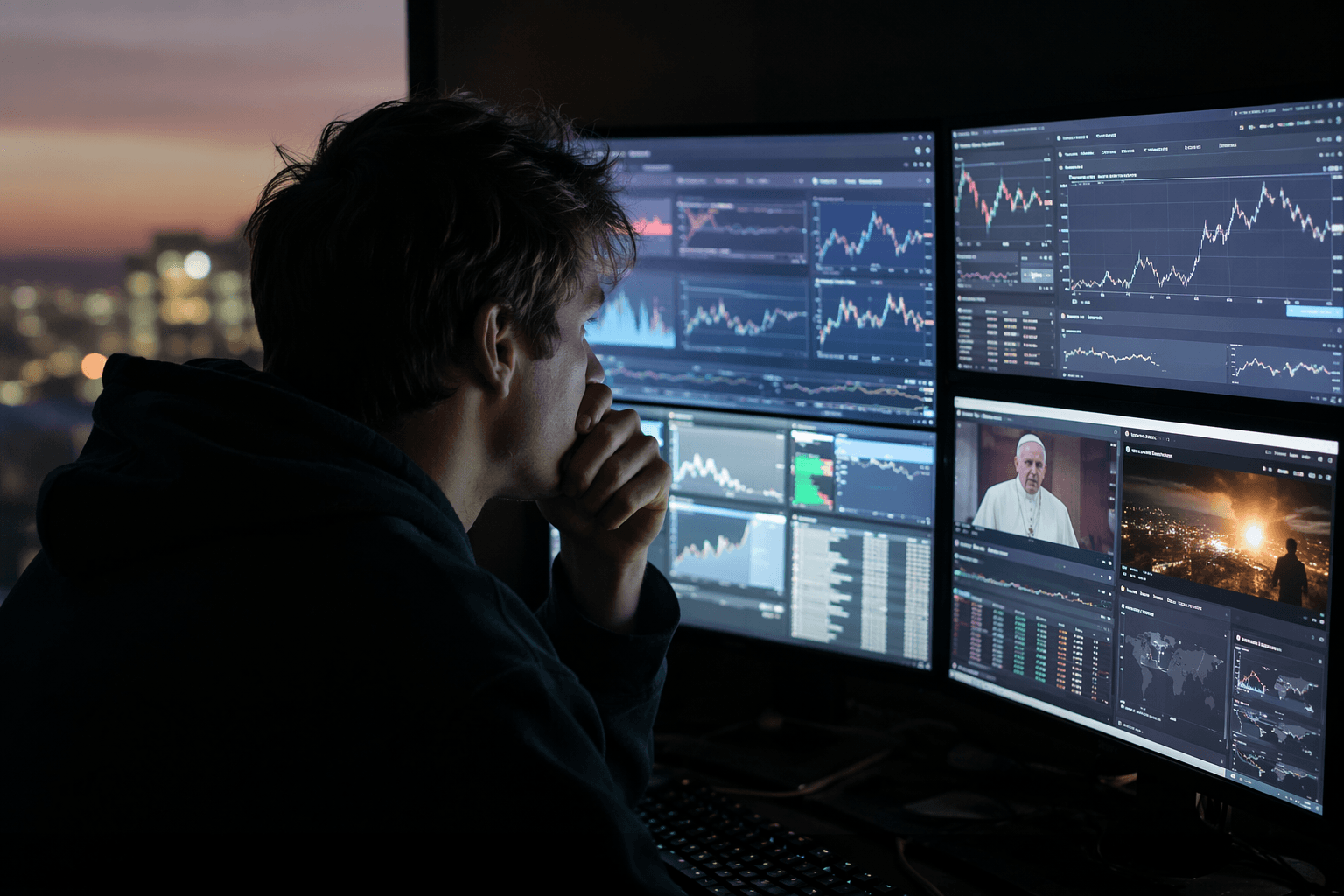
The surge began in the fall of 2024, when Kalshi accelerated adoption by offering political contracts, including a market on whether Donald Trump would win the White House. The Commodity Futures Trading Commission tried to block those contracts, Kalshi sued, and Kalshi won. That legal victory helped open the door to a much broader menu of wagers across crypto, climate, economics, companies, entertainment, and sports.
Why young traders think they can beat the field
What makes prediction markets compelling is the same thing that makes them dangerous: they are built on the idea that information has a price. If one trader knows more, reacts faster, or structures a better hedge, that trader can profit from the gap between public opinion and market odds. In practice, that has drawn a generation of young, technically fluent participants who treat the platforms less like casinos and more like micro-exchanges.
MarketWatch reported in May 2025 that traders on Kalshi had wagered more than $10 million on “Who will the next pope be?” One of the most vivid examples was Coby Shpilberg, a 21-year-old in Palo Alto, who tried scraping Rotten Tomatoes updates to gain an edge on movie-score markets. He initially lost money, then shifted to market-making, a move that shows how quickly these venues can reward not just prediction, but liquidity provision, pricing discipline, and speed.
That evolution matters because prediction markets are no longer just about picking a side. Traders increasingly use arbitrage and market-making strategies more familiar to traditional finance, where the real edge often comes from understanding spreads, order flow, and how a market is likely to react before the crowd does.
Politics, pope bets, and the spread of financialization
The range of contracts now being traded reveals how far the market model has spread into daily public life. Kalshi’s Rotten Tomatoes category includes live markets on upcoming films and shows, including “Backrooms,” “Masters of the Universe,” “Toy Story 5,” “Dune: Part Three,” and “Avengers: Doomsday.” As critics post reviews, market prices and volumes move in real time, turning cultural judgment into a tradable signal.
Polymarket, which calls itself “the world's largest prediction market,” has pushed the same logic into politics, sports, crypto, finance, geopolitics, tech, culture, economy, and weather. The appeal is obvious: these platforms promise a cleaner read than punditry, because participants are putting capital on the line. But the very breadth of the contracts also raises a harder question about what is being measured. Are these markets discovering truth, or merely packaging attention into a wager?
Michael Froman of the Council on Foreign Relations argued in August 2025 that prediction markets are a useful democratic experiment, but warned that liquidity constraints limit reliability and that they should not replace expertise. That is the central tension in the sector. Thin markets can produce noisy prices, while deeper markets may still reflect who is most willing to take a position, not who is most right.
Why regulators and lawmakers are pushing back
The boom has also triggered a political and regulatory backlash. Gaming groups, tribal nations, and states have filed lawsuits and cease-and-desist letters, arguing that prediction markets are drifting too close to gambling or stepping into areas reserved for state-regulated gaming rules. The concern is not just moral discomfort. It is about jurisdiction, consumer protection, and whether financial wrappers can be used to relabel bets that would otherwise face stricter limits.
Regulators are worried about information abuse as well. On February 25, 2026, the CFTC issued an advisory focused on misuse of nonpublic information and fraud in prediction markets, underscoring how closely these products can resemble other markets where insider trading is a real threat. If a trader uses privileged knowledge to profit from a contract on a war decision or corporate event, the line between speculation and misconduct can blur quickly.
Congress has responded with sharper language. On March 26, 2026, Sens. Jeff Merkley and Elizabeth Warren and Rep. Jamie Raskin introduced legislation to ban prediction-market bets on sports, war, elections, and government actions. Their argument is that these markets invite corruption and erode public trust. That is a significant shift: the debate is no longer about whether prediction markets are novel, but whether they are too powerful to leave lightly regulated.
War, inside information, and the most controversial wagers
The most explosive criticism has come from the way these platforms have been used to bet on real-world conflict and state action. The controversy intensified after a series of well-timed wagers tied to Nicolás Maduro’s ouster and the war in Iran. Those bets made the sector’s core vulnerability impossible to ignore: if a market is efficiently pricing political or military outcomes, the best-informed traders may be the ones closest to power.
That concern became even sharper after reporting that more than $1 billion had been staked online on military decisions and outcomes in 2026 alone. CBS News also reported that a soldier allegedly used classified intelligence to bet on a Venezuela operation. Whether such cases are isolated or symptomatic, they point to a structural problem: the more closely a market tracks confidential developments, the more it depends on information barriers that are difficult to police.
Forecasting tool or lightly disguised gambling
Prediction markets can be useful, but usefulness is not the same as truth. They can aggregate dispersed information faster than many institutions can, especially when news is unfolding in public and participants have incentives to move quickly. They can also expose uncertainty better than a poll or a pundit’s take, because the market price is constantly adjusting to new inputs.
Yet the same features that make these markets informative also make them vulnerable to hype, manipulation, and thin liquidity. A market can be lively without being reliable. It can attract sophisticated traders and still be dominated by noise if the participant base is small or if everyone is chasing the same headline.
The boom in prediction markets says as much about the appetite to monetize uncertainty as it does about the future of forecasting. Politics, war, and entertainment have become tradable because modern platforms can package almost any public event into a contract. The real test now is whether lawmakers and regulators decide these markets are an upgraded information tool, or simply gambling with a cleaner interface and a more persuasive argument.
This article was produced by Prism’s automated news system from verified source data, official records, and press releases, then run through automated quality and moderation checks before publishing. The system is built and supervised by the people who set the standards it runs under. Read our full AI policy.
Did this article answer your question?

%3Amax_bytes(150000)%3Astrip_icc()%2FCertificate-of-deposit-2301f2164ceb4e91b100cb92aa6f868a.jpg&w=1920&q=75)
