President Proposes Triumphal Arch Near Lincoln Memorial for America's 250th
Trump's 250-foot "Independence Arch" at Memorial Circle is facing a federal lawsuit and a new $15 million taxpayer funding plan that contradicts his promise of private financing.

The question of who controls Washington's most sacred skyline has landed in federal court. President Donald Trump's proposal to erect a 250-foot triumphal arch at Memorial Circle, directly across the Potomac River from the Lincoln Memorial, has collided with legal, procedural, and political resistance, even as documents released this week reveal the project may rely on $15 million in taxpayer funds despite Trump's repeated assurances it would be "fully financed."
The structure, formally called the "Independence Arch" and informally dubbed the "Arc de Trump," would rise at Memorial Circle on Columbia Island between the Lincoln Memorial and Arlington National Cemetery. At 250 feet tall, one foot for every year of American independence, the classical arch would dwarf the Lincoln Memorial at 99 feet, the White House at 70 feet, and even Paris's Arc de Triomphe at 164 feet. By standard building measurements, it would be the equivalent of a 16- to 20-story structure.
Trump first showcased the concept in October 2025, when a model appeared on the Resolute Desk during an Oval Office press conference. He named Vince Haley to lead the project in December 2025 and presented an updated design on January 23, 2026. Architect Nicolas Leo Charbonneau of Harrison Design has been retained, with the classical styling shaped in part by the National Civic Art Society, led by Justin Shubow, drawing on Trump's 2020 executive order promoting traditional federal architecture. On December 31, Trump signaled construction was imminent, and on Air Force One in January he told reporters: "I'd like it to be the biggest one of all. We're the biggest, most powerful nation."
The legal challenge arrived swiftly. On February 19, advocacy group Public Citizen filed suit in the U.S. District Court for the District of Columbia on behalf of three Vietnam War veterans, Michael Lemmon, Shaun Byrnes, and Jon Gundersen, along with architectural historian Calder Loth. The complaint names Trump, senior White House officials, and the National Park Service as defendants and alleges the project violates the Commemorative Works Act, the National Environmental Policy Act, and the National Historic Preservation Act. Memorial Circle falls within the Commemorative Works Act's "Area I" designation, a zone carrying stricter congressional oversight because of its already pronounced density of monuments. No act of Congress has authorized the arch.
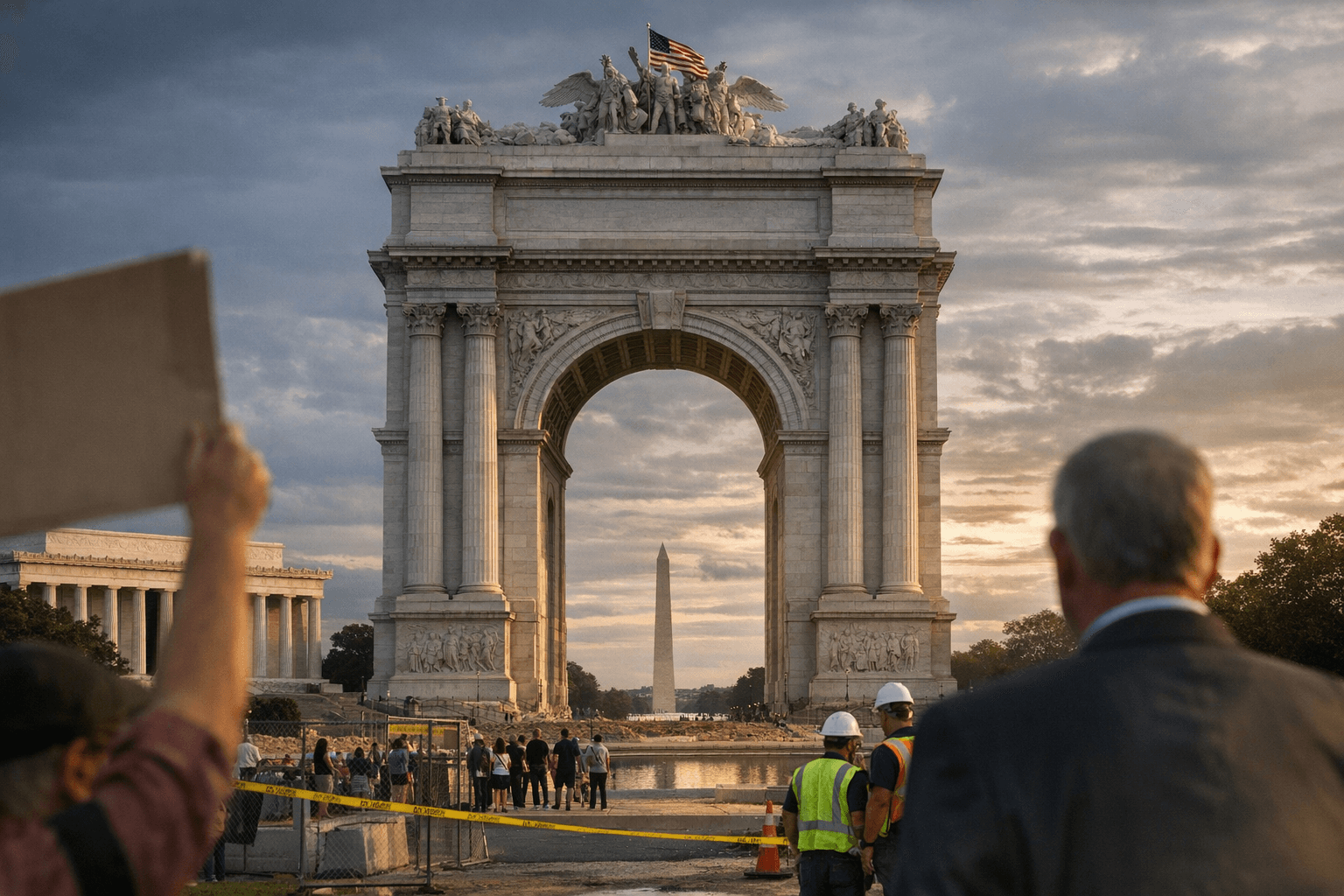
The veterans argue the structure would sever the ceremonial sightline between Arlington House and the Lincoln Memorial, a visual axis long understood as a symbol of post-Civil War reunification. The plaintiffs also raise an aviation concern: at 250 feet, the arch sits directly within the flight approach path serving Reagan National Airport. Democratic lawmakers subsequently filed in support of the challenge, arguing in a court brief that the Commemorative Works Act ensures new structures are "the product of deliberation, consensus and accountability through the legislative process."
The funding picture has grown more complicated as the July 4, 2026 target date draws closer. A spending plan from the National Endowment for the Humanities submitted to the Office of Management and Budget on April 7 sets aside approximately $2 million in special initiative funds and $13 million in matching grants for the project, totaling $15 million in public money. It represented the first public acknowledgment of federal financing for a monument Trump had described to donors as privately funded.
The design still requires review by the National Capital Planning Commission and the Commission on Fine Arts, two bodies Trump has stacked with sympathetic appointees. Whether those approvals can be secured in time, legal challenges overcome, and construction started before the nation's 250th birthday on July 4 remains the central uncertainty hanging over Washington's monumental core.
This article was produced by Prism’s automated news system from verified source data, official records, and press releases, then run through automated quality and moderation checks before publishing. The system is built and supervised by the people who set the standards it runs under. Read our full AI policy.
Did this article answer your question?