Congress Funding Battle Leaves Department Employees Frustrated and Without Clarity
More than 480 TSA screeners have quit and nearly $1 billion in paychecks went missing as the record-long DHS funding standoff left workers facing eviction and empty bank accounts.
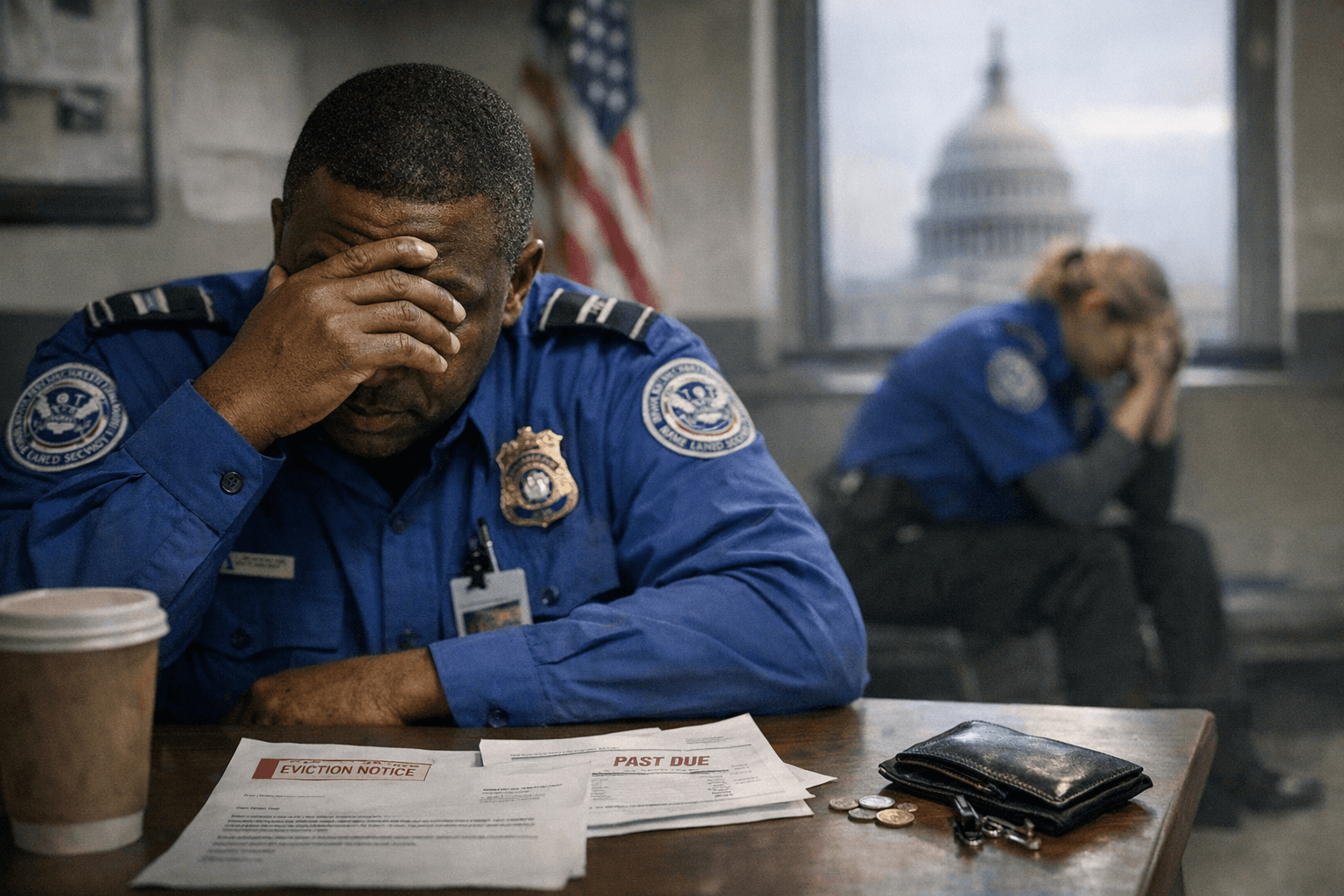
More than 480 airport screeners quit since the partial Department of Homeland Security shutdown began on February 14, as the agency tallied nearly $1 billion in missed paychecks while Congress continued to battle over how to fund the nation's security apparatus.
The shutdown, which became the longest partial government shutdown in American history, began after appropriations lapsed when lawmakers failed to extend funding beyond a February 13 deadline. The dispute centered on Democratic demands for reforms to Immigration and Customs Enforcement and Customs and Border Protection, following deadly shootings involving ICE and CBP agents in Minnesota in January 2026. Rather than negotiating a full-year spending bill, Congress had repeatedly turned to continuing resolutions, short-term extensions that roll over prior funding levels without addressing long-term agency needs. TSA itself has operated under a continuing resolution for every fiscal year since the agency's founding in the wake of the September 11 attacks.
For the roughly 120,000 DHS employees across TSA, FEMA, the Coast Guard, CISA, and the Secret Service who worked without paychecks, the congressional deadlock translated directly into personal financial crisis. Pascual Contreras, a Phoenix-based TSA agent, described the toll plainly: "The impact is life-altering. We've had people that are still recovering from the last one. They took loans out. They took out their retirement to cover childcare, rent, mortgage, car payments and food. Just basic necessities of life." Some officers slept at airports or in their cars because they could not afford to commute. AFGE Local 554 President Aaron Barker, speaking outside Atlanta's Hartsfield-Jackson International Airport, was more direct: "TSA workers are working without pay. Many are coping with eviction notices, vehicle repossession, empty refrigerators, and overdrawn bank accounts."
The financial hardship was compounded by a structural gap in federal law. Under a 2019 statute, excepted federal employees are guaranteed eventual back pay, but they receive no additional compensation for penalties or fees incurred from late rent, missed loan payments, or overdraft charges accumulated during the lapse.
The operational consequences spread well beyond airport lines. At the Cybersecurity and Infrastructure Security Agency, Acting Director Nick Andersen testified before the House Committee on Homeland Security on March 25 that roughly 60 percent of CISA's staff had been furloughed or were otherwise unable to work, leaving remaining personnel to carry out mission-essential functions without pay "while facing increasing pressure from nation-state and criminal actors." The BioWatch early warning system covering more than 30 major cities was non-operational during the shutdown. FEMA Associate Administrator Victoria Barton warned that with hurricane season approaching, each additional day of the shutdown increased the risk that a catastrophic disaster could overwhelm a diminished agency.
President Trump signed a memorandum on March 28 directing DHS to redirect existing funds to pay TSA workers, then signed a broader directive on April 2 extending that relief to the entire department. Homeland Security Secretary Markwayne Mullin described the mechanism as using presidential flexibility within existing dollar accounts, though he and budget officials acknowledged that sustaining payments ultimately depended on Congress restoring formal appropriations. DHS employees were set to receive back pay through April 4 under the arrangement. Lawmakers also granted affected workers a 30-day tax filing extension, pushing their deadline to May 15.
The current lapse was the third time since October 2025 that DHS employees had worked without pay. With reprogramming authority serving as a temporary patch rather than a permanent fix, and no full-year appropriations bill signed into law, the financial certainty that 120,000 national security workers were owed remained contingent on the next congressional move.
This article was produced by Prism’s automated news system from verified source data, official records, and press releases, then run through automated quality and moderation checks before publishing. The system is built and supervised by the people who set the standards it runs under. Read our full AI policy.
Did this article answer your question?

