Protesters in Dublin demand answers after Yves Sakila's death
Hundreds rallied outside Leinster House as Yves Sakila’s death became a test of Irish policing, race relations and state accountability.

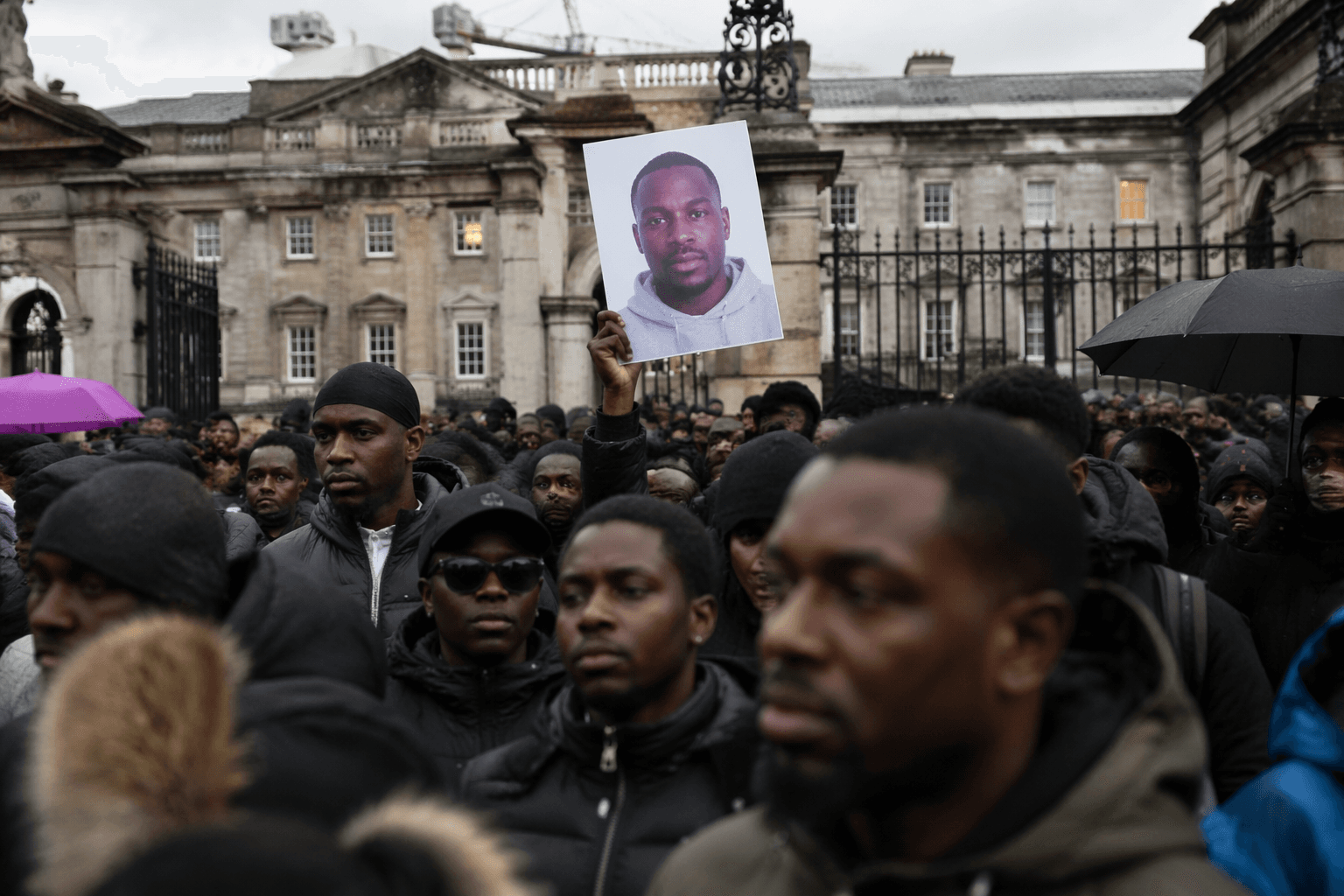
Hundreds of people gathered outside Leinster House on May 21, demanding answers after the death of Yves Sakila, a Congolese-born man whose restraint outside a Dublin department store has shaken Ireland’s public life. Sakila, 35, had lived in Ireland since 2004.
The confrontation on Henry Street began with an alleged shoplifting incident and ended with Sakila unresponsive at the scene before he was later pronounced dead in hospital. Video shared widely on social media appears to show him pinned to the ground by at least five men for almost five minutes while bystanders watched, with one man appearing to kneel on his head or neck for a few seconds. Irish reporting also said an elderly man was seriously injured during the episode and remained hospitalized.
Pressure on the government intensified quickly. Micheál Martin called for a thorough, full investigation on May 20, and gardaí said the next day that they had recovered CCTV and social-media footage and were seeking witnesses who were on Henry Street between Moore Street and Coles Lane at the time. An autopsy had been completed by May 21, but the cause of death had not been publicly released, and Sakila’s family still did not know how he died nearly a week after the incident.
The case has also drawn a broader civil-rights response. The Irish Network Against Racism said it was very concerned that excessive force may have been used, while Ireland’s Special Rapporteur on Racism and Racial Equality called for an independent investigation. A solicitor described the force used as “extraordinarily disproportionate,” a judgment that has deepened scrutiny of how a shoplifting detention could end in a death now being examined across the country.
The public anger has spread beyond one street corner. A vigil was held on Henry Street on May 19, and the larger rally outside parliament on May 21 brought fresh attention to tensions between demonstrators and counter-protesters, along with increased garda patrols near Leinster House. David Kaliba, a former schoolmate of Sakila’s, called it an Irish “George Floyd moment,” while Yemi Adenuga, a Black Coalition Ireland spokesperson and Fine Gael councillor, said the video looked like a reenactment of the Minneapolis killing and argued that the government had failed to put enough protections in place for a growing immigrant population. In a country still shaped by the 2023 Dublin riots and rising anti-immigrant activism, the Sakila case has become more than a single investigation: it is a measure of whether Ireland’s institutions can answer demands for accountability before outrage hardens into something larger.
Know something we missed? Have a correction or additional information?
Submit a Tip