Public Hearings Set for Kaʻūpūlehu Fisheries Plan as 10-Year Try Wait Ends
The State Land Board approved public hearings on draft rules to implement the Kaʻūpūlehu Fisheries Management Plan as the 10-year Try Wait closure is scheduled to lapse June 30, 2026.
The State Board of Land and Natural Resources approved the Division of Aquatic Resources’ request to hold public hearing(s) on administrative rules to implement a Kaʻūpūlehu Fisheries Management Plan, a procedural step contained in DAR’s ITEM F-3 land‑board submittal dated February 27, 2026. The submittal, prepared by Brian J. Neilson and approved for filing by Acting Chairperson Ryan K.P. Kanakaʻole, asked the Board to “approve the holding of public hearing(s) on the proposed adoption of chapter 13-60.12, HAR, ‘Kaʻūpūlehu Fisheries Management Area, Hawaiʻi’, and the proposed amendments to and compilation of chapter 13-60.4, HAR, ‘West Hawaiʻi Regional Fishery Management Area, Hawaiʻi’; and 2. Delegate to the Chairperson the authority to appoint hearing officer(s) to conduct the aforementioned public hearing(s).”
DAR’s ITEM F-3 also reiterates the administrative condition that frames the timetable: “The KMR fishing closure is in effect until June 30, 2026, ‘or until the effective date of rules implementing a comprehensive fisheries management plan as developed by the department in consultation with the Kaʻūpūlehu community and other interested parties, whichever occurs later.’” The Kaʻūpūlehu Marine Reserve (KMR), also called the Kaʻūpūlehu Fish Replenishment Area (KFRA), was created in July 2016 with “overwhelming community support” and covers roughly 3.6 miles of coastline from Kīkaua Point to Kalaemanō, seaward to 20 fathoms (120 feet).
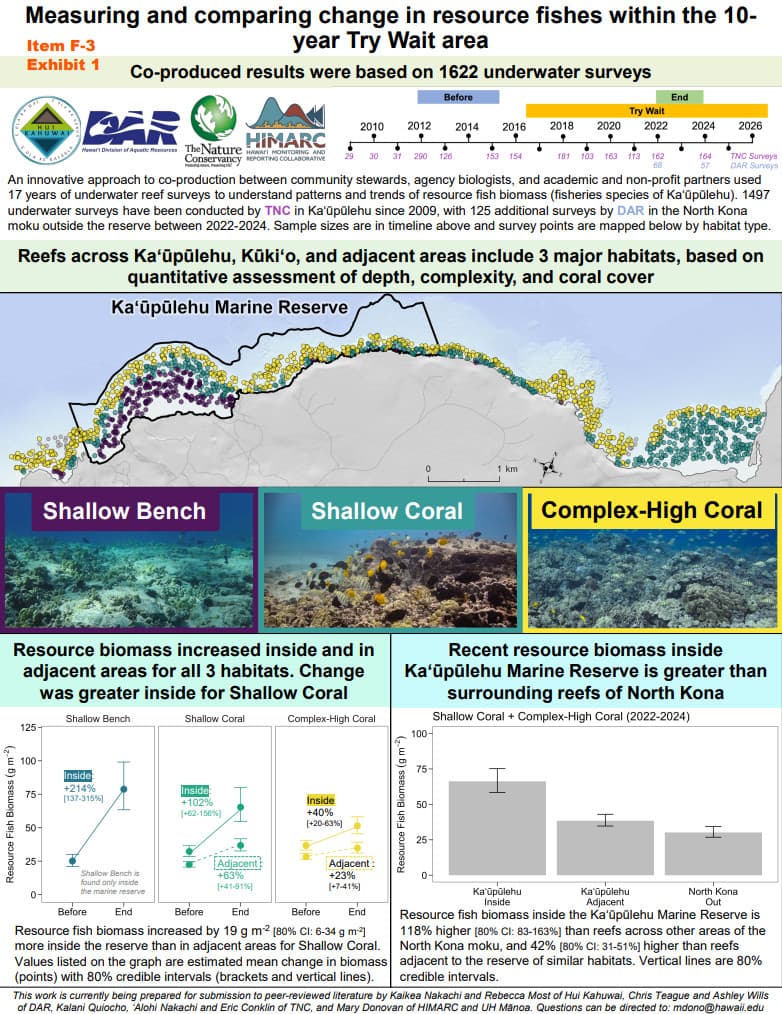
The DAR packet includes two attachments intended to inform rulemaking: Exhibit 1, titled “Try Wait” Data Analysis Summary, which the submittal and accompanying materials say shows an increase in biomass during the 10-year Try Wait period; and Exhibit 2, Draft Rules in Ramseyer Format (HAR 13-60.12 and 13-60.4). The Nature Conservancy’s testimony included in the submittal states, “Within the first few years of Try Wait, kūpuna and kamaʻāina observed abundance returning to the reef, and fishers who knew the area commented that it looks like how it used to be a long time ago.” TNC further wrote that “Continuous and consistent monitoring created one of the strongest nearshore datasets in Hawai‘i…reinforced kūpuna observations that fish abundance was returning to these reefs. Altogether, this was evidence that the rest period achieved its ecological goals and that management must now ensure continued ecological integrity.”
Exhibit 2’s draft regulatory proposals quoted in the DAR submittal include specific bag and possession measures: 1) A bag limit of 15 male ʻaʻama per person per day; 2) A bag limit of 2 heʻe per person per day; 3) No take or possession of live kūpeʻe; 4) A combined bag limit of 2 per person per day for ula and ula pāpapa; 5) No take or possession of native limu with a holdfast or roots attached; and 6) An aggregate bag limit of 15 per person per day for all urchin species (wana, hāʻukeʻuke, ʻina, hāwaʻe, etc.). The submittal’s Figure 1 maps the Kaʻūpūlehu Fisheries Management Area, Kai Malu Management Area, Wai a Kāne Cultural Site and Freshwater Spring, and ʻOpihi Rest Area Rotational Zones.

Local stakeholders are positioned to help implement the plan. The Kaʻūpūlehu Marine Life Advisory Committee, a multi-decade coalition of landowners, businesses, advocacy groups and families with ancestral ties, has worked with the State for nearly 30 years on reef restoration. Hui Kahuwai, which the DAR materials identify as a community partner, is represented by Executive Director Rebecca Most, who told Hawaiʻi Public Radio, “It's been our intention from the beginning to always be able to manage from a place of abundance rather than depletion. And we know that when fishing resumes, it's going to open to all.” Most added, “What we don't know is how many people are going to come fish, so we intentionally designed our fisheries management plan and the regulations … to take a precautionary approach so that those that are coming to feed their families can feed their families for the long term.”
Procedurally, the Board also asked DAR and the hui to collaborate with other resource users before holding the public hearings, and the Board delegated authority to the Chairperson to appoint hearing officer(s). DAR’s packet does not include scheduled hearing dates; the formal timetable for hearings and the numeric details behind Exhibit 1’s biomass findings will be key to whether the Kaʻūpūlehu closure lifts on June 30, 2026, or remains in place until the proposed HAR rules take effect.
Sources:
Know something we missed? Have a correction or additional information?
Submit a Tip