Putin Demands Economic Fixes as Russia’s Growth Slows Sharply
Putin pressed officials after output fell 1.8% in two months, exposing how wartime spending is losing its power to keep growth afloat.
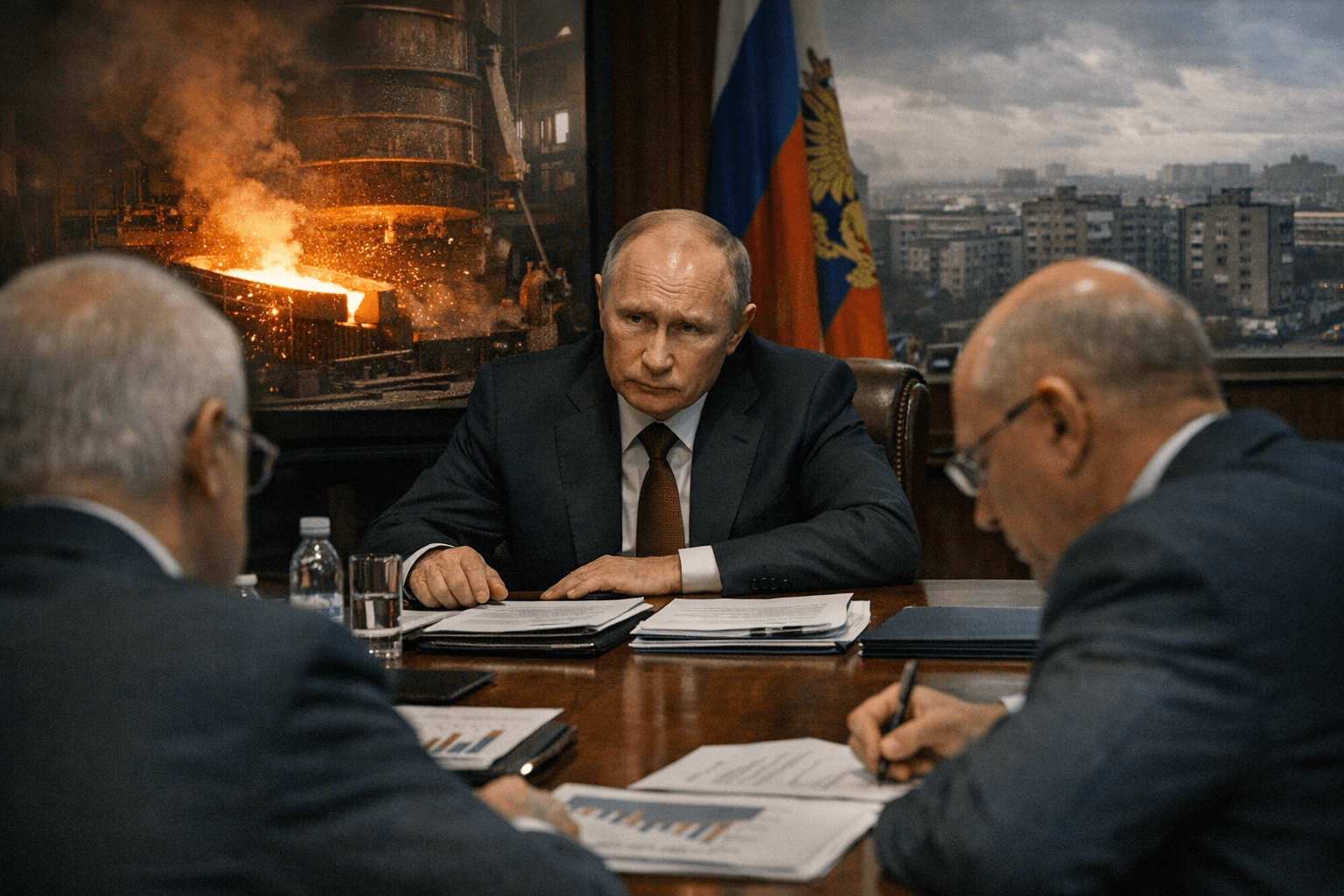
Weakness in manufacturing, industrial production and construction has become the first clear crack in Russia’s wartime economic model, and Vladimir Putin responded by demanding detailed fixes from his top economic team. In a closed-door Kremlin meeting, the president pressed Prime Minister Mikhail Mishustin, Central Bank Governor Elvira Nabiullina and Deputy Prime Minister Alexander Novak for answers after output fell 1.8% in the first two months of the year.
The pressure is building on an economy that had defied expectations for three straight years. Russia’s GDP contracted in 2022, then grew in 2023, 2024 and 2025, but the pace slowed sharply as the war in Ukraine, still Europe’s deadliest conflict since World War Two, collided with double-digit interest rates. Rosstat said growth in 2025 was 1.0 percent, down from 4.9 percent in 2024, and fourth-quarter growth also came in at 1.0 percent year over year. The statistical agency put GDP at current prices in 2025 at 54,501.3 billion rubles.
The slowdown is showing up where the Kremlin can least afford it: in civilian investment and the broader industrial base that supports the rest of the economy. The World Bank said Russia’s 2025 deceleration was driven by fading fiscal stimulus and tight monetary conditions, and warned that falling oil revenues widened the fiscal deficit and narrowed the external surplus. The Bank of Russia cut its key rate from a peak of 21 percent in 2024 to 16 percent during 2025, but borrowing costs remain high enough to keep credit expensive for households and businesses.
That leaves Putin with a narrow set of options. The International Monetary Fund said in its April 2026 outlook that higher defense spending can lift activity in the short term, but it also risks stoking inflation, weakening fiscal and external sustainability and crowding out social spending. The World Bank expects Russia’s growth to slow to 0.9 percent in 2025 and stay near 1 percent in 2026 and 2027, while the broader Europe and Central Asia region is projected to slow to 2.1 percent this year amid conflict spillovers, geopolitical tensions and trade fragmentation.
There is still one cushion. The IMF’s April 2026 assumptions used an average oil price of $82.22 a barrel in 2026 and $75.97 in 2027, a level that could support energy revenues and soften the blow. The ruble has also been relatively firm, trading around 76.11 to the dollar on April 16 and strengthening over the previous month. But the policy tradeoff remains stark: military production can keep parts of the economy moving, yet inflation, costly credit and weak civilian investment are pulling in the opposite direction, making growth harder to sustain without sacrificing the war effort.
This article was produced by Prism’s automated news system from verified source data, official records, and press releases, then run through automated quality and moderation checks before publishing. The system is built and supervised by the people who set the standards it runs under. Read our full AI policy.
Did this article answer your question?