Putin says Russia will deploy Sarmat missile by year-end, touts nuclear power
Putin said the Sarmat would enter service by year-end, reviving a weapon analysts say has been delayed by failed tests and possible propulsion problems.
Vladimir Putin said Russia would deploy its RS-28 Sarmat strategic nuclear missile by the end of 2026, framing the weapon as proof that Moscow could still outmatch Western defenses and remain a nuclear peer of the United States. He described Sarmat as “the most powerful in the world” and said its warhead yield was more than four times greater than any Western equivalent.
Putin said the missile’s range exceeded 35,000 kilometers, or about 21,750 miles, and argued it could evade existing and future missile defenses. That claim is central to the Kremlin’s message: Sarmat is not only meant to threaten targets in the United States or Europe, it is meant to signal that Russia can still impose unacceptable costs even after years of battlefield setbacks and sanctions.
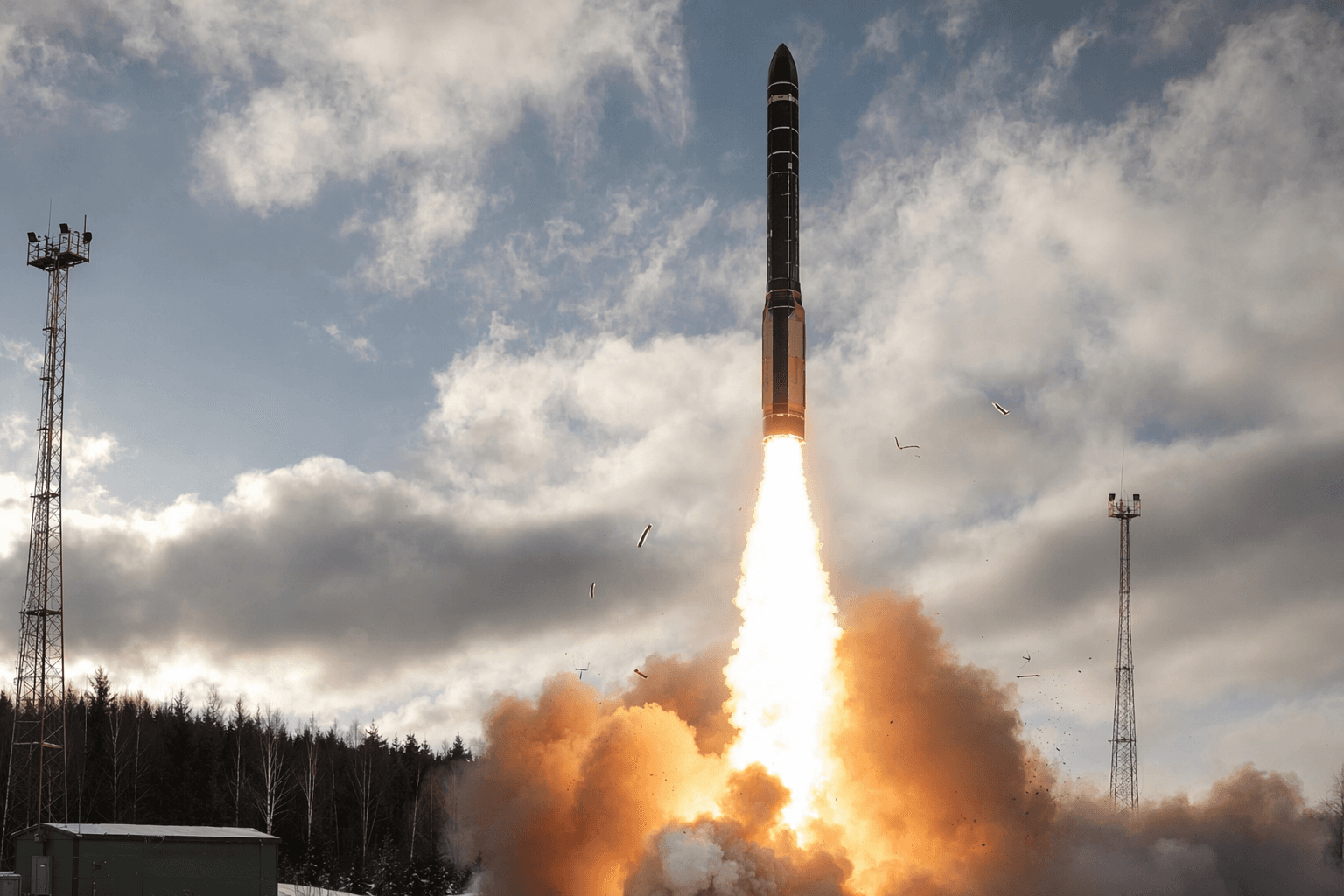
The timing matters because Sarmat has been delayed for years and has suffered public failures. A 2024 test left a deep crater at the launch silo, and Western defense analysts said that failure pointed to possible propulsion problems. The Arms Control Association said a September 2024 failure at the Plesetsk Cosmodrome left major damage at the Yubileynaya launch silo. SIPRI said Russia’s nuclear modernization effort in 2024 was hit by a Sarmat test failure and further delays.
The gap between Putin’s claims and outside assessments is also striking. The Center for Strategic and International Studies says Sarmat is a three-stage, liquid-fueled missile with a launch weight of 208.1 metric tons and a range of about 18,000 kilometers. It says the missile can carry a 10-ton payload and be configured with up to 10 large warheads, 16 smaller warheads, warheads with countermeasures, or hypersonic boost-glide vehicles. That makes Sarmat a formidable system, but not necessarily the near-invulnerable breakthrough Moscow describes.
State television showed Strategic Missile Forces commander Sergei Karakayev telling Putin that a successful launch had been completed and that the system would be placed on combat duty by the end of the year. The public rollout fits a pattern that began when Putin first unveiled Sarmat in his March 1, 2018 address on new strategic weapons. For Moscow, the missile is as much a political instrument as a military one: a message to NATO planners, a warning to adversaries, and a domestic display of strength at a time when arms-control erosion has made strategic stability more fragile.
This article was produced by Prism’s automated news system from verified source data, official records, and press releases, then run through automated quality and moderation checks before publishing. The system is built and supervised by the people who set the standards it runs under. Read our full AI policy.
Did this article answer your question?


