Quantum-Si Launches Proteus Roadshow to Advance Single-Molecule Protein Sequencing
Quantum-Si's Proteus roadshow opened in Seattle on April 7, with the Branford, Conn. firm targeting a full commercial launch by year-end and an early access program beginning this summer.
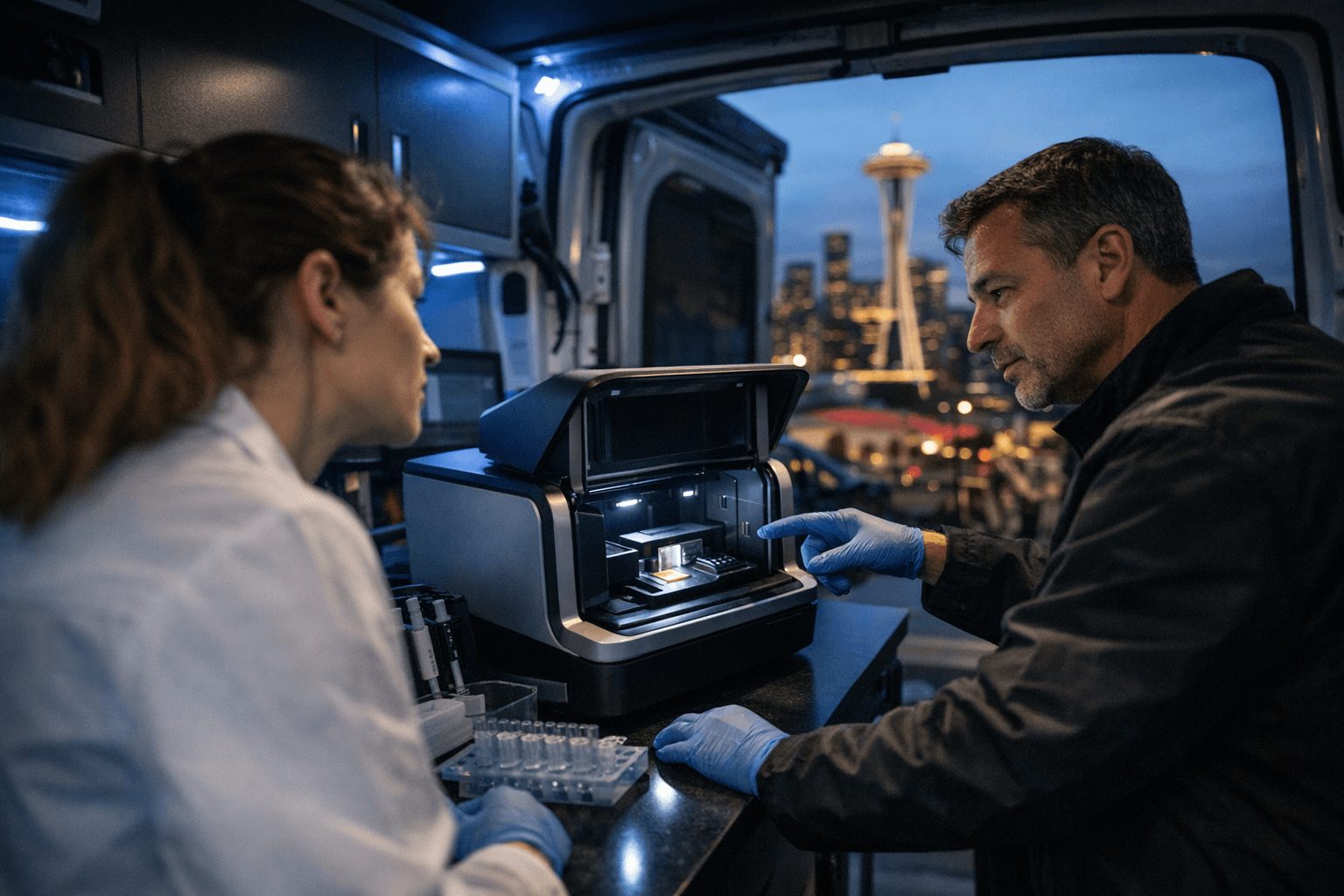
Quantum-Si Incorporated kicked off its Proteus roadshow in Seattle on April 7, beginning a multi-city pre-launch campaign that will take the Branford, Connecticut company's single-molecule protein sequencing platform to Washington, D.C. on April 30 and Houston on May 5, with additional U.S. and European stops yet to be confirmed.
The Nasdaq-listed company (QSI) announced the roadshow on April 6 through a press release distributed on Business Wire. Rather than relying solely on investor presentations, Quantum-Si structured the events around existing customers of its first-generation Platinum Pro instrument, who will present their own protein-sequencing applications at each stop. That choice reflects a deliberate strategy: let early adopters make the scientific case while the company focuses on closing the gap between laboratory proof and commercial scale.
The platform Quantum-Si is selling into that narrative sets an ambitious technical bar. Proteus is designed to sequence individual protein molecules, moving proteomics beyond the statistical averaging of bulk methods toward direct detection of proteoforms, post-translational modifications, and sequence variants at high sensitivity. At launch, the platform is expected to cover 18 of the 20 standard amino acids, with full 20-amino-acid detection targeted before the end of 2026. A controlled cleavage sequencing chemistry that the company says could deliver billions of sequencing reads per run is slated for market deployment in 2027, adding another capability milestone investors will be tracking.
"We are excited to kick off this important pre-launch program to expand the breadth and depth of customer awareness for both Proteus and protein sequencing," said Jeff Hawkins, president and chief executive officer. "Proteus is expected to far exceed Platinum Pro's capabilities, and this outreach will help us reach customers we were not previously able to reach with Platinum Pro."
The business model Quantum-Si is building mirrors the instrument-plus-consumables structure that anchored Illumina's genomics expansion: hardware sales followed by high-margin recurring revenue from reagents, flow-cells, and service contracts. Pricing information is scheduled to be disclosed in the second quarter of 2026, with product launch capabilities outlined for the third quarter and an Early Access Program set to begin in summer 2026 before full commercial availability. That sequencing of milestones gives investors a structured set of checkpoints, but it also concentrates execution risk in a very tight window.
That risk is not trivial. Technical reproducibility at scale, the challenge of manufacturing flow-cells in commercial volumes, and the long timeline required for regulatory and clinical validation of diagnostic applications all sit between the roadshow podium and a recurring revenue line. Competitive pressure from both academic proteomics groups and rival companies developing next-generation protein-analysis platforms adds urgency. A 90-minute run time per sample, one of Proteus's cited performance metrics, addresses a real workflow bottleneck in busy research and clinical labs, but throughput and cost per sample at scale remain the figures that will ultimately determine whether the platform earns a durable place in laboratory infrastructure. The Seattle roadshow was the first public test of whether that data, filtered through customer voices, lands persuasively enough to convert curiosity into purchase orders.
This article was produced by Prism’s automated news system from verified source data, official records, and press releases, then run through automated quality and moderation checks before publishing. The system is built and supervised by the people who set the standards it runs under. Read our full AI policy.
Did this article answer your question?