Record $772 monthly payments and $49,191 sticker prices dent U.S. car demand
Edmunds, Kelley Blue Book and Cox Automotive data show rising monthly payments and record sticker prices coincided with weaker February sales and growing dealer concern.
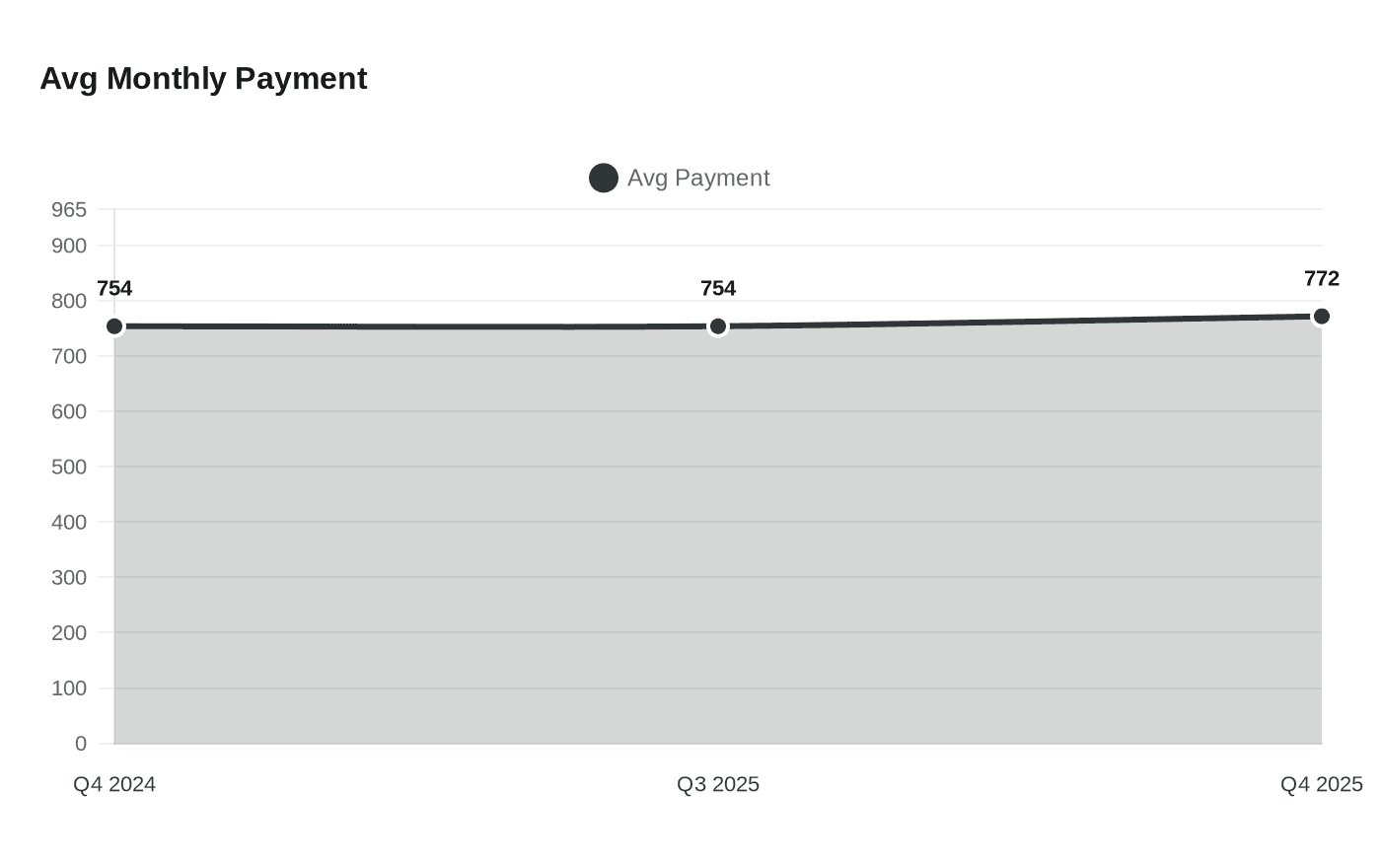
Edmunds, Kelley Blue Book and Cox Automotive data together paint a clear drain on U.S. auto demand: Edmunds reports the average financed monthly payment reached a record $772 in the fourth quarter of 2025, Kelley Blue Book says the average new-car price hit $49,191 in January 2026, and Cox Automotive projects February sales of 1.19 million vehicles, down 3.4 percent from February 2025.
The combination of elevated prices and heavier financing burdens appears to be pulling some buyers off the market. Edmunds also found the share of new-car buyers committing to monthly payments of $1,000 or more rose to a record 20.3 percent in Q4 2025, up from 19.1 percent in Q3 2025 and 18.9 percent in Q4 2024. Ivan Drury, Edmunds' director of insights, linked the trend explicitly to purchases stretching household budgets. “Faced with persistently high vehicle prices and borrowing costs, many consumers were forced to adapt by financing larger amounts, stretching loan terms and, increasingly, taking on four-figure monthly payments,” he said in a statement.
Cox Automotive released new data on March 3 that underscored the demand slump. The firm’s February 2026 sales projection of 1.19 million vehicles represents a 3.4 percent year-over-year decline, a signal that higher costs are translating into lower transaction volumes. Dealer sentiment in Cox’s survey tightened as well: 52 percent of dealers said the economy was providing a drag on auto sales in the first quarter of 2026, up from 45 percent in the same period a year earlier. The only other survey factor topping 35 percent was market conditions, cited by 37 percent of dealers.

Consumer attitudes mirror the strain. A recent Washington Post and ABC News poll found that 74 percent of Americans say buying a new car is unaffordable. That widespread perception helps explain why many households appear to be delaying purchases, shifting to older vehicles or tightening their search to lower-cost models.
Taken together, the figures show both ends of the marketplace experiencing stress. On the supply side, manufacturers and dealers face slower turnover and pressure to offer incentives to move inventory. On the demand side, buyers are coping with higher sticker prices and heavier monthly obligations; Edmunds’ quarterly averages climbed from $754 in both Q3 2025 and Q4 2024 to $772 in Q4 2025. Meanwhile, the share of buyers taking four-figure monthly payments has continued its upward march.
The tightening is likely to have ripple effects beyond the showroom. U.S. auto sales are a major component of global demand for cars and light trucks; sustained weakness in the American market could force global strategy adjustments for manufacturers, affect production planning and change the calculus on incentives.
Industry watchers are asking whether incentives will restore buyers who have stepped back. Kelley Blue Book is expected to publish February pricing data soon, and Cox’s March 3 dealer survey suggests dealers are watching macroeconomic signals closely. For now, the data indicate that record-high monthly payments and near-record sticker prices are a material brake on demand, and that consumers and dealers alike see affordability as the central challenge.
This article was produced by Prism’s automated news system from verified source data, official records, and press releases, then run through automated quality and moderation checks before publishing. The system is built and supervised by the people who set the standards it runs under. Read our full AI policy.
Did this article answer your question?

