Red Buttes Observatory Anchors University of Wyoming Research and Teaching Programs
University of Wyoming's Red Buttes Observatory south of Laramie supports ongoing student training and research with a 0.6 m telescope and advanced cameras, producing published results.
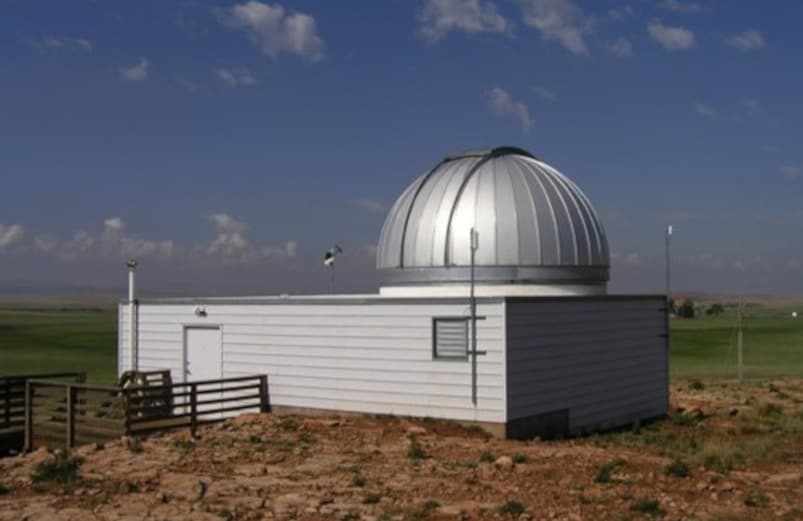
A compact research facility about nine miles south of Laramie is a central asset for University of Wyoming undergraduate education and for local scientific work. Red Buttes Observatory operates a 0.6 m f/8.43 Ritchey-Chrétien Cassegrain telescope installed by DFM Engineering and, according to the Department of Physics and Astronomy, is used nightly for both science and student training.
The observatory sits at roughly 2,240 m elevation near coordinates 41.1763° N, 105.5741° W and was constructed in 1994 as UW’s second research observatory. The university describes RBO’s founding purpose plainly: “RBO began operation with the mission of enriching the undergraduate astronomy curriculum with practical experiences in observation.” That hands-on mandate is reflected in the observatory’s schedule: “It is used every clear night of the year for science and student training.”
RBO’s instrument suite supports a range of projects. The primary telescope couples to two main imaging options: a high-resolution 4096×4096 camera with 9 micron pixels and a Kodak 16803 chip providing a 25 arcminute field-of-view in a Finger Lakes Instruments ProLine housing, or a 1024×1024 camera with 13 micron pixels on an e2v CCD 47-10 giving a 9.2 arcminute field-of-view in an FLI MicroLine housing. The telescope uses an 8-position filter wheel accepting 2" square filters, with a complement that includes Johnson UBV and Bessel RI filters. Wikipedia notes a near-infrared camera is also associated with the site, and a smaller Orion-built 0.2 m reflector is mounted as an auxiliary scope.
Research at Red Buttes has ranged from monitoring Cepheid variable stars to follow-up confirmation of gamma-ray bursts, prototyping new instrumentation, and measuring eclipsing binary distances to star forming regions. University material highlights recent student-led outcomes: “Light curves of two brown dwarfs reported in a discovery paper by UW undergraduate Xander Larsen (2025).” Those outputs demonstrate RBO’s role in turning classroom training into peer-reviewed science.
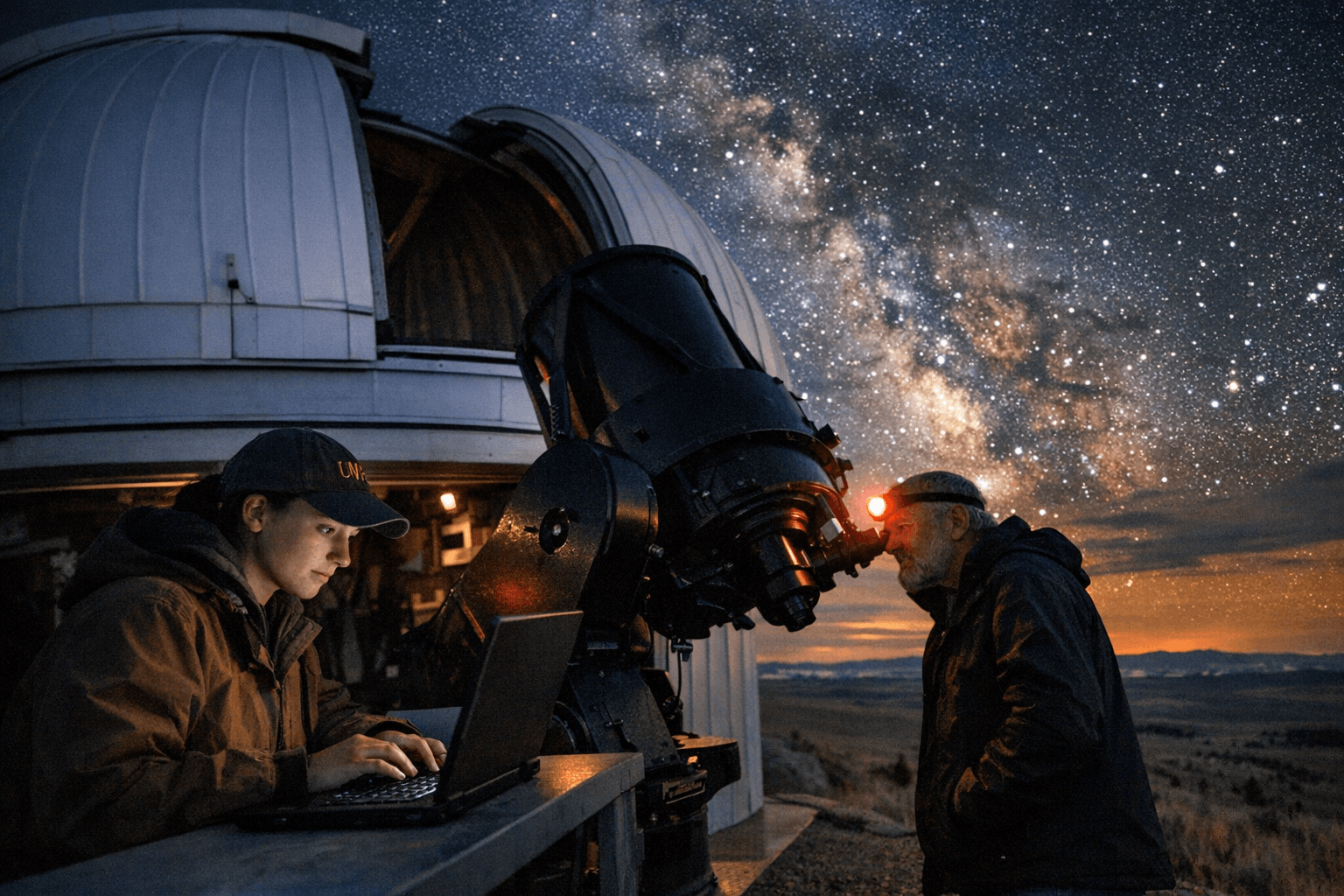
For Albany County the observatory represents both an educational pipeline and a research platform that raises the university’s profile. Local students gain direct experience with modern detectors and data reduction, and the facility’s nightly use increases the chance that time-sensitive events, such as gamma-ray burst afterglows, are captured from a regional observing site.
Administration remains managed through UW’s Department of Physics and Astronomy, and some internal materials are gated behind restricted access listed on the department pages as “Observatory Documents (password required).” As RBO continues to produce student publications and instrument development, the university may be asked to clarify equipment inventories, confirm technical details such as the near-infrared camera model, and provide media access to site imagery. For residents and prospective students, the observatory is a visible example of local investment in STEM training and scientific discovery, with more research and student work expected as instrumentation and curricula evolve.
Sources:
Know something we missed? Have a correction or additional information?
Submit a Tip