Reform surge rattles Labour and Conservatives in Sunderland and beyond
Reform won no Sunderland council seats in 2024, then took 58 of 75 two years later, ending more than 50 years of Labour rule.

Reform UK’s rise in Sunderland began as a warning and ended as a takeover. The party failed to win a single council seat in the 2 May 2024 local elections, yet it still built enough support to become the dominant force in the city by 2026, when it won 58 of 75 seats and ended more than half a century of Labour control.
The 2024 local elections showed how far Labour’s grip had loosened even before Reform entered office. Labour held Sunderland City Council, won 18 of the 25 seats contested, and increased its majority to 53 of 75 seats overall. The Conservatives held 10 seats overall, the Liberal Democrats 12, and Reform none. But the party was already standing across the city, raising its profile in traditional Labour territory and preparing the ground for a much larger break in the vote.
That pressure became visible in the general election three months later. In Houghton and Sunderland South, Reform’s Sam Woods-Brass won 11,668 votes, well ahead of the Conservative candidate on 5,514, while Labour’s Bridget Phillipson held the seat with 18,837 and a majority of 7,169. The numbers pointed to more than a simple Conservative collapse. They showed a party pulling support from both sides of the old two-party divide, especially in working-class communities where Labour had long been the default and where the Conservatives struggled to present themselves as a serious alternative.
The same pattern appeared across North East England. In the North East mayoral contest, Reform finished fourth but was only about 10,000 votes behind the Conservatives, a sign that its appeal was no longer confined to protest on the margins. It was becoming a credible destination for voters who had drifted away from Labour and for those who had lost faith in the Conservatives without returning to the old centre ground.

The pattern was not unique to Sunderland. In Swansea West, Reform candidate Patrick Benham-Crosswell won 6,246 votes, or 18 per cent, at the July 2024 general election. In Neath and Swansea East, Dai Richards won 10,170 votes, or 25 per cent. Those are post-industrial, working-class areas where the two main parties have long competed for loyalty, but where Reform has been able to exploit frustration with declining trust and weak local attachment.
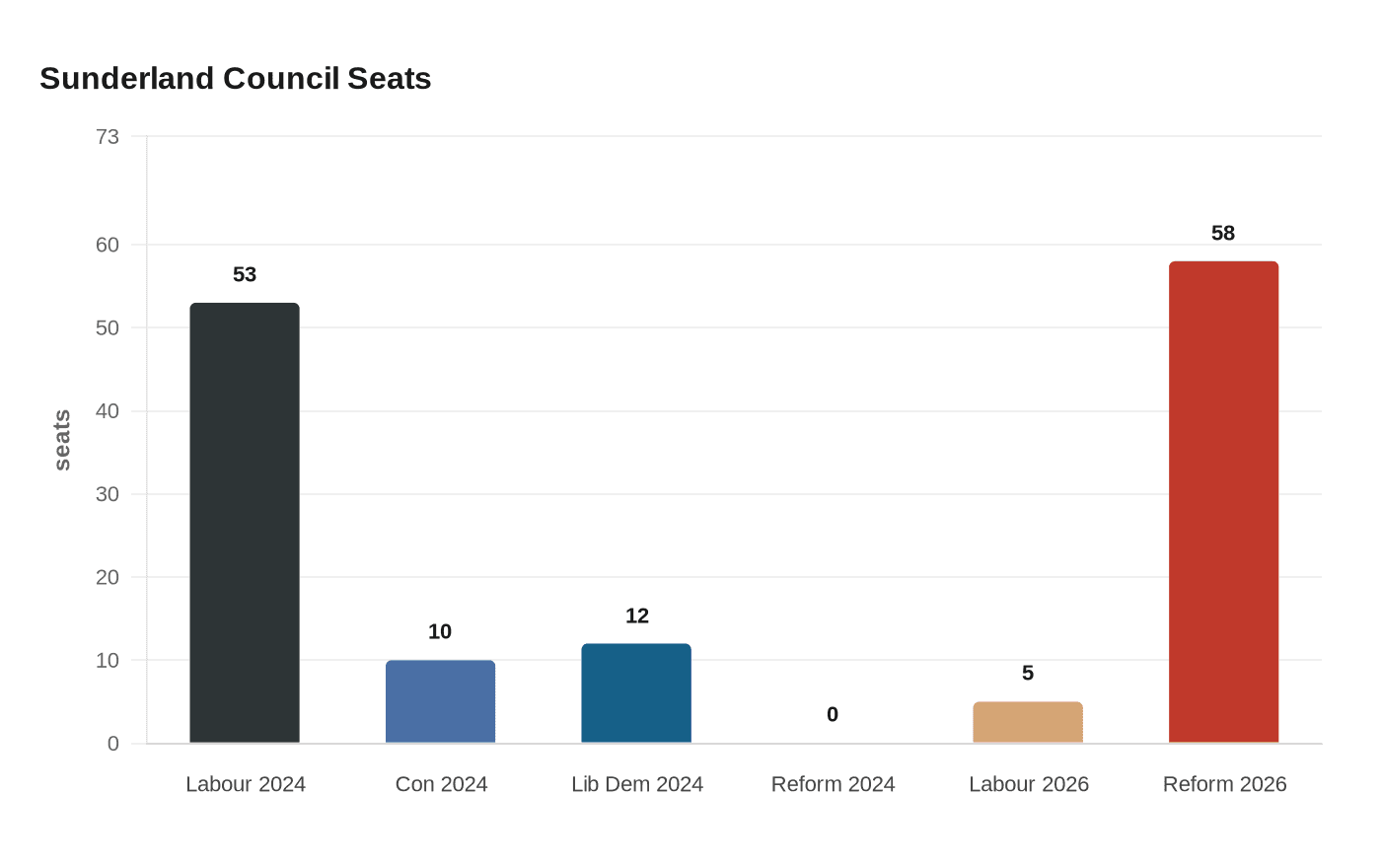
The 2026 Sunderland result suggested this was more than a passing protest. Labour was cut down to five seats, while Reform took control of the council outright. For Labour, the danger is that old loyalties have become conditional; for the Conservatives, the problem is worse, because many former supporters are now moving straight to Reform instead. In Sunderland and beyond, the question is no longer whether Reform can disturb the system. It is whether the system can still hold the voters it once took for granted.
This article was produced by Prism’s automated news system from verified source data, official records, and press releases, then run through automated quality and moderation checks before publishing. The system is built and supervised by the people who set the standards it runs under. Read our full AI policy.
Did this article answer your question?

