Reform sweeps Essex as Labour, Conservatives suffer heavy local election losses
Reform’s 53-seat sweep in Essex, on 43.6% turnout, showed how quickly Britain’s fractured vote is outgrowing its old two-party map.

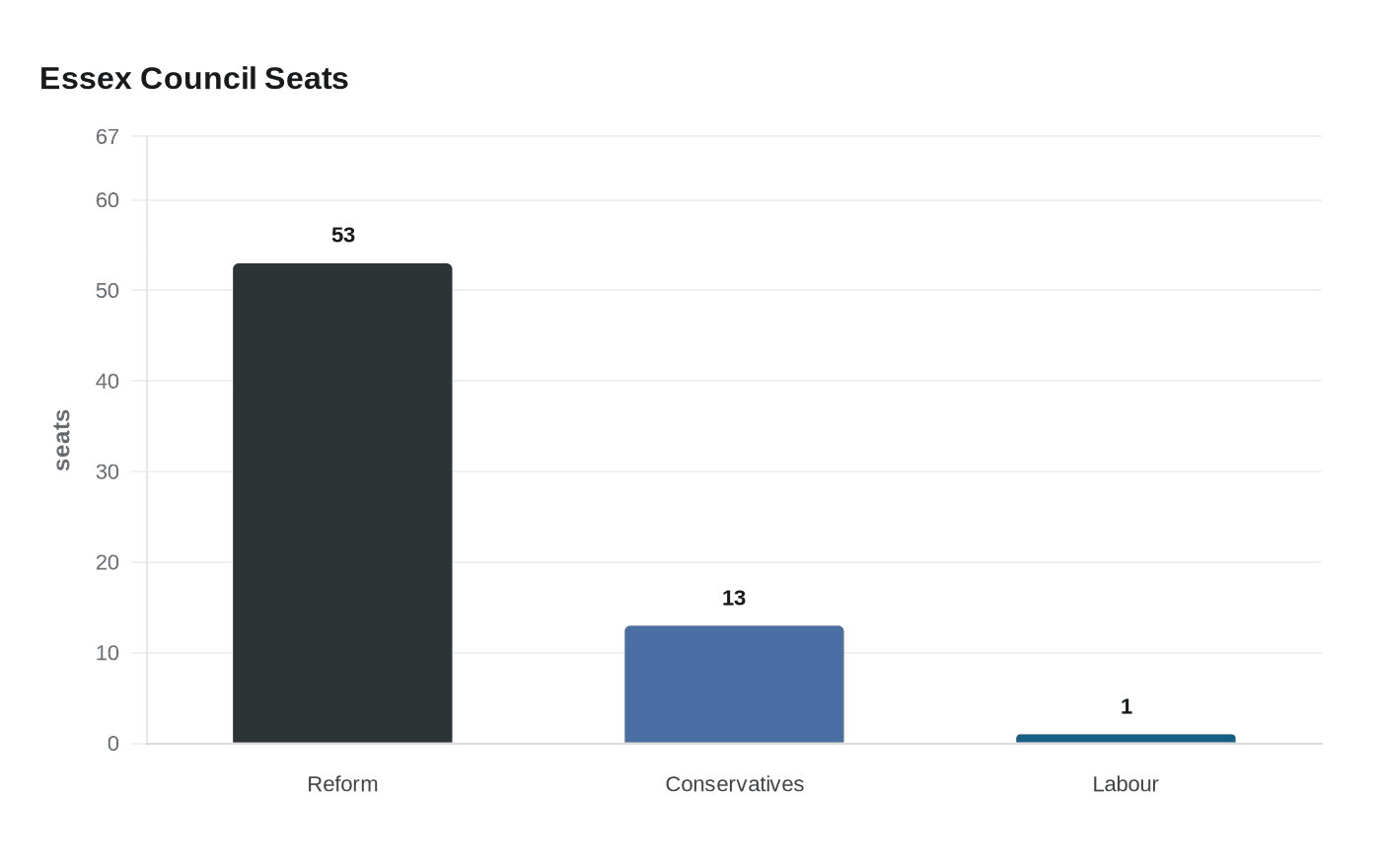
Reform UK took control of Essex County Council with 53 of 78 seats, leaving the Conservatives on 13 and Labour with just one councillor. The party’s majority was 14 seats, in a contest the council said drew a record 428 candidates and a turnout of 43.6 percent, the highest it had been for decades.
The result landed hard in Westminster. More than 20 Labour MPs were reported to be pressing Keir Starmer to set out a timetable for resignation after the local election losses, but the prime minister said he would not walk away and said Labour had made “unnecessary mistakes.” The pressure underscored how quickly a bad local election night had become a test of Starmer’s authority as Reform pressed its challenge from the right.

Essex was also a sharp reminder of a deeper problem in British politics: votes and seats are no longer moving in lockstep. In the 4 July 2024 general election, Labour won 33.7 percent of the vote and 411 seats, the Conservatives won 23.7 percent and 121 seats, and Reform won 14.3 percent but only five seats. It was the first general election in which four parties cleared 10 percent of the vote and five passed 5 percent, yet that spread of support did not produce a proportional Parliament.
That mismatch is built into Britain’s electoral machinery. The House of Commons Library says nearly all elections in Great Britain used first-past-the-post until 1997, and that several different systems have since been introduced for some elections across the UK. But local elections in England and Wales still use first-past-the-post, and the Electoral Reform Society says the 2024 general election produced the most disproportionate vote-to-seat result on record, with Labour and the Conservatives’ combined vote share falling to 57.4 percent, the lowest in the era of universal suffrage.
Reform’s advance in Essex did more than punish Labour and the Conservatives. It exposed how a political system designed around two dominant parties is now struggling to translate a splintered electorate into stable representation, let alone stable government. As Nigel Farage’s party consolidates the right and voters keep scattering across more parties and independents, Britain is confronting a democratic stress test that reaches well beyond one county council and points to the same pressures now unsettling other Western democracies.
This article was produced by Prism’s automated news system from verified source data, official records, and press releases, then run through automated quality and moderation checks before publishing. The system is built and supervised by the people who set the standards it runs under. Read our full AI policy.
Did this article answer your question?


