Research Identifies Five Distinct Donor Profiles Among American Givers
New peer-reviewed research finds 42% of American donors are financially constrained but motivated, suggesting nonprofits are asking the wrong people for the wrong things.

Nearly nine in ten Americans still give to charity, but a peer-reviewed study published in March 2026 argues that the country's donor class is not a class at all. It is five distinct populations, each activated by different triggers and deterred by different failures, and most fundraising strategies are built for only one of them.
The research, published in Nonprofit Management & Leadership and drawing on the Generosity Commission's 2023 national survey of 2,569 U.S. adults, used latent profile analysis to sort respondents into five segments based on motivation, financial capacity, and trust in charitable institutions. The authors summarized their findings on April 3, 2026, arguing that "different kinds of Americans are generous in different ways" and that treating donors as a uniform audience leaves significant civic participation on the table.
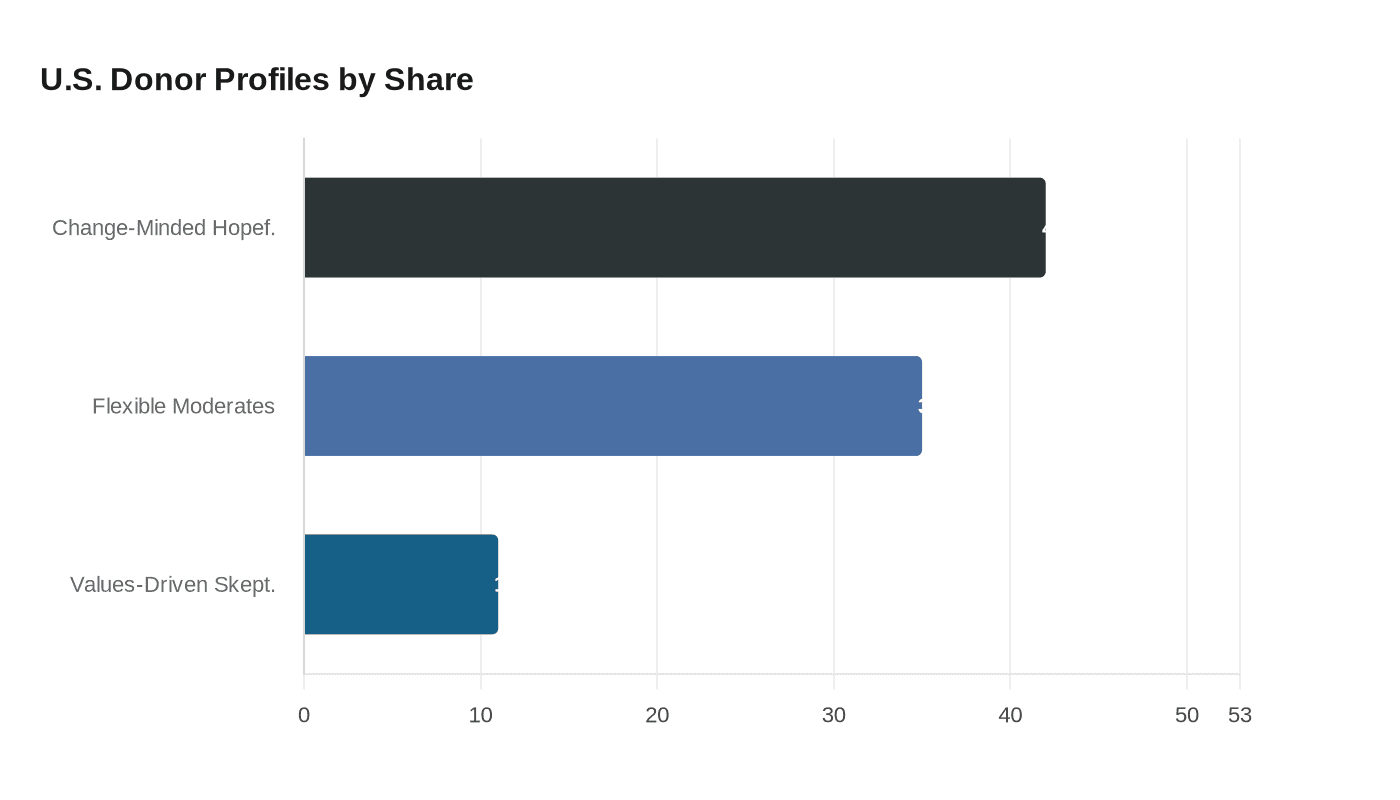
The largest group, which the researchers call change-minded hopefuls, accounts for roughly 42% of respondents. Typically women with lower household incomes, they reported wanting to give but feeling blocked by finances. For a mutual-aid network or food bank seeking to grow its volunteer base, this segment represents the most underutilized resource in American civil society. The barrier is not indifference; it is the size of the ask. Micro-giving options, recurring $5 monthly donations, or two-hour volunteer shifts rather than week-long commitments are the structural changes most likely to activate them.
Flexible moderates, at about 35%, present a less complicated picture. Open to giving money, time, or in-kind support, they respond to general appeals without requiring heavy persuasion. A neighborhood church's annual food drive or a community foundation's end-of-year giving campaign lands squarely within their comfort zone, and they rarely need a specialized pitch.
The third-largest segment, values-driven skeptics at around 11%, is older, more conservative, more religious, and predominantly male. They give, but they are worried their donations will be wasted. A food bank that publishes cost-per-meal data, or a faith-based organization that ties contributions to verifiable outcomes, stands a stronger chance with this group than one that leads with emotional storytelling. For them, accountability is not a bonus feature; it is the condition of participation.
Two smaller segments round out the five profiles, though their full characteristics are not detailed in the published summary. Collectively, all five groups produced a striking headline number: 82% of survey respondents reported making at least some charitable contribution in the past year, even as broader civic indicators have trended downward.
The authors situated their findings against declining institutional trust and the economic pressures reshaping household budgets. Polarization, they suggest, has not simply divided Americans politically; it has fractured the social contracts that once made broad-based giving campaigns viable. A single message optimized for a values-driven skeptic will often alienate a change-minded hopeful, and vice versa.
The practical implication for any organization trying to rebuild civic participation is that segmentation is no longer optional. Clearer outcome reporting, lower-cost entry points, and giving structures matched to actual financial capacity are not strategic refinements; according to the researchers, they are the baseline requirement for reaching a country that wants to give but is being asked in the wrong language.
This article was produced by Prism’s automated news system from verified source data, official records, and press releases, then run through automated quality and moderation checks before publishing. The system is built and supervised by the people who set the standards it runs under. Read our full AI policy.
Did this article answer your question?