Rising Demand for Used EVs Driven by Growing List of Reasons
Used EV sales hit 93,500 units in Q1 2026, up 12% year over year, as prices close to within $1,300 of comparable gas vehicles.
The used electric vehicle market has quietly staged one of the more striking reversals in recent automotive history. While new EV sales fell 28% in the first quarter of 2026, the used market surged, with 93,500 units sold, up 12% from 83,587 in the same quarter a year earlier and up 17% from the fourth quarter of 2025, according to Cox Automotive data. The driver is not a single factor but a convergence of supply, pricing, battery reliability, and infrastructure that is reshaping where and how Americans enter the EV market.
The most arresting data point is price. Used EVs now average $34,821, placing them within $1,300 of the $33,487 average for comparable used gasoline vehicles. That near-parity is unprecedented: the gap between used EVs and internal combustion equivalents exceeded $10,000 as recently as a few years ago. The compression reflects a surge in off-lease supply that is fundamentally restructuring inventory. Roughly 123,000 EVs returned from leases in 2025; that number is projected to jump more than 200% to as many as 330,000 in 2026, according to data from Recurrent and J.D. Power. Cox Automotive projects monthly lease returns across all vehicles will reach 240,000, with roughly 20%, or about 50,000 units, being electric.
The volume traces back to a lease boom that unfolded between 2022 and early 2025. EV lease penetration climbed from about 15% in 2022 to 67% by March 2025, a period in which nearly one million EV leases were written and accounted for close to half of all franchise EV sales. Many of those vehicles are now flowing back to dealerships carrying significant remaining factory coverage, including the federally mandated battery warranty of eight years or 100,000 miles.
That warranty matters more now that battery performance data has caught up with buyer anxiety. Recurrent's analysis found that only 2% of EVs from model years 2017 through 2021 required a battery replacement, and that figure drops to just 0.3% for EVs produced since 2022. A 2025 industry benchmark report found average battery health of 95.15% across all vehicles tested, with vehicles eight to nine years old still holding around 85% median capacity, above standard OEM warranty thresholds. Battery replacement costs are also trending downward: EV battery prices have dropped 20%, with forecasts pointing toward replacement costs falling below the price of major gasoline engine work by 2030. For shoppers weighing longevity, models equipped with lithium iron phosphate chemistry are showing slower degradation than those using nickel-based cells.
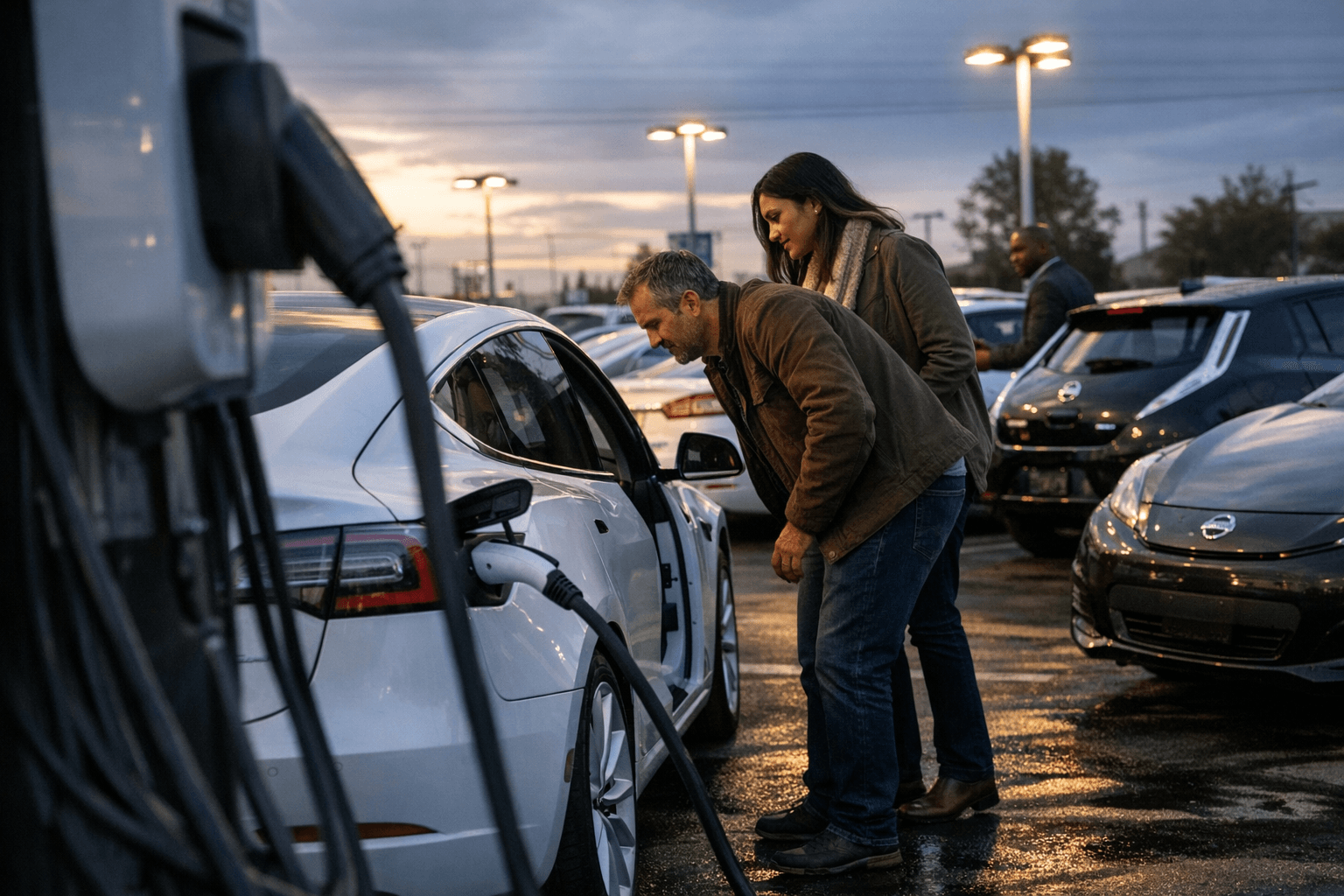
Buyers willing to do pre-purchase diligence should request a battery health report, now available through services like Recurrent, which collects state-of-charge, mileage, and range data from participating vehicles and produces independent condition profiles. Software update history and home-charging installation costs, typically ranging from $500 to $1,200 for a Level 2 setup, are the other two variables worth nailing down before signing.
The infrastructure picture has shifted considerably in favor of used EV owners who lack home charging or travel frequently. More than 18,000 new DC fast-charging ports were installed across the United States in 2025, a 30% increase and the largest single-year buildout ever recorded. As of February 2026, the country had 77,148 publicly accessible charging stations hosting more than 236,000 ports, a network roughly six times larger than what existed a decade ago.
What the numbers collectively signal is a market moving into a second phase. The first phase rewarded early adopters willing to pay a premium and absorb range uncertainty. The current phase rewards patient buyers who can now access well-warranted, software-current vehicles at near-gasoline prices, plugged into a charging network that no longer requires route planning the way it once did. The convergence of those conditions is producing demand that has continued to rise even as the policy tailwinds, including the federal used-EV tax credit of up to $4,000, expired in September 2025.
This article was produced by Prism’s automated news system from verified source data, official records, and press releases, then run through automated quality and moderation checks before publishing. The system is built and supervised by the people who set the standards it runs under. Read our full AI policy.
Did this article answer your question?