Rising Pacific temperatures could push tuna stocks east, threatening island economies
Tuna could drift east out of Pacific island waters, cutting license income and food security as Papua New Guinea, Micronesia and the Marshall Islands face steep catch declines.
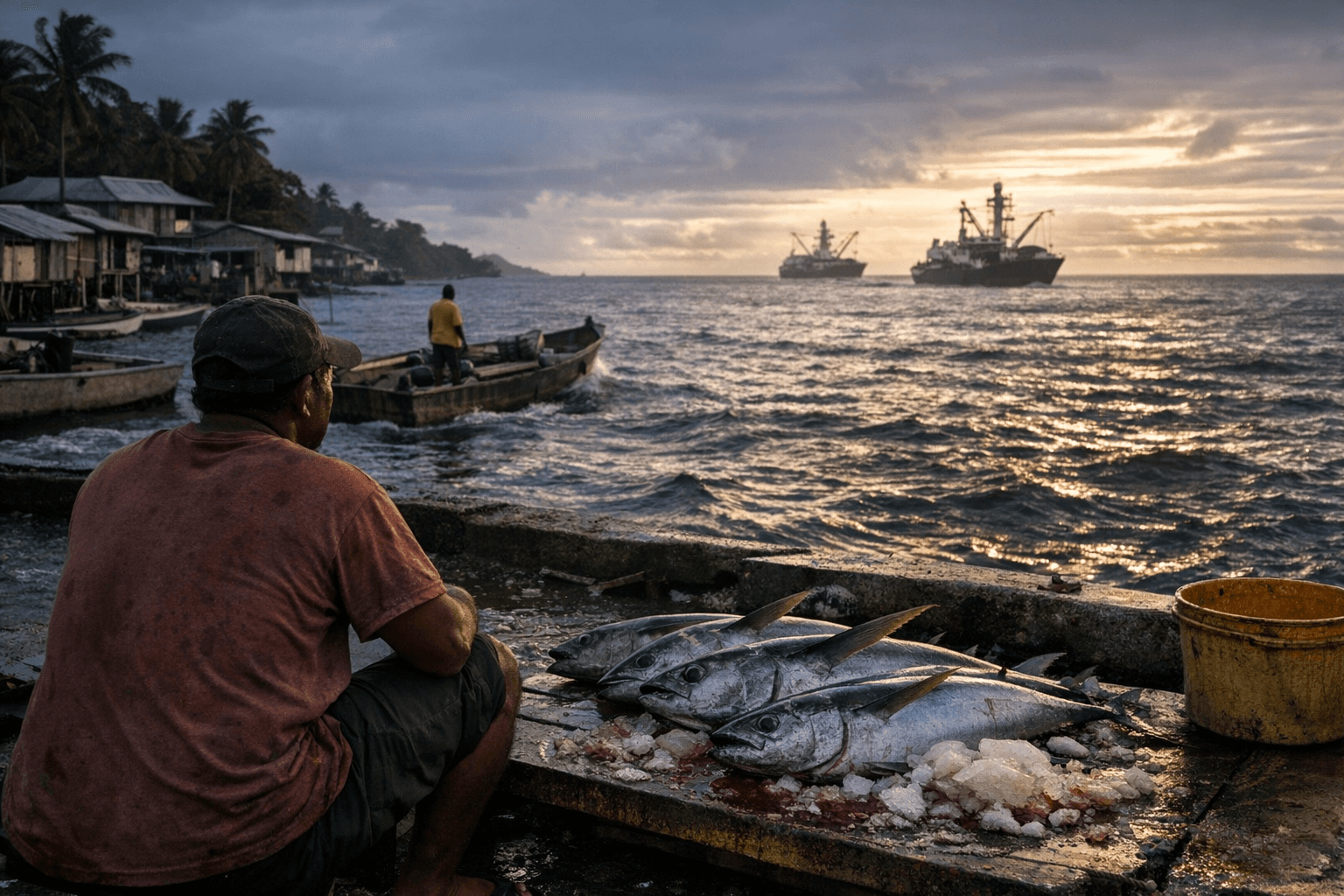
Rising water temperatures are turning tuna into an economic risk for Pacific Island states that depend on the fish for jobs, food and public budgets. The Pacific Ocean and the islands within it produce more than half of the world’s tuna, and the Western and Central Pacific Ocean accounts for about 55% of global production, with roughly half of that catch coming from Pacific island countries’ exclusive economic zones.
A Pacific climate report in 2018 warned that skipjack, yellowfin, bigeye and South Pacific albacore are expected to move eastward and to higher latitudes as the ocean warms. In 2016, the combined harvest of those four species from Pacific island EEZs topped 1.5 million tonnes, about 30% of the global tuna catch. As those stocks shift, Pacific governments risk losing access fees from foreign fleets, along with a major source of leverage over an industry that underwrites food security across the region.
The FAO Common Oceans Program’s 2024 modelling puts hard numbers on the danger. Between 2016 and 2050, combined biomass of skipjack, yellowfin and bigeye could fall by as much as 37% in Papua New Guinea, 26% in the Federated States of Micronesia and 15% in the Marshall Islands. Farther east, biomass could rise by 18% in the Cook Islands and 15% in Kiribati. The same model projects that the share of government revenue derived from tuna fishing licenses could drop from 47.2% to 39.9% in Micronesia, from 45.1% to 41% in the Marshall Islands and from 2.4% to 1.5% in Papua New Guinea. In Kiribati, it could climb from 54.4% to 57.9%, and in the Cook Islands from 8.9% to 10.3%.

Kiribati shows what is at stake. Spread across 33 islands in the Gilbert, Phoenix and Line groups, its exclusive economic zone covers more than 3.4 million square kilometres, larger than India. The country generated US$137 million from fishing licenses in 2024, and fishing revenue accounted for 71% of total government revenue in 2018. The IMF says fishing license fees make up more than 90% of Kiribati’s total fishing revenue and that fishing revenue supplied almost three-quarters of government income between 2018 and 2022, equal to roughly two-fifths of GDP.
Scientists say the shift is already underway. Paul Hamer of the Pacific Community said skipjack move with the ocean’s warm pool, which expands east in El Niño years and contracts west in La Niña years, while long-term warming is expected to drive a more persistent eastward expansion. SPC says the Pacific contributes less than 0.03% of global greenhouse gas emissions, yet remains among the most vulnerable regions on earth. It warns that 9 of 16 Pacific Island entities could see more than a 50% decline in maximum catch potential by 2100 compared with 1980 to 2000.

Governments are trying to respond. In February 2025, 14 Pacific Island countries received NZD 187 million, or US$107 million, from the Green Climate Fund for a Regional Tuna Programme led by the Pacific Community and regional partners. The Western and Central Pacific Fisheries Commission already manages the world’s largest tuna fishery, but as the stocks move east, the region’s bigger fight will be to keep revenue, bargaining power and long-term economic sovereignty from slipping beyond national waters.
This article was produced by Prism’s automated news system from verified source data, official records, and press releases, then run through automated quality and moderation checks before publishing. The system is built and supervised by the people who set the standards it runs under. Read our full AI policy.
Did this article answer your question?


