South Korea and Google launch AI campus in Seoul to boost research
Seoul is tying its AI future to Google, with a campus in Gangnam meant to pull Korean engineers and universities deeper into U.S.-linked research networks.
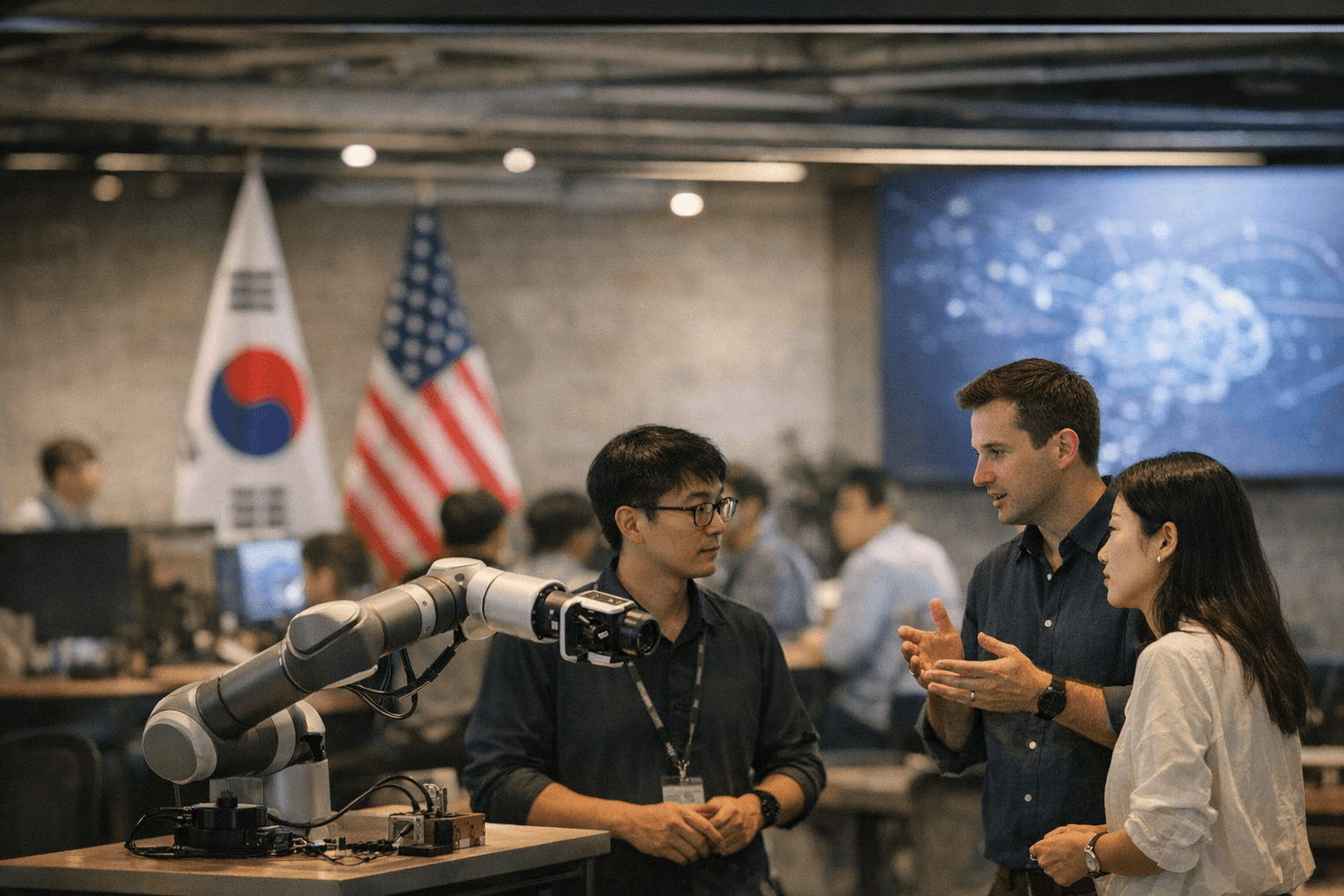
Google and South Korea have set up a new AI campus in Seoul, a move that puts the country deeper inside U.S.-aligned technology networks as governments compete for talent, computing power and influence. The facility will open within this year inside Google’s Seoul offices, in a 600-pyeong space in Gangnam, and is being pitched as a bridge between Google DeepMind, Korean engineers, startups and researchers.
The plan was discussed in Seoul between President Lee Jae Myung and Demis Hassabis, the chief executive of Google DeepMind, with presidential policy adviser Kim Yong-beom confirming the talks. South Korea’s Ministry of Science and ICT and Google DeepMind signed a memorandum of understanding covering joint research, talent development and responsible AI use. Seoul also asked Google to send at least 10 engineers from its U.S. headquarters to the campus, a request Hassabis said he would consider.
The government is positioning the campus as part of the K-Moonshot Project, a state-backed effort aimed at lifting research productivity and tackling national missions by 2035. The agenda stretches across advanced bio, future energy, semiconductors, space and quantum, showing how Seoul is treating AI less as a private-sector trend than as national infrastructure. Officials want the campus to connect Google with domestic startups and research institutes, while giving Korean engineers and universities a more direct line into global AI research pipelines.
Google DeepMind said Korea has the world’s highest AI innovation density and the fastest-growing AI adoption rate among the world’s top 30 economies. That makes the country an attractive partner for a company looking to expand its scientific base beyond Silicon Valley. The company also said it will initially explore collaborations with Seoul National University, the Korea Advanced Institute of Science and Technology and the ministry’s three AI Bio Innovation Hubs, with a focus on life sciences, weather and climate, energy and related research. More than 85,000 researchers in Korea already use AlphaFold, giving Google an existing scientific foothold to build on.
The partnership also carries political and historical weight. Hassabis and Lee discussed AI governance and the need for guardrails against misuse, including warfare, as governments try to manage the risks of a technology that can reshape labor markets, security policy and industrial power. The meeting took place in the same city where AlphaGo beat Lee Sedol 4-1 in 2016, a symbolic moment in the modern AI era. Hassabis, who won the 2024 Nobel Prize in Chemistry for work on AI-based protein structure prediction, is now helping turn that memory into a broader strategy for research, talent and geopolitical leverage.
This article was produced by Prism’s automated news system from verified source data, official records, and press releases, then run through automated quality and moderation checks before publishing. The system is built and supervised by the people who set the standards it runs under. Read our full AI policy.
Did this article answer your question?


