Rivian Deliveries Fall 18% in 2025 as EV Demand Softens
Rivian reported 2025 vehicle deliveries of 42,247 units, an 18% decline from 2024 and modestly below Wall Street expectations, underscoring weakening demand for higher-priced electric vehicles. The results keep the company within its revised guidance but sharpen investor focus on cost cuts, the upcoming lower-cost R2 SUV launch, and February financial disclosures.
Rivian Automotive Inc. reported on Jan. 2, 2026 that it delivered 42,247 vehicles in 2025, down roughly 18% from 51,579 in 2024 and slightly below the Street’s consensus. Production in 2025 totaled 42,284 units, both numbers falling inside the company’s lowered guidance range of 41,500 to 43,500 vehicles set during the third quarter of 2025. Rivian described the results as “in line with Rivian’s outlook.”
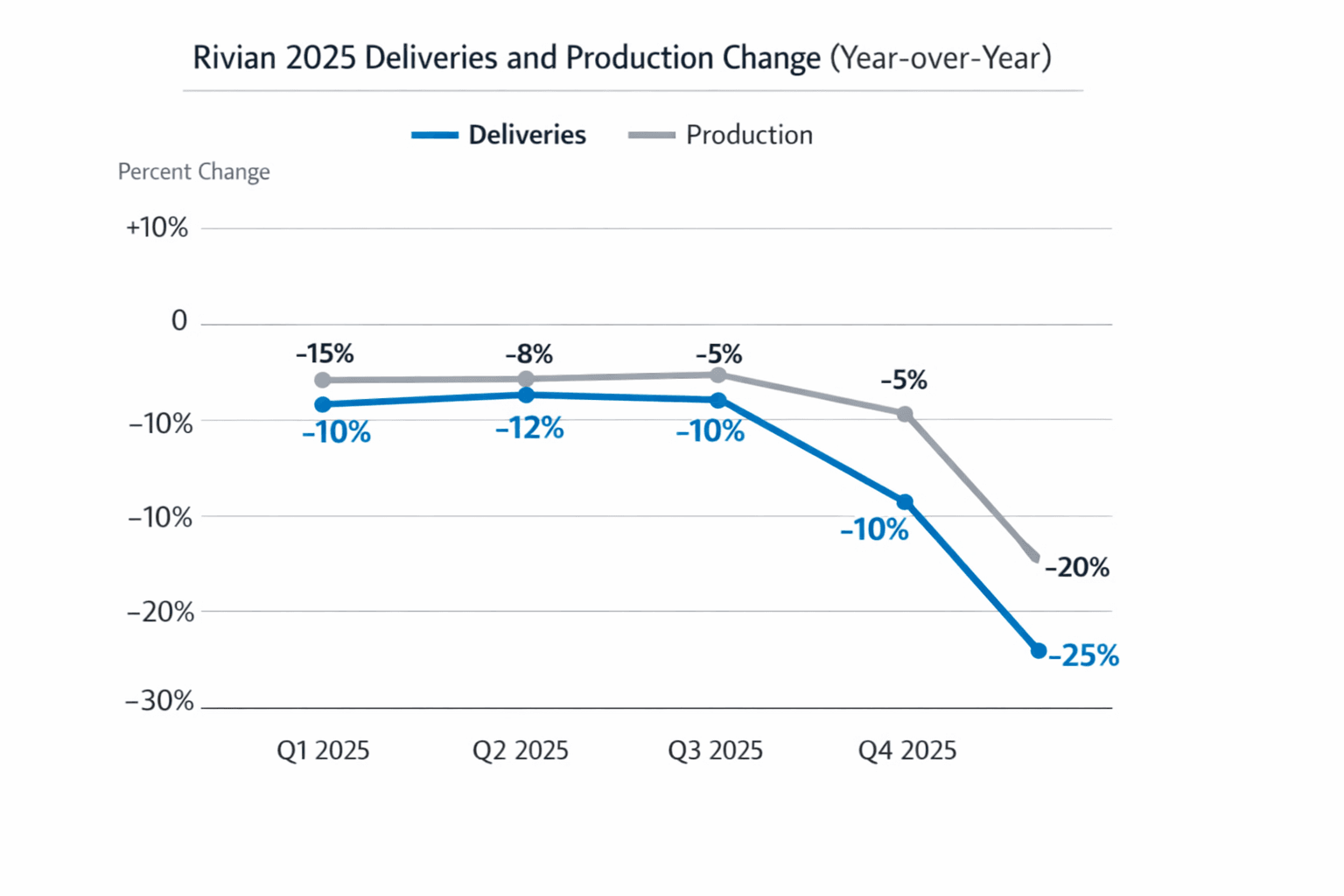
The fourth quarter at the company’s Normal, Illinois plant showed sharper short‑term weakness. Q4 production was 10,974 vehicles and deliveries were 9,745, declines of about 14% and 31% respectively versus the fourth quarter of 2024. Visible Alpha consensus had been looking for roughly 10,050 Q4 deliveries and roughly 42,500 for the full year, leaving Rivian modestly under those expectations but within its own forecast band.
A quarterly production pattern through 2025 reveals the uneven recovery the company navigated. Production by quarter was 14,611 in Q1, 5,979 in Q2, 10,720 in Q3, and 10,974 in Q4. The midyear trough and subpar year‑over‑year performance in three of four quarters highlight both operational constraints and shifting demand conditions.

Industry analysts and company executives point to the expiration of the $7,500 federal EV tax credit at the end of September 2025 as a significant near‑term headwind. The loss of that incentive effectively raised out‑of‑pocket prices for many buyers and contributed to softer sales across higher‑priced electric vehicle segments, where Rivian competes. Visible Alpha’s consensus implied a roughly 17.6% year‑over‑year decline in deliveries; the company’s 18% drop aligns with that signal and reflects broader price sensitivity in the U.S. EV market.
Rivian is pursuing cost reductions while it waits for demand to pick up. The company said it is implementing efficiency measures at its Normal plant and simplifying components to lower material and manufacturing costs as a way to narrow losses without depending solely on volume growth. Those measures are intended to improve gross margins given near‑term volume pressures, but their ultimate impact will depend on execution and supply chain dynamics.
Attention among investors will turn to the company’s lower‑cost R2 SUV, which Rivian plans to begin delivering in the first half of 2026. The R2 is positioned as a fulcrum for restarting growth and diluting fixed costs across a larger volume base, but success will hinge on market reception in a more price‑sensitive environment and the broader policy landscape for EV incentives.
Rivian said it will release detailed fourth‑quarter and full‑year 2025 financial results on Feb. 12, 2026, after markets close. Those figures and any forward guidance will be closely watched for signs of whether cost cuts and the R2 rollout can offset the demand shock from the tax credit lapse and stabilize the company’s path to profitability.
This article was produced by Prism’s automated news system from verified source data, official records, and press releases, then run through automated quality and moderation checks before publishing. The system is built and supervised by the people who set the standards it runs under. Read our full AI policy.
Did this article answer your question?

