Robot boom leaves out-of-work factory workers in Kunshan adrift
Foxconn’s Kunshan plant cut headcount from 110,000 to 50,000 after robots arrived, and many displaced workers now spend their days in parks.

In Kunshan, Foxconn cut one factory’s workforce from 110,000 to 50,000 after introducing robots, a shift that has left some out-of-work employees lingering in public parks with fewer stable options. The county-level city near Shanghai has become a test case for how China’s automation drive reaches beyond the factory floor and into the local labor market.
Kunshan built its wealth on electronics manufacturing and then leaned further into automation. Local officials said in 2016 that up to 600 enterprises in the city planned to use robots in the near future. The city also founded the Kunshan German Industrial Park in 2005, part of a broader push toward intelligent manufacturing and logistics parks as it searched for new engines of growth.

The scale of China’s robot buildout has been far larger than what Kunshan saw alone. The International Federation of Robotics said China had 1,755,132 industrial robots operating in factories in 2023, with 276,288 new installations that year, equal to 51 percent of global demand. In 2024, the stock rose to 2,027,000 industrial robots, and annual installations reached 295,000 units, about 54 percent of global demand.
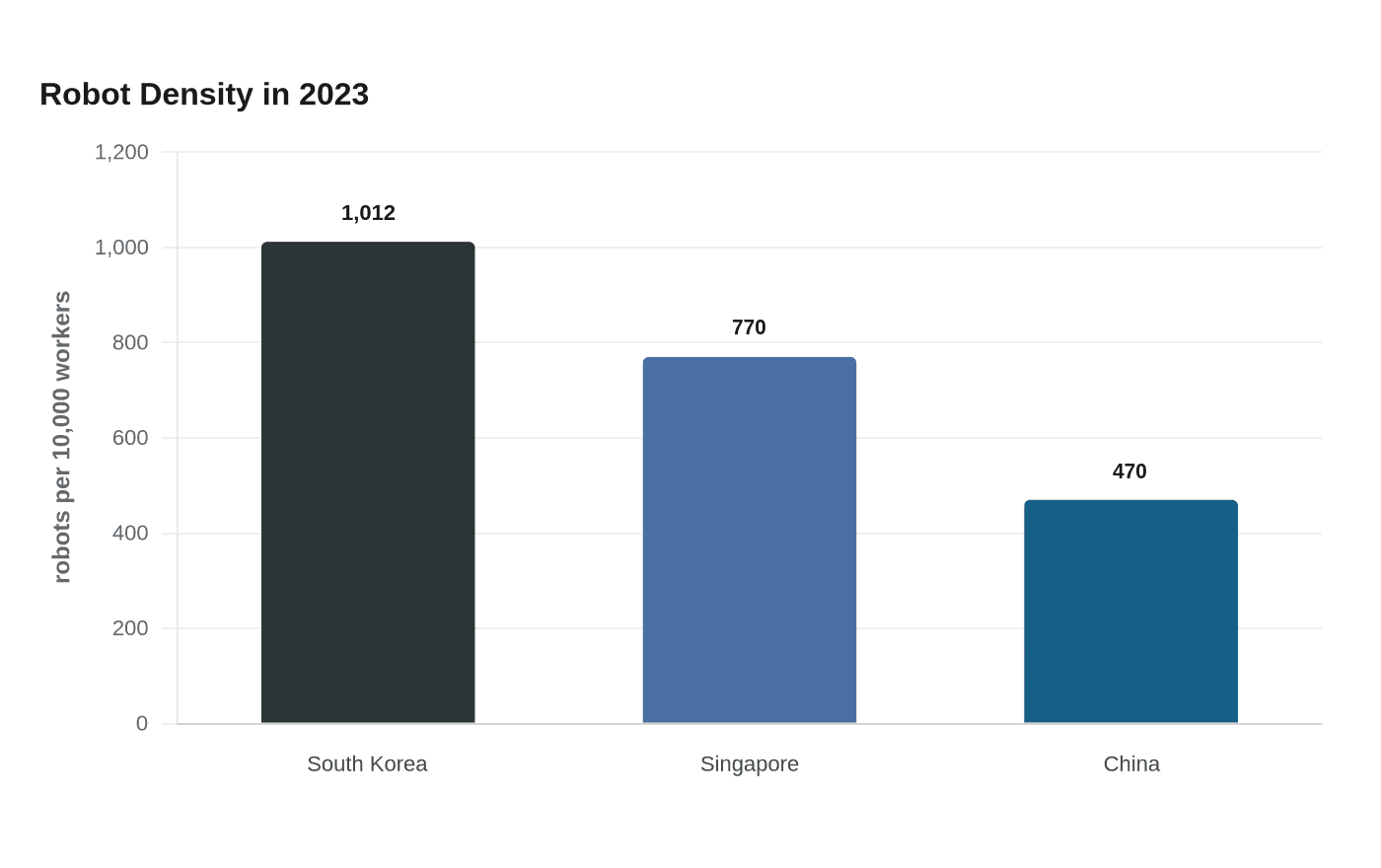
China also ranked third globally in robot density in 2023, with 470 robots per 10,000 manufacturing workers, behind South Korea’s 1,012 and Singapore’s 770. Even with that pace of automation, the country still had about 37 million manufacturing workers, showing how large the human workforce remains alongside the machines.
Beijing has treated the shift as a strategic priority. China’s Ministry of Human Resources and Social Security has expanded training in industrial robot operation and intelligent manufacturing as part of its skills system, trying to help workers adjust to automated production lines. But in Kunshan and other parts of China’s factory belt, retraining has moved more slowly than the machines.
That mismatch is visible in the lives of workers pushed out of plants that once anchored entire neighborhoods. As factories add robots and cut labor costs, the people who lose those jobs are often left waiting for the next shift in parks, where there is little else to do and fewer places to go.
This article was produced by Prism’s automated news system from verified source data, official records, and press releases, then run through automated quality and moderation checks before publishing. The system is built and supervised by the people who set the standards it runs under. Read our full AI policy.
Did this article answer your question?