Robot faceplants during Beijing's humanoid marathon prep, exposing robot limits
A robot face-planted on Beijing’s 21-kilometre test route as more than 70 teams rehearsed for a humanoid half-marathon, exposing how fragile bipedal robots still are.
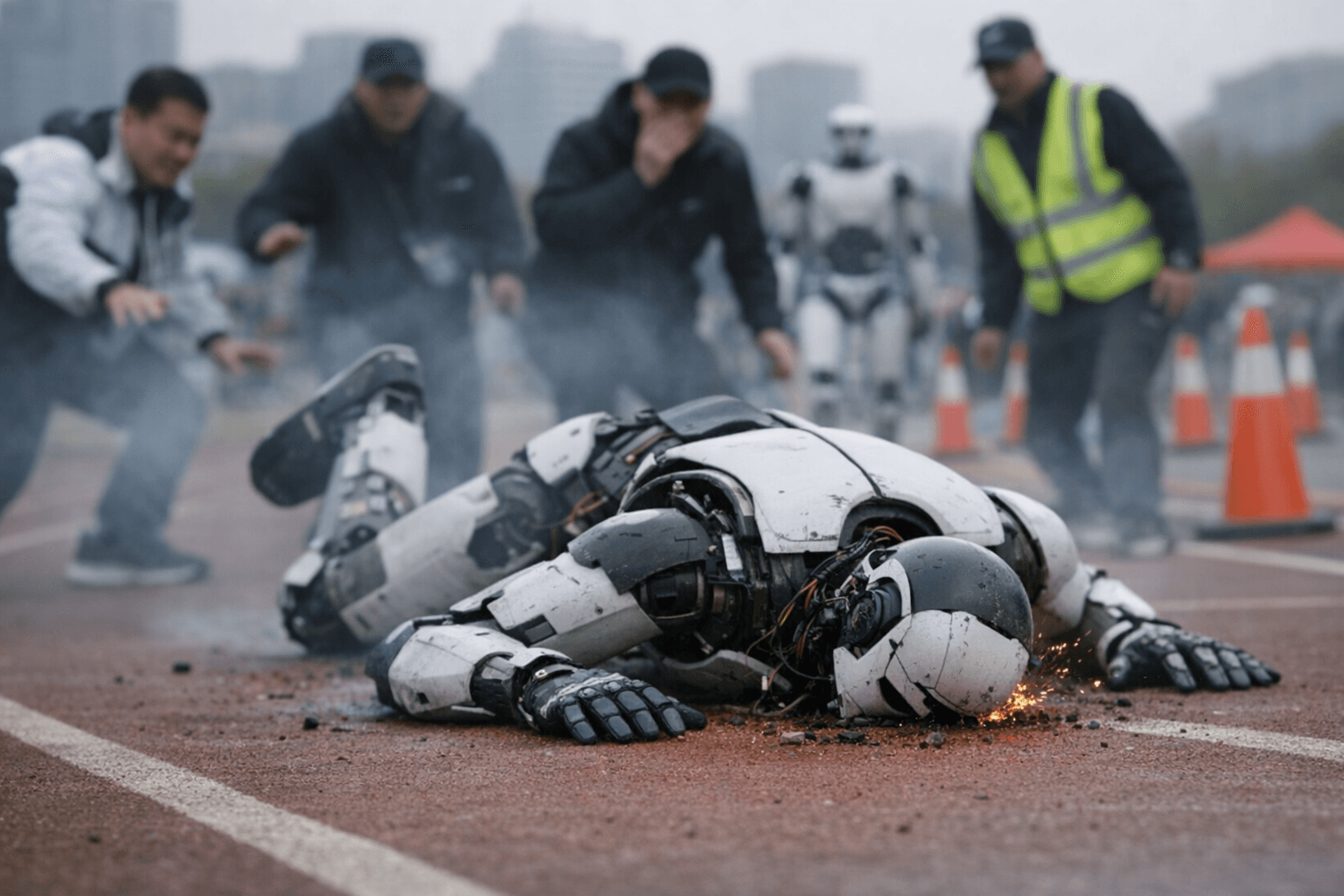
A faceplant on Beijing’s half-marathon route became the clearest reminder yet that humanoid robots still struggle with the basics of balance, recovery and endurance. As more than 70 teams ran an overnight full-course test in the city’s E-Town development zone, one machine toppled during preparation for the second humanoid robot half-marathon, scheduled for April 19.
The event has grown quickly from last year’s debut, when 21 robots lined up and only a handful made it to the end. Bloomberg reported that just four completed the race within the four-hour limit, while Euronews said six of the 21 starters finished. Tiangong Ultra won that race in 2 hours, 40 minutes and 42 seconds, setting the benchmark for this year’s field.
This time, organizers said more than 100 robots were expected to compete, and about 40% of the teams were relying on fully autonomous navigation. That shift raised the difficulty sharply. Human operators can correct a robot that wobbles or drifts off line; autonomous machines must read the route, adjust their gait, and keep moving without direct intervention. New awards were also added for endurance and simply reaching the finish line, a sign that finishing itself remains a meaningful accomplishment.
The overnight test covered the full 21-kilometre course in Beijing’s E-Town development zone, the same distance as the official race, and teams reported a familiar set of failures. Joints overheated, motors overheated and batteries drained quickly. Some competitors said they were still assembling their robots just hours before the run, underscoring how much of the field remains in a prototype stage rather than in anything close to reliable deployment.
That gap matters because the marathon has become more than a spectacle. It is a public stress test for humanoid machines that China wants to deploy beyond lab demos, in environments that require route navigation, equipment coordination, emergency response and the ability to handle rougher terrain. The course itself was designed to expose weaknesses, including slopes, bumpy roads and outdoor conditions that force machines to keep moving under strain.
The latest falls and breakdowns do not diminish the ambition behind the race. They make it clearer how far the technology still has to go before polished demonstrations translate into useful, sustained real-world performance.
This article was produced by Prism’s automated news system from verified source data, official records, and press releases, then run through automated quality and moderation checks before publishing. The system is built and supervised by the people who set the standards it runs under. Read our full AI policy.
Did this article answer your question?


