Russia closes in on Kostiantynivka, threatening Ukraine’s eastern fortress belt
Russian troops were closing in on Kostiantynivka, where only about 5,000 civilians remained. Its fall would expose the road to Kramatorsk and Sloviansk.

Kostiantynivka has become the hinge point of Ukraine’s eastern defense, a battered industrial and railway city whose loss could open the road to Kramatorsk and Sloviansk and bring Russia closer to controlling all of Donbas. Built into a roughly 50-kilometer fortress belt that also includes Sloviansk, Kramatorsk, Druzhkivka and Oleksiyevo-Druzhkivka, the city has been fortified for about 11 years as one of the main barriers to Russian advance.
That barrier was being tested from inside and out. By June 15, Ukrainian officials estimated that about 123 Russian servicemen were present in Kostiantynivka, while the overall situation was described as difficult but not yet an encirclement. Multiple Ukrainian reports said Russian troops had infiltrated the city center by June 12, and military observers said advance elements moving from the Bakhmut and Toretsk directions were closing to within roughly two kilometers of each other. Russia had also missed a reported May deadline to take the city.
The human toll in Kostiantynivka was stark. Before the full-scale invasion, the city had about 67,000 to 70,000 residents. By mid-June 2026, Ukrainian officials said only about 5,000 people remained inside the city, with several hundred more in nearby villages, as near-daily Russian artillery, missile and drone strikes continued to grind down life behind the front. Kostiantynivka’s role as one of Ukraine’s main glass-making centers and a key transit junction in the Kramatorsk agglomeration has made it strategically valuable for decades, and that geography now carried military weight.
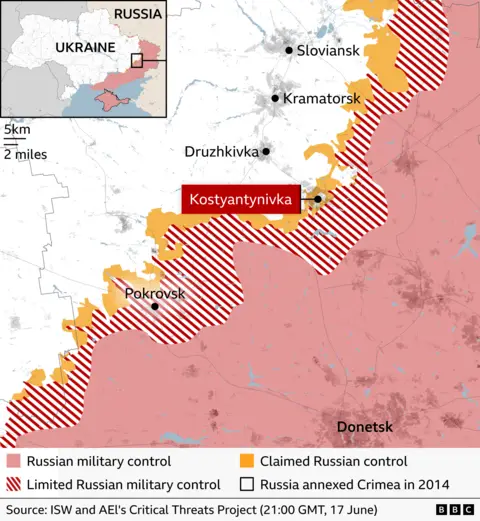
The Institute for the Study of War assessed that Russia had made Kostiantynivka the main objective of its spring-summer 2026 offensive. Russian forces were using infiltration tactics similar to those seen around Pokrovsk, a method intended to split Ukrainian defenses, complicate command and make organized resistance harder. Ukrainian and Western monitors also said Russian assault elements had been reinforced and were pressing hard in the Kostiantynivka-Druzhkivka direction, with the goal of turning a breach in one city into pressure on the entire eastern fortress belt.

If Kostiantynivka were to fall, the next line of danger would shift westward toward Druzhkivka and then to Kramatorsk and Sloviansk, the last major Ukrainian strongholds in the east. That is why the battle for a single city now carries consequences far beyond Donetsk Oblast: it could shape supply lines, the tempo of the broader war and the diplomatic calculus around whether Ukraine can still hold its eastern spine.
This article was produced by Prism’s automated news system from verified source data, official records, and press releases, then run through automated quality and moderation checks before publishing. The system is built and supervised by the people who set the standards it runs under. Read our full AI policy.
Did this article answer your question?