Russia Raids Novaya Gazeta, Labels Nobel Prize Group Memorial Extremist
Russia criminalized support for Nobel-winning Memorial and raided Novaya Gazeta on the same day, threatening up to 4 years in prison for sharing the group's work.
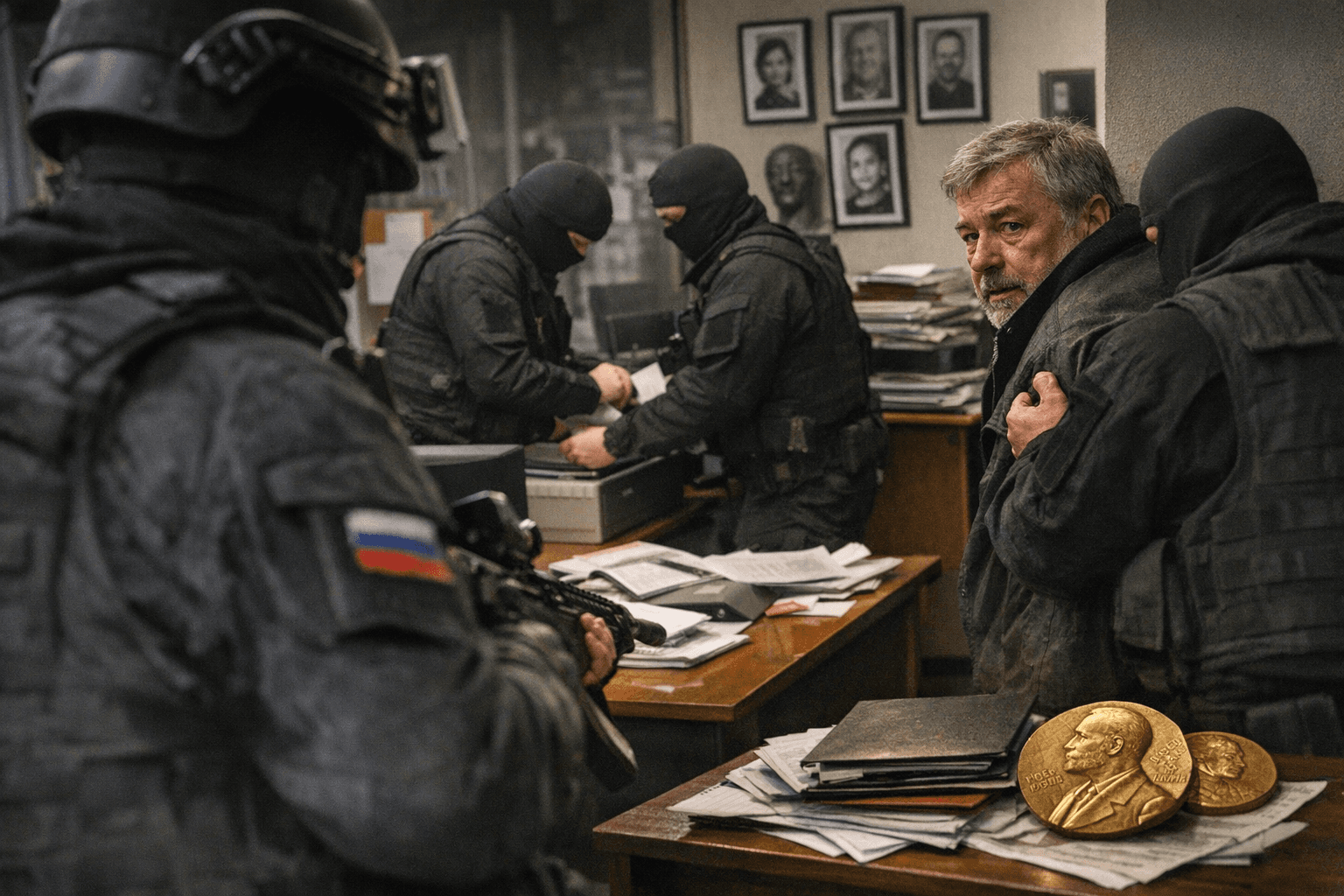
The same morning Russia's Supreme Court convened behind closed doors to brand Nobel Peace Prize-winning human rights group Memorial an "extremist" organization, masked security officers entered the Moscow newsroom of Novaya Gazeta around noon, barring the newspaper's lawyers from the building. The twin strikes eliminated two of the country's last functioning mechanisms for independent rights documentation and investigative accountability.
The Supreme Court's ruling against Memorial, issued following a petition by Russia's Justice Ministry, went further than the dissolution order that had shuttered the organization in December 2021. The new designation criminalizes not just Memorial's activities but anyone who contributes to its work, donates to it, or shares materials it publishes, with penalties of up to four years in prison. The court declared Memorial's activities "clearly anti-Russian in nature and aimed at destroying the basic foundations of Russian statehood." Memorial called the decision unlawful, saying it "marks a new stage of political pressure on Russian civil society."
What that ruling effectively deletes is a 39-year institutional record. Memorial was founded in August 1987 under Gorbachev's glasnost reforms, with Soviet physicist and dissident Andrei Sakharov, the 1975 Nobel Peace Prize laureate, as its first chairman. Over decades it assembled the largest publicly available database on Gulag victims, documented rights abuses in Chechnya and Syria, tracked Ukrainian prisoners of war, and maintained a list of political prisoners that had grown to more than 1,000 names by 2026, up from just 46 in 2015.
The Kremlin had already dismantled the organization piece by piece. Russia's Supreme Court ordered it dissolved in December 2021; hours after Memorial was awarded the 2022 Nobel Peace Prize alongside Ukraine's Center for Civil Liberties and jailed Belarusian activist Ales Bialiatski, a Moscow court ordered its headquarters seized and transferred to state ownership. Co-chair Oleg Orlov was sentenced to two and a half years in prison in February 2024 for publicly opposing the war in Ukraine before being freed in a prisoner exchange that August. Jan Raczynski, chair of the International Memorial entity liquidated in Russia in 2021, said he was surprised and bewildered by the Justice Ministry's petition, noting that Memorial's name had been synonymous with perestroika and glasnost for decades.
At Novaya Gazeta's Moscow offices, Russia's Interior Ministry confirmed the search was connected to a criminal probe into the "illegal use, transfer or storage of information containing personal data." The specific target was journalist Oleg Roldugin, a co-founder of the independent newspaper Sobesednik, whose reporting had examined the inner circle of Chechnya Governor Ramzan Kadyrov and Russia's state-run messaging platform Max. Roldugin's home was also searched and he was taken to Moscow's Main Investigative Directorate for questioning.
Novaya Gazeta, Russia's oldest independent newspaper, was founded in 1993 using seed money from Mikhail Gorbachev's 1990 Nobel Peace Prize winnings. Editor-in-chief Dmitry Muratov shared the 2021 Nobel Peace Prize with Filipino journalist Maria Ressa for efforts to safeguard freedom of expression; when accepting the award, Muratov dedicated it to six Novaya Gazeta journalists murdered for their work, including Anna Politkovskaya, shot dead in the elevator of her Moscow apartment building on October 7, 2006. Muratov was designated a "foreign agent" in 2023, the paper's media license was revoked in 2022, and its exile successor, Novaya Gazeta Europe, has since been banned in Russia as "undesirable."
Norwegian Nobel Committee chairman Jørgen Watne Frydnes condemned both actions, calling the extremist designation "an affront to the fundamental values of human dignity and freedom of expression." The FSB's simultaneous detention of a former Radio Free Europe freelance journalist on treason charges underscored that April 9 was not a coincidence but a coordinated purge. With Memorial's archive now contraband and Novaya Gazeta's newsroom searched, the infrastructure for documenting Russia's political prisoners, its battlefield conduct, and its wartime repression grows harder to reconstruct with each passing order.
This article was produced by Prism’s automated news system from verified source data, official records, and press releases, then run through automated quality and moderation checks before publishing. The system is built and supervised by the people who set the standards it runs under. Read our full AI policy.
Did this article answer your question?