Saharan Dust Plume Blankets Greece With Hazy Skies, Muddy Rain
A Saharan haboob spanning more than 1,000 miles sent a mineral dust plume into the Mediterranean, delivering muddy rain and degraded air quality across Greece through April 2.
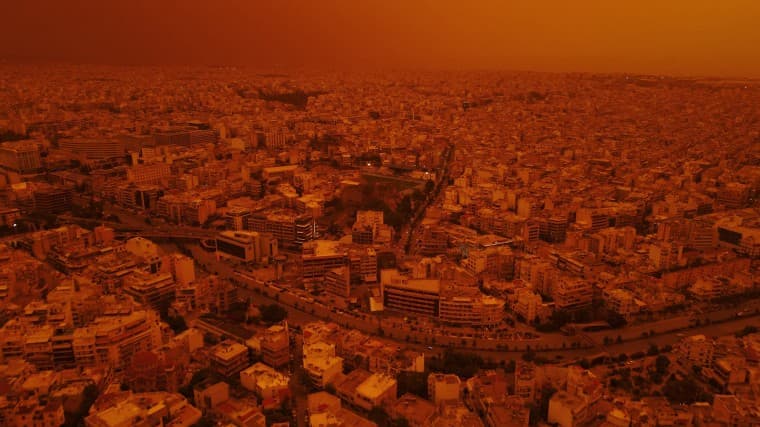
A wall of dust and sand swept out of western Algeria and across northwestern Africa on Monday, spawning a haboob that stretched more than 1,000 miles from the Saharan interior toward the Atlantic and launching a mineral plume that reached western Greece by Tuesday. Orange-tinged haze, reddish film on surfaces, and brown-tinted rainfall are now spreading across the country as the event enters its peak phase.
The massive dust storm swept across the Sahara Desert from western Algeria into Mauritania, Morocco, Western Sahara and the Canary Islands on March 30. Copernicus Sentinel-2 satellite imagery captured the storm sweeping across the Algeria-Mali border, while social media video showed a thick wall of sand bearing down on the town of Tindouf, near the Mauritanian and Western Saharan borders. Fine particles from the haboob did not settle quickly; instead, carried northeast by southerly winds across Libya and Egypt, they remained suspended at altitude before reaching Greek territory.
Dust transferred from Libya and Egypt began affecting Greece on March 31, and AtmoHub, the online portal for air quality information in Greece, forecast it would affect the entire country between Tuesday and Thursday, March 31 through April 2. The dust transfer is accompanied by extensive rainfall, initially in western Greece on March 31 and then, on April 1 and 2, across the entire country. This is producing the phenomenon of "muddy rain" in several areas, while also contributing to a reduction in dust concentrations near the surface. However, southern regions with more limited rainfall, including the Cyclades, Crete and the Dodecanese, are expected to experience greater air quality decline on Wednesday and Thursday.
Muddy rain forms when precipitation acts as a natural scrubber, pulling suspended mineral particles downward and mixing them into droplets before they reach the ground. The result is a reddish-brown deposit left on every exposed surface once the rain clears.
The Hellenic National Meteorological Service (EMY) issued an updated severe weather bulletin covering April 1 and April 2. Widespread, prolonged, and intense rainfall and thunderstorms are expected across much of Greece, with localized hail possible. Easterly to southeasterly winds of 7 to 9 Beaufort, reaching 10 Beaufort locally in the Dodecanese, are forecast for eastern Greece on Wednesday. Heavy snowfall is expected for mountainous areas of Epirus and Macedonia. Meteorological conditions are also favorable for the transport of Saharan dust, primarily affecting eastern and southern parts of the country.

The public health dimension of the event is direct. PM10 concentrations during Saharan dust intrusions regularly exceed the European Union's 24-hour mean exposure threshold of 50 micrograms per cubic meter. At those concentrations, fine mineral particles penetrate deep into the respiratory tract, worsening asthma, chronic obstructive pulmonary disease and cardiovascular conditions. When the mineral load combines with urban pollutants already present in Athens and other cities, the aggregate burden rises further. Authorities urged people with respiratory problems, the elderly and children to limit outdoor exertion and consider masks or air filtration when indoors. Hospitals and clinics were advised to prepare for higher respiratory admission rates through the end of the week.
AtmoHub delivers daily air quality forecasts aligned with EU Air Quality Directives and provides in-situ measurements for key pollutants including NO2, ozone, PM10 and PM2.5. Hourly forecasts at five-kilometer resolution are produced for major pollutants and natural aerosols including dust. That granularity is essential during peak intrusion windows when concentrations can shift rapidly across short distances.
The Sahara Desert releases between 60 and 200 million tonnes of mineral dust per year; while the largest particles return to earth quickly, the smallest can travel thousands of kilometers, potentially reaching all of Europe. Dust transport toward the Mediterranean follows a seasonal rhythm that intensifies in late winter and spring. The central and eastern Mediterranean region experiences several Saharan dust intrusions during the first few months of each year, with plumes regularly reaching Italy and Greece and resulting in hazy skies and dust reaching ground level. As regional heat seasons grow more variable, events of this intensity are expected to recur, making real-time monitoring infrastructure and coordinated public health warnings the most consequential tools available for reducing their impact.
This article was produced by Prism’s automated news system from verified source data, official records, and press releases, then run through automated quality and moderation checks before publishing. The system is built and supervised by the people who set the standards it runs under. Read our full AI policy.
Did this article answer your question?


