Samsung Electronics to Buy 2.5 Trillion Won in Shares for Compensation
Samsung Electronics announced a KRW 2.5 trillion stock repurchase program to fund employee and executive pay under a performance-linked scheme, with purchases set for Jan. 8–Apr. 7, 2026. The move matters because it reallocates capital toward compensation, affects share float and potentially corporate governance, and signals how large tech firms manage incentives and dilution.
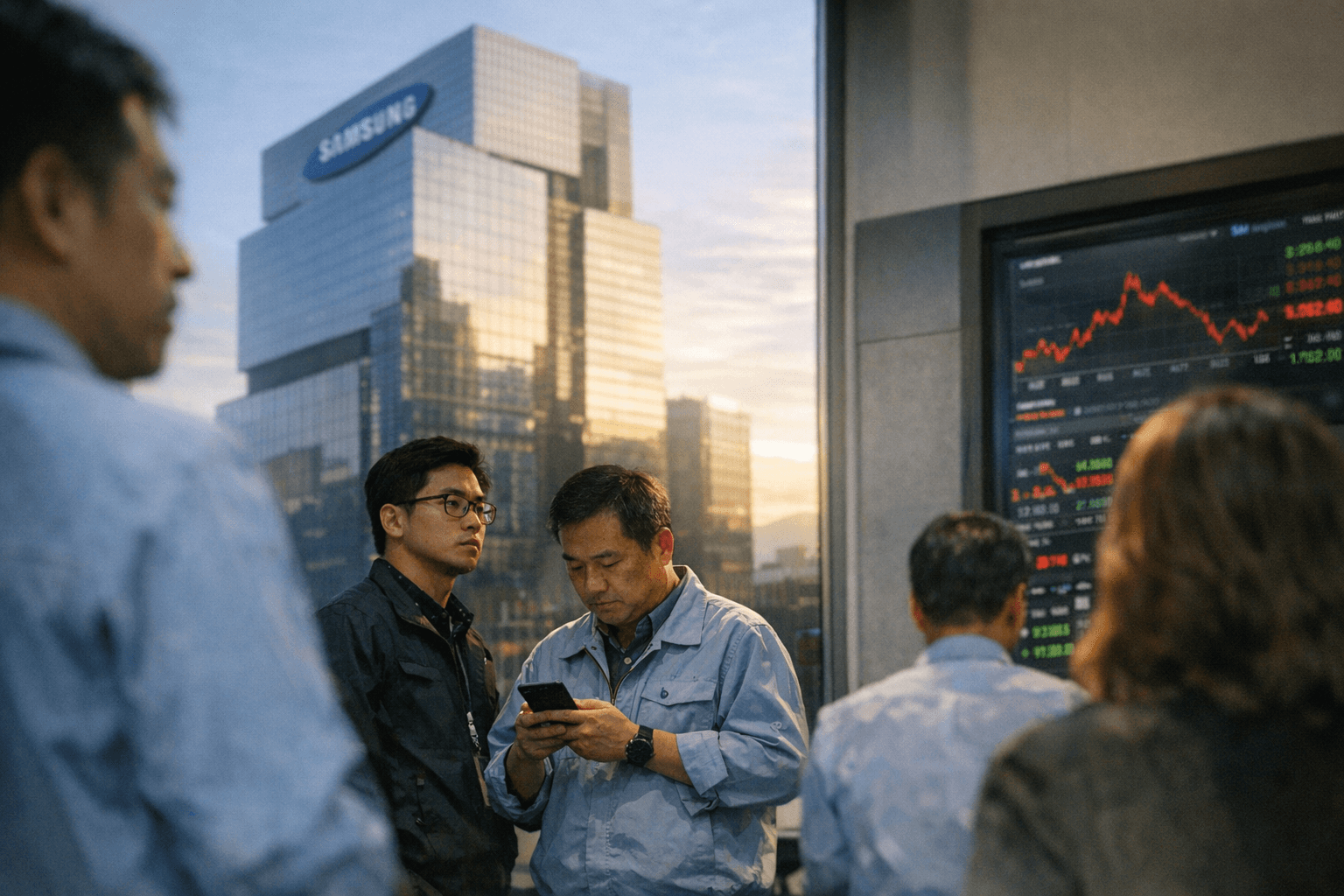
Samsung Electronics Co. Ltd. said on Jan. 7, 2026, that it will acquire KRW 2.5 trillion of its own shares on the open market to fund employee and executive compensation. The regulatory filing sets a purchase window running from Jan. 8 through Apr. 7, 2026, and ties the buyback explicitly to a performance-linked compensation scheme introduced in October 2025. At an exchange rate of KRW 1,446.17 to the dollar, the program is worth roughly $1.73 billion.
The company filed the plan with Korean regulators and identified the purchases as a mechanism to allocate equity for pay rather than a standard cash-return program aimed primarily at supporting the stock price. Executed through market purchases, the repurchase will reduce the free float over the quarter and provide Samsung with treasury shares that can be distributed under compensation plans, offsetting dilution from stock grants and long-term incentive awards.
Buybacks used to fund employee compensation are increasingly common among large technology firms seeking to align incentives while managing the accounting and tax consequences of cash payouts. For Samsung, a conglomerate with broad operational exposure from semiconductors to consumer electronics, the timing of a concentrated, market-based acquisition raises questions about short-term market impact and longer-run capital allocation priorities. Reduced float during the purchase window can increase volatility and transient price support, but the stated purpose and open-market mechanism suggest the company is framing the operation as administrative rather than a market-stabilizing intervention.
Key details remain opaque. The filing discloses the total KRW amount and the trading window but does not specify granular allocation rules, vesting schedules, or the distribution between employee ranks and executives. Absent those mechanics, investors and governance analysts will focus on the program's design, including performance metrics that determine awards, the measurement period tied to the October 2025 scheme, and whether the company will disclose recipient categories or post-distribution dilution impacts.
For shareholders, the immediate financial effect depends on how the repurchased shares are deployed. If treasury shares are used to satisfy equity awards, buybacks can be accretive by offsetting share issuance. If the program reduces outstanding shares permanently, earnings per share dynamics could improve modestly depending on the scale relative to Samsung's market capitalization and earnings base. Without an explicit share-count disclosure in the filing, the percent impact on float and EPS cannot be precisely calculated at this time.
Regulatory observers and investors will also watch for follow-up disclosures from Samsung investor relations and subsequent registry filings that could clarify share counts and allocation mechanics. Analysts will likely monitor trading volumes and price behavior for ticker 005930.KS on the Korea Exchange during the Jan. 8–Apr. 7 window to gauge market reaction.
The repurchase underscores a broader trend among large-cap technology companies to use share buybacks as tools for compensation management and capital allocation. For policymakers and corporate governance advocates, the key questions will center on transparency of award formulas, executive pay linkage to sustained performance, and whether such programs meaningfully align management incentives with long-term shareholder value.
This article was produced by Prism’s automated news system from verified source data, official records, and press releases, then run through automated quality and moderation checks before publishing. The system is built and supervised by the people who set the standards it runs under. Read our full AI policy.
Did this article answer your question?

