Sanctions relief could strengthen Iran’s Revolutionary Guard economy
Sanctions relief could reopen Iran’s economy, but the first big winners may be the Revolutionary Guards and their sprawling commercial network.
A U.S.-Iran deal meant to ease confrontation could hand Tehran’s most powerful security force a fresh financial windfall. The paradox is blunt: the sanctions relief designed to produce diplomatic gains may also funnel money into the Islamic Revolutionary Guard Corps, the state-backed machine that already sits at the center of Iran’s shadow economy.
A deal that could reward the system built to evade pressure
Reuters says the emerging contours of an agreement include waivers on sanctioned oil sales in an interim deal, while a broader settlement could lift additional sanctions and open access to a reported $300 billion reconstruction fund. That would be a major shift for an economy long cut off from capital, trade and finance, but it would also create a fast lane for institutions that have spent years surviving precisely because they know how to operate under pressure.
Four senior Iranian sources told Reuters that the Guards are unusually well placed to capture a large share of any new money. The reason is not just political influence. It is operational advantage. The IRGC already runs much of the sanctions-busting machinery that kept Iran functioning through years of restrictions, giving it a head start over private firms that were squeezed out of normal markets long ago.
That makes the policy problem unavoidable. Washington may want a deal that lowers regional tensions and curbs Iran’s nuclear and military posture, but any reopening of trade and investment could also strengthen a force that remains designated as a terrorist organization by the United States and its allies. The question is no longer whether sanctions relief would move money. It is where that money would go.
The Guard economy is broad, opaque and deeply embedded
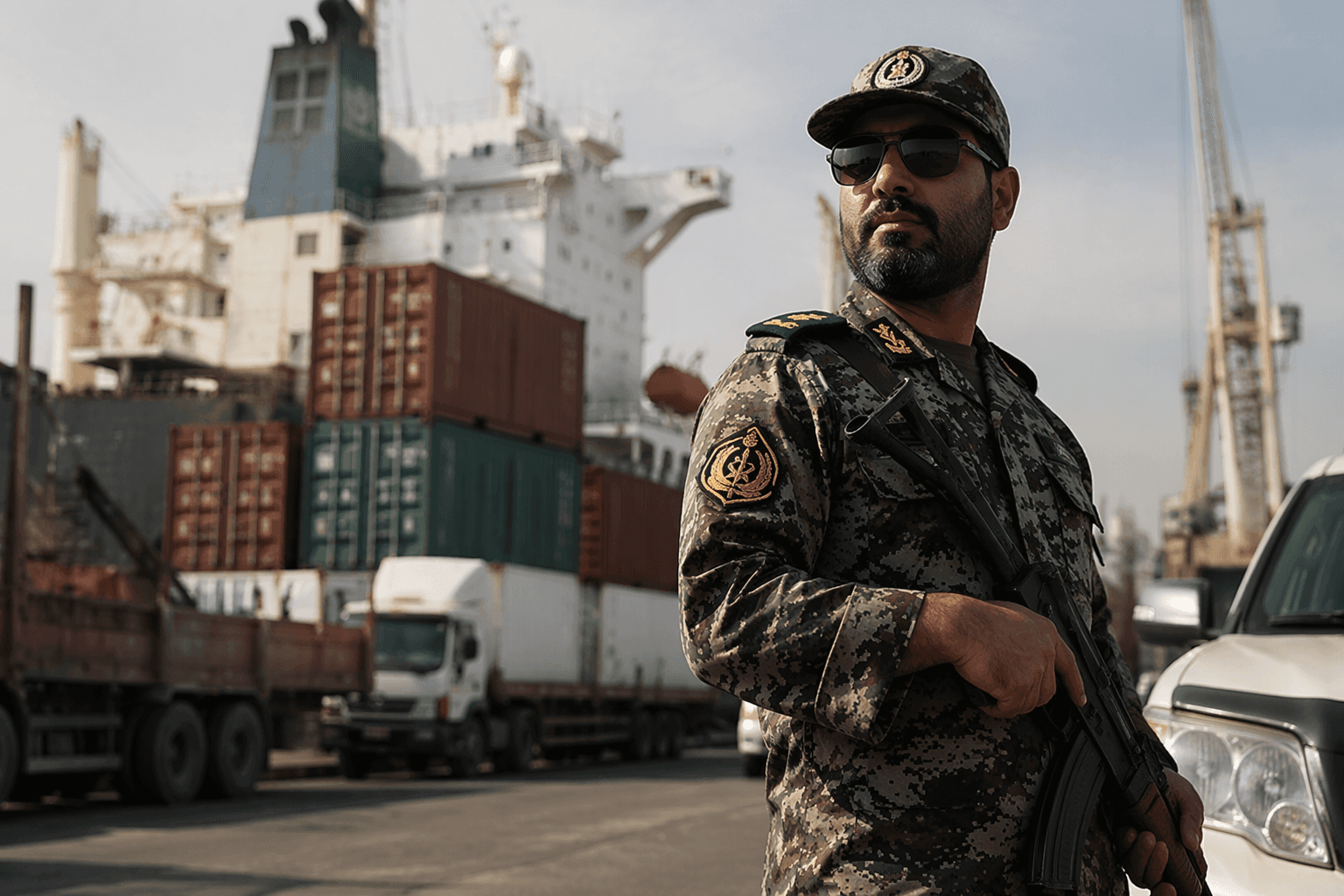
The IRGC is not a narrow military unit waiting on the sidelines for a windfall. It has spent years building a commercial empire that reaches across oil, construction, shipping, telecommunications and ports, sectors that would be among the first to benefit if sanctions ease and outside capital returns. In practice, that means the same institutions that helped Iran endure isolation could be the best positioned to profit from reintegration.
Treasury has described a small number of regime-linked foundations and firms as controlling large swaths of the economy, and in January 2021 it said the IRGC-owned Khatam al-Anbiya, together with Supreme Leader-linked foundations, was part of that structure. Treasury also said some of those entities are said to control more than half of the Iranian economy. It further described the Execution of Imam Khomeini’s Order, or EIKO, as having a stake in nearly every sector, including energy, telecommunications and financial services.
That breadth matters because sanctions relief does not arrive in a vacuum. Oil waivers would immediately affect export channels, shipping and ports. A reconstruction fund would likely touch construction, procurement and logistics. Telecommunications and financial services would become conduits for contracts, payment systems and data infrastructure. In an economy already organized around opaque, politically protected conglomerates, these are not neutral sectors. They are pipes through which influence and cash can move quickly.
The Guards’ reach is reinforced by their personnel base and parallel institutions. The National Counterterrorism Center says the IRGC has between 150,000 and 190,000 personnel, while the IRGC-Quds Force has between 5,000 and 15,000. The IRGC includes ground, naval and air forces, plus the Basij militia and the Quds Force. That scale helps explain why the organization is not just a security actor, but also a powerful economic broker.
Why the United States sees the IRGC as a sanctions paradox
The U.S. government has continued tightening pressure even as diplomatic discussions move forward. On May 28, 2026, the State Department said it sanctioned entities, individuals and vessels tied to Iran’s illicit oil economy, saying the networks directly funded the IRGC and Iran’s military apparatus. That action underlines the central contradiction in any relief package: loosening restrictions in one channel while trying to choke off the revenue streams that support the same apparatus in another.
The American designation history is just as important. The United States designated the IRGC as a foreign terrorist organization in April 2019. The State Department said at the time the move was intended to counter Iran’s support for terrorism. That framework still shapes how U.S. officials think about any bargain with Tehran, because the force likely to profit from sanctions relief is also the force Washington treats as a direct security threat.
The IRGC-QF adds another layer of risk. The NCTC says it has provided the Houthis in Yemen with advanced weapons and training, and that the Houthis used those capabilities throughout 2024 to attack commercial shipping in the Red Sea. That is a reminder that the IRGC’s commercial strength and external military reach are connected. Money is not just money. For the Guards, it can underwrite projection of power in Iraq, Syria, Yemen and across the region.
The political economy goes beyond commerce
The IRGC’s influence is not only financial. The Council on Foreign Relations says the force was created after the 1979 revolution as a counterweight to Iran’s traditional armed services and answers directly to the Supreme Leader. Over time, many IRGC veterans have moved into senior government roles, which means the Guard network is deeply entwined with the state itself rather than merely attached to it.
That matters for the long run because future succession politics are already visible in the background. CFR notes that many experts expect the IRGC to play a pivotal role in selecting a successor to Ayatollah Ali Khamenei. Some analysts see that as one reason the Guards have become such a durable institution: their economic power reinforces their political weight, and their political weight protects their economic interests.
This is also why the deal’s domestic effects could look very different from the outside. Sanctions relief may be sold as a way to revive private commerce and improve conditions for ordinary households. Yet if contracts, imports, reconstruction money and oil revenues pass through a network dominated by sanctioned military-economic elites, then the first beneficiaries may be the same institutions that have long profited from scarcity, opacity and state protection.
What negotiators have to weigh now
Reuters says the Guards have signaled support for the deal, and a spokesperson declined to comment. That silence is revealing in itself. A force that has long thrived in ambiguity does not need to campaign loudly for access to capital when the structure of the agreement may already be working in its favor.
For Washington, the core policy question is stark. Can it strike a deal that limits proliferation risks, eases regional tensions and unlocks reconstruction without financially strengthening the very actors it seeks to constrain? The answer may depend on enforcement, on who controls the oil channels, on who administers reconstruction funds and on whether relief can be designed to reach private sectors without passing through the IRGC’s commercial empire.
Absent that kind of discipline, sanctions relief risks becoming more than a diplomatic concession. It could become a transfer of economic oxygen to a sanctioned security state, one with oil terminals, shipping lines, telecom stakes, construction arms and deep ties to Iran’s political future.
This article was produced by Prism’s automated news system from verified source data, official records, and press releases, then run through automated quality and moderation checks before publishing. The system is built and supervised by the people who set the standards it runs under. Read our full AI policy.
Know something we missed? Have a correction or additional information?
Submit a Tip