Santorini winemakers fight heat and drought with new water solutions
Santorini's Assyrtiko harvest has collapsed from 2,500 metric tons to 500 as growers test wastewater reuse, drip irrigation and air-harvesting to save a 3,500-year-old trade.
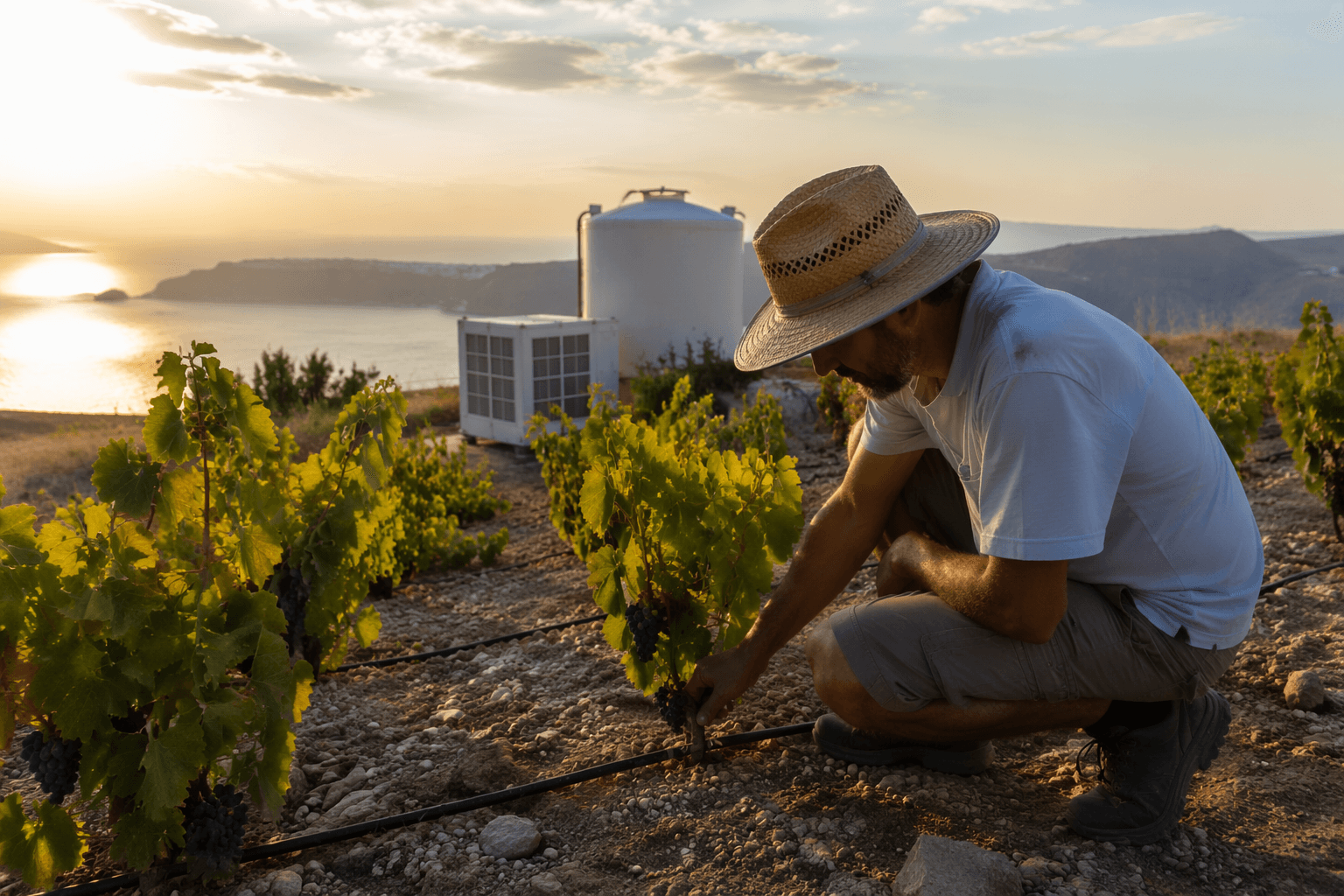
Near Oia, Yiannis Boutaris points to a dried-up kouloura vine that survived for 90 years before heat and drought finally finished it. On an island where winegrowing dates back more than 3,500 years, heat and drought have killed old vines, lifted grape prices and pushed winemakers to experiment with new ways to capture water before a celebrated heritage industry runs out of margin.
A heritage crop under modern strain
The vine is a stark symbol of what is changing on Santorini: low rainfall, searing temperatures and a narrower water budget are now shaping every decision in the field.
The island’s dominant grape, Assyrtiko, sits at the center of that pressure. Production fell from 2,500 metric tons in 2022 to just 500 tons last year, and growers are now paying farmers 10 euros a kilogram for fruit that once moved in a much less strained market. In northern Greece, by contrast, a kilo goes for only 80 cents.
Boutaris, who runs Domaine Sigalas and comes from a sixth-generation winemaking family, frames the shift as adaptation rather than surrender. The traditional vineyard layout and the island’s dry-farmed identity are still part of the story, but they are no longer enough on their own when summers are hotter and rainfall is less predictable across Greece.
Water is now the main bottleneck
Santorini’s vineyards do not compete with climate alone. Hotels, swimming pools and the broader tourism economy also draw from the same limited supply, which makes every drop more valuable and every irrigation decision more political. In 2024, tourism, drought and heat intensified water shortages on Santorini and Mykonos, turning water into a shared constraint for both agriculture and hospitality.
That broader squeeze is why growers are now looking at water reuse and low-energy irrigation as practical survival tools. The Santorini Winemakers Association is working with Aristotle University of Thessaloniki and the Santorini Municipal Water and Wastewater Company on a pilot scheme to reuse treated wastewater in vineyards, giving the effort institutional backing beyond a single estate.
If hotels and households produce treated wastewater, some of it may be redirected to vines instead of being treated as waste.
From tradition to precision
At Domaine Sigalas, the adaptation work is already visible in the ground. Ktima Sigalas is a site for smart, precision drip irrigation and water reuse on Santorini. Domaine Sigalas manages 45 hectares of vineyards in and around Oia, including 17 hectares that are newly planted.
Boutaris is also testing a shift in vineyard geometry. Instead of the traditional scattered layout, he is experimenting with rows of vines that can make irrigation more efficient, reducing losses and making water delivery easier to manage.
The vineyard is also testing atmospheric water harvesting that pulls moisture from the air and extracts it with heat generated by solar panels.
Why the economics matter as much as the climate
Santorini’s wine problem is not only agronomic, it is financial. When grapes rise to 10 euros a kilogram, the cost structure changes for wineries, growers and buyers across the island. High prices may preserve some vineyards in the short term, but they also raise the risk that smaller producers will be squeezed out if yields keep falling.
The island’s vineyard footprint has already contracted sharply. Santorini had around 1,100 hectares of vineyards in recent years, down from earlier decades. The Santorini winemakers’ association had identified weaknesses in the PDO Santorini model as early as 1993.
Assyrtiko-based PDO wines carry the island’s identity in export markets and in tourism, where visitors expect a distinct place-based story. If production keeps shrinking, the island risks losing not only volume but also the scale that helps sustain a recognized wine economy.
A warning for the Mediterranean
Professor Stefanos Koundouras of Aristotle University in Thessaloniki says Santorini reached a limit of dramatic conditions in 2023 and 2024, and he warns that the wine sector could become less sustainable across the Mediterranean if heat and dryness continue. Mediterranean agriculture is built around crops and practices that assume a seasonal balance of heat, water and soil, and that balance is now shifting.
Santorini’s response offers a preview of what adaptation may look like elsewhere: wastewater reuse, precision irrigation, solar-powered water capture and tighter vineyard planning.
This article was produced by Prism’s automated news system from verified source data, official records, and press releases, then run through automated quality and moderation checks before publishing. The system is built and supervised by the people who set the standards it runs under. Read our full AI policy.
Did this article answer your question?


