Scientists Detect Record-Breaking Neutrino, Possibly From Exploding Black Hole
A ghost particle 35 times more powerful than any neutrino ever recorded may have come from an exploding ancient black hole smaller than an atom.

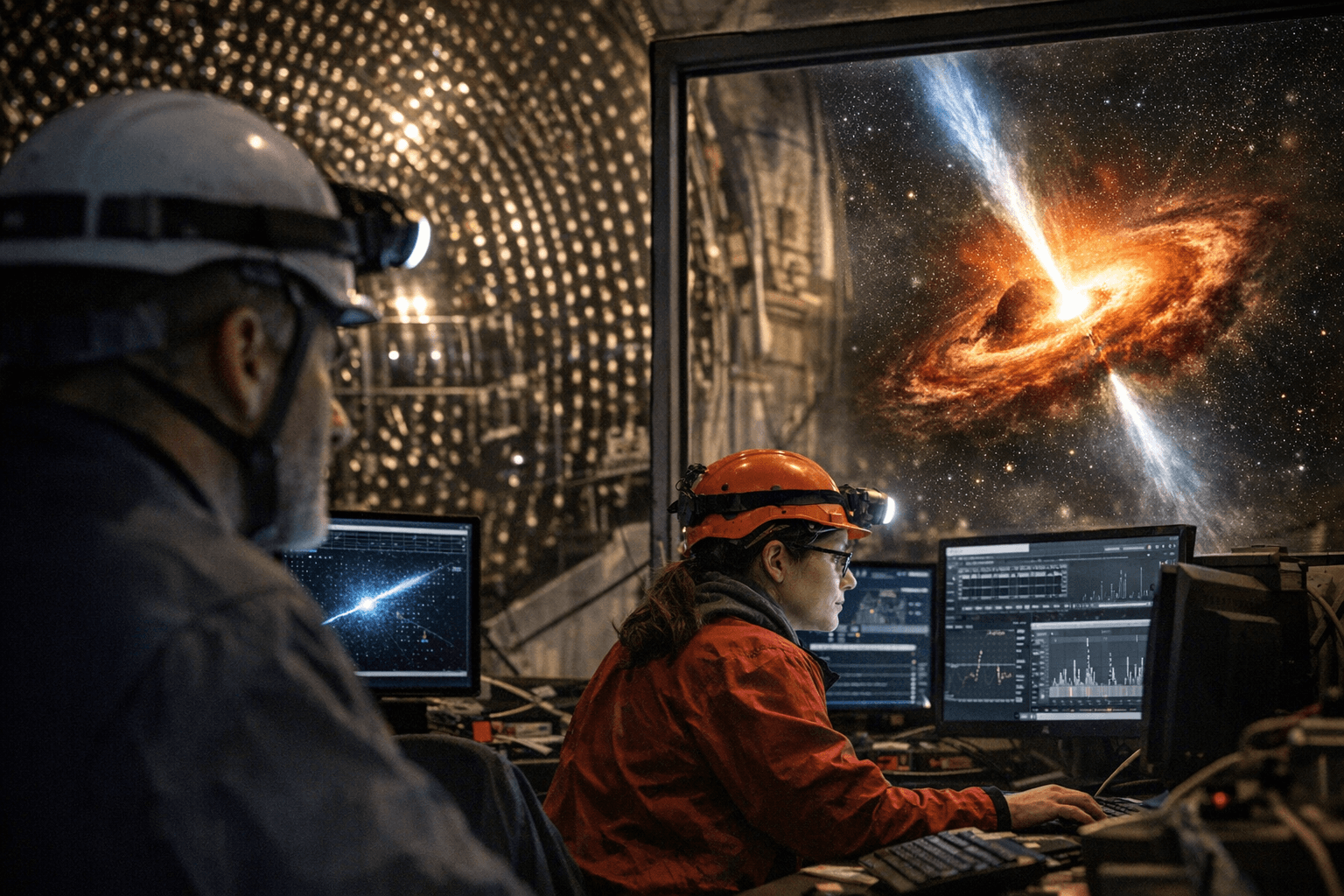
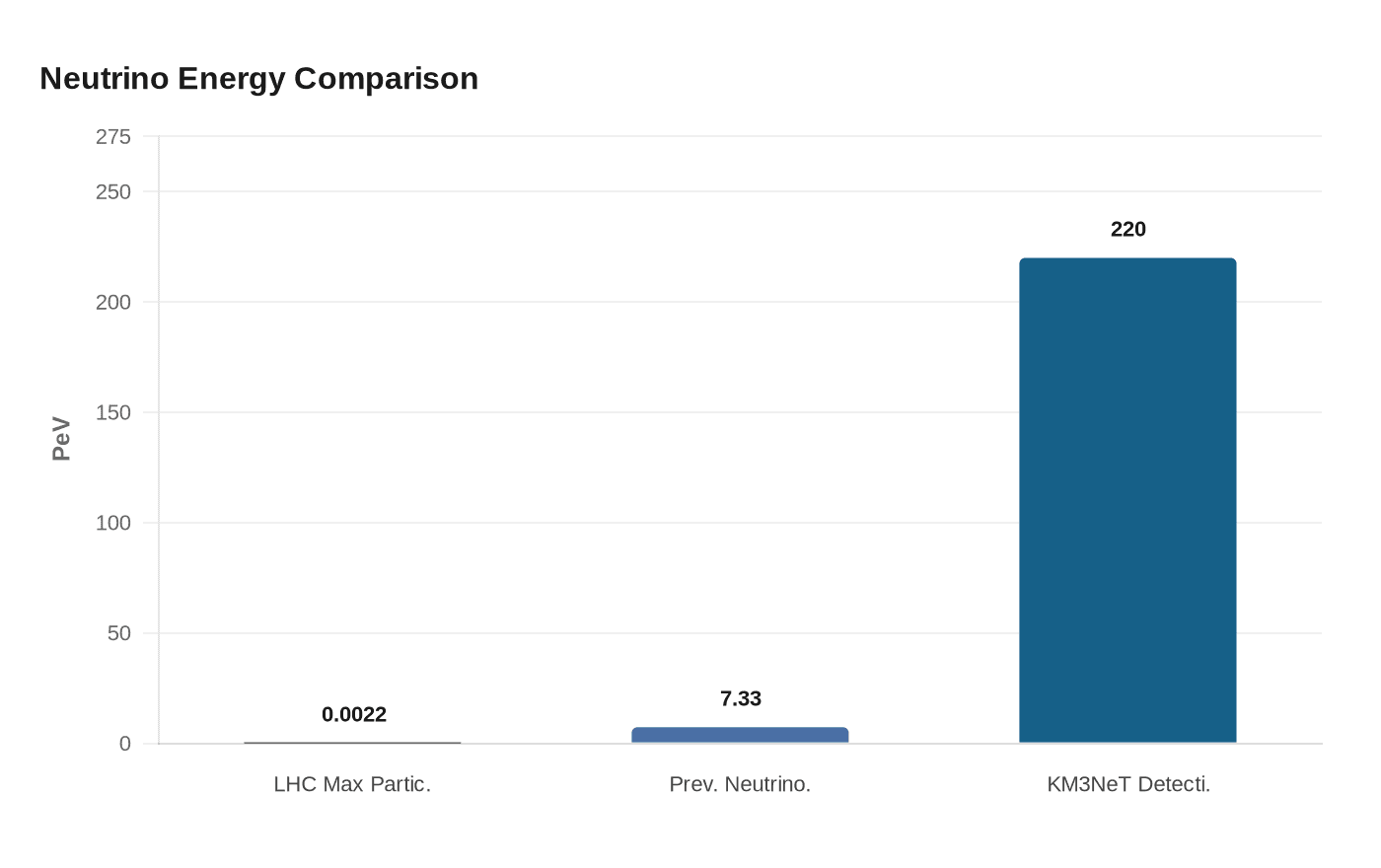
Deep in the Mediterranean Sea in February 2023, the KM3NeT collaboration's ARCA detector registered something extraordinary: a neutrino with an estimated energy of about 220 peta-electron-volts, or 220 million billion electron volts. Its energy was roughly 30 times the highest neutrino energy previously detected. For context, that energy is 100,000 times more than the highest-energy particle ever produced by the Large Hadron Collider, the world's most powerful particle accelerator. The source of that particle has baffled physicists ever since.
Now MIT physicists Alexandra Klipfel and David Kaiser have offered one of the most striking explanations yet: a black hole that formed in the first moments after the Big Bang, smaller than an atom, completing its evaporation just outside our solar system.
In a paper appearing in Physical Review Letters, MIT physicists put forth a strong theoretical case that a recently observed, highly energetic neutrino may have been the product of a primordial black hole exploding outside our solar system. The phenomenon belongs to a category that, as of now, exists only in theory.
KM3NeT's ARCA detector is mainly dedicated to the study of the highest energy neutrinos and their sources in the universe. It is located at 3,450 meters depth, about 80 kilometers from the coast of Portopalo di Capo Passero, Sicily. The excellent optical properties of Mediterranean seawater allowed the characterization of the neutrino interaction and facilitated this breakthrough in neutrino astronomy. The collaboration formally reported its findings in the journal Nature in February 2025, more than a year after the actual detection.
Understanding why this particular neutrino is so significant requires a brief detour into what neutrinos actually are. Neutrinos are the most common particle in the universe. Despite their commonality, they are incredibly difficult to detect because they interact with normal matter only through the weak nuclear force and gravity. Their invisible nature and the way they leave barely a trace of their interactions earned them the nickname "ghost particles." "This is an incredibly high energy, far beyond anything humans are capable of accelerating particles up to," Klipfel said. "There's not much consensus on the origin of such high-energy particles."
The MIT paper's theoretical engine runs on Stephen Hawking's nearly 50-year-old prediction that black holes slowly radiate energy and eventually evaporate. All black holes should slowly radiate over time. The larger a black hole, the colder it is, and the lower-energy particles it emits as it slowly evaporates. Any particles that are emitted as Hawking radiation from heavy stellar-mass black holes would be near impossible to detect. Primordial black holes, the hypothetical relics forged from density fluctuations in the first seconds after the Big Bang, are a different category entirely.
In its final nanosecond, once a black hole is smaller than an atom, it should emit a final burst of particles, including about 10²⁰ neutrinos, or about a sextillion of the particles, with energies of about 100 peta-electron-volts, around the energy that KM3NeT observed. That is the theoretical fingerprint the MIT team went looking for.
Klipfel and Kaiser found that a primordial black hole would have to explode relatively close to our solar system, at a distance about 2,000 times further than the distance between the Earth and the sun. Their calculations further showed there is an 8 percent chance that an explosion of this kind could happen once every 14 years, producing enough ultra-high-energy neutrinos to reach Earth.
"An 8 percent chance is not terribly high, but it's well within the range for which we should take such chances seriously," Kaiser said, "all the more so because so far, no other explanation has been found that can account for both the unexplained very-high-energy neutrinos and the even more surprising ultra-high-energy neutrino event."
The stakes of confirmation could hardly be higher. If such a scenario had indeed occurred, the recent detection of the highest-energy neutrino would represent the first observation of Hawking radiation, which has long been assumed but has never been directly observed from any black hole. What's more, the event might indicate that primordial black holes exist and that they make up most of dark matter, a mysterious substance that comprises 85 percent of the total matter in the universe, the nature of which remains unknown.
The theory is not without critics. Physicist Lua Airoldi doubts the idea, since a nearby explosion should have spewed other particles, like gamma rays, which were not detected. "Not seeing gamma rays would be like standing outside during a tropical storm and only feeling a single raindrop hit you," said Airoldi, of the University of São Paulo. Kaiser has countered that the proposed explosion would have been distant enough that its gamma-ray signature would fall below detectable thresholds.
The duo's hypothesis could be tested using data from future detections of peta-electron-volt neutrinos. If the proposal is correct, these particles should preferentially arrive from the Galactic Center, where the density of dark matter is greatest. Until more such neutrinos are found and their origins triangulated, the Mediterranean's ghost particle remains the most powerful and most mysterious cosmic messenger ever caught on record.
This article was produced by Prism’s automated news system from verified source data, official records, and press releases, then run through automated quality and moderation checks before publishing. The system is built and supervised by the people who set the standards it runs under. Read our full AI policy.
Did this article answer your question?


