Scientists find 27 possible new planets orbiting two stars
Astronomers identified 27 candidate planets circling two stars, a haul that could point to a hidden population of circumbinary worlds.
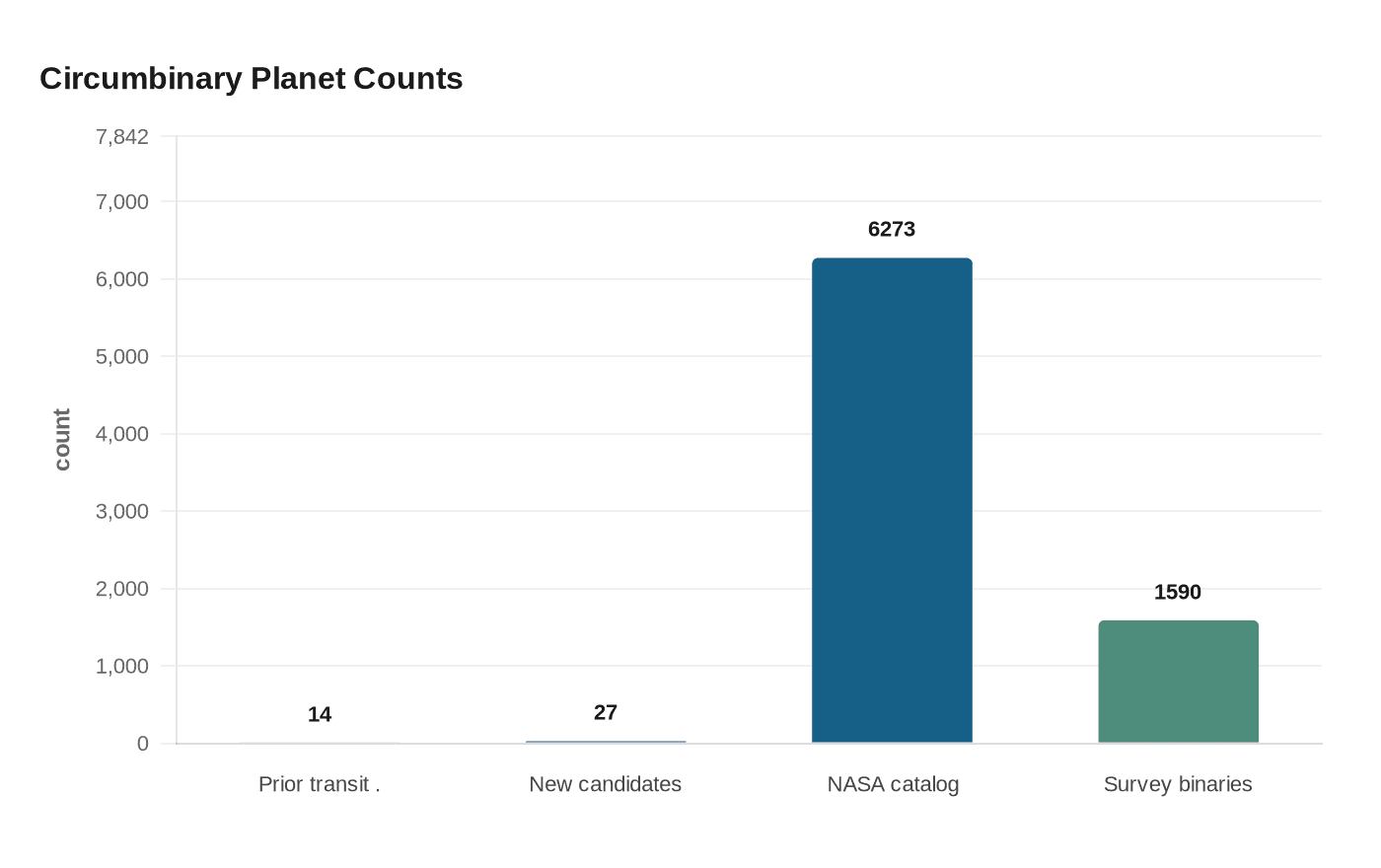
Astronomers have identified 27 possible new planets orbiting pairs of stars, a result that could sharply expand the known population of circumbinary worlds and reshape ideas about where stable planets can form. The candidates were pulled from TESS observations of 1,590 eclipsing binaries in the Gaia DR3 Catalogue of Eclipsing Binary Candidates, where the signal was not explained by gravity alone, tides, or stellar rotation.
The study reported 27 candidate circumbinary planets, plus 6 additional candidate companions with higher minimum mass. These are not yet confirmed planets. The researchers said the next step is radial-velocity follow-up, which can help break the mass-orbit degeneracy and determine whether the objects are truly planets or heavier companions.

Circumbinary planets orbit the center of mass of two stars rather than a single sun-like star. That makes them scientifically important because they test how planetary systems assemble in more chaotic environments and how far a stable world can stray from the narrow, coplanar setups most transit surveys are best at finding. ESA workshop material has described such planets as once thought to be difficult to form and long treated as science-fiction territory. Kepler and TESS changed that view, but the sample remains small.
That scarcity matters. ESA says that since Kepler-16b was discovered in 2011, only 14 circumbinary planets had been found via transit missions before this work. NASA says more than 6,000 exoplanets have now been confirmed overall, with its live catalog listing 6,273, yet the circumbinary subset remains tiny. The new findings suggest that the true population may be much larger than the transit record indicates.
The bias is built into the search method. Transit surveys are most sensitive to planets whose orbits line up neatly with their binary stars, leaving wider or misaligned systems largely invisible. By using apsidal precession, the study opens another path to planets that do not transit cleanly, which could widen the map of where planets survive around double stars. The paper was received on Dec. 8, 2025, accepted on March 11, 2026, and published in 2026, marking a significant step in the fast-growing search for worlds in binary systems.
This article was produced by Prism’s automated news system from verified source data, official records, and press releases, then run through automated quality and moderation checks before publishing. The system is built and supervised by the people who set the standards it runs under. Read our full AI policy.
Did this article answer your question?


