Scientists Measure Black Hole Jet Power, Equal to 10,000 Suns
For the first time, astronomers measured a black hole jet in real time, finding Cygnus X-1's outflow rivaled 10,000 suns.
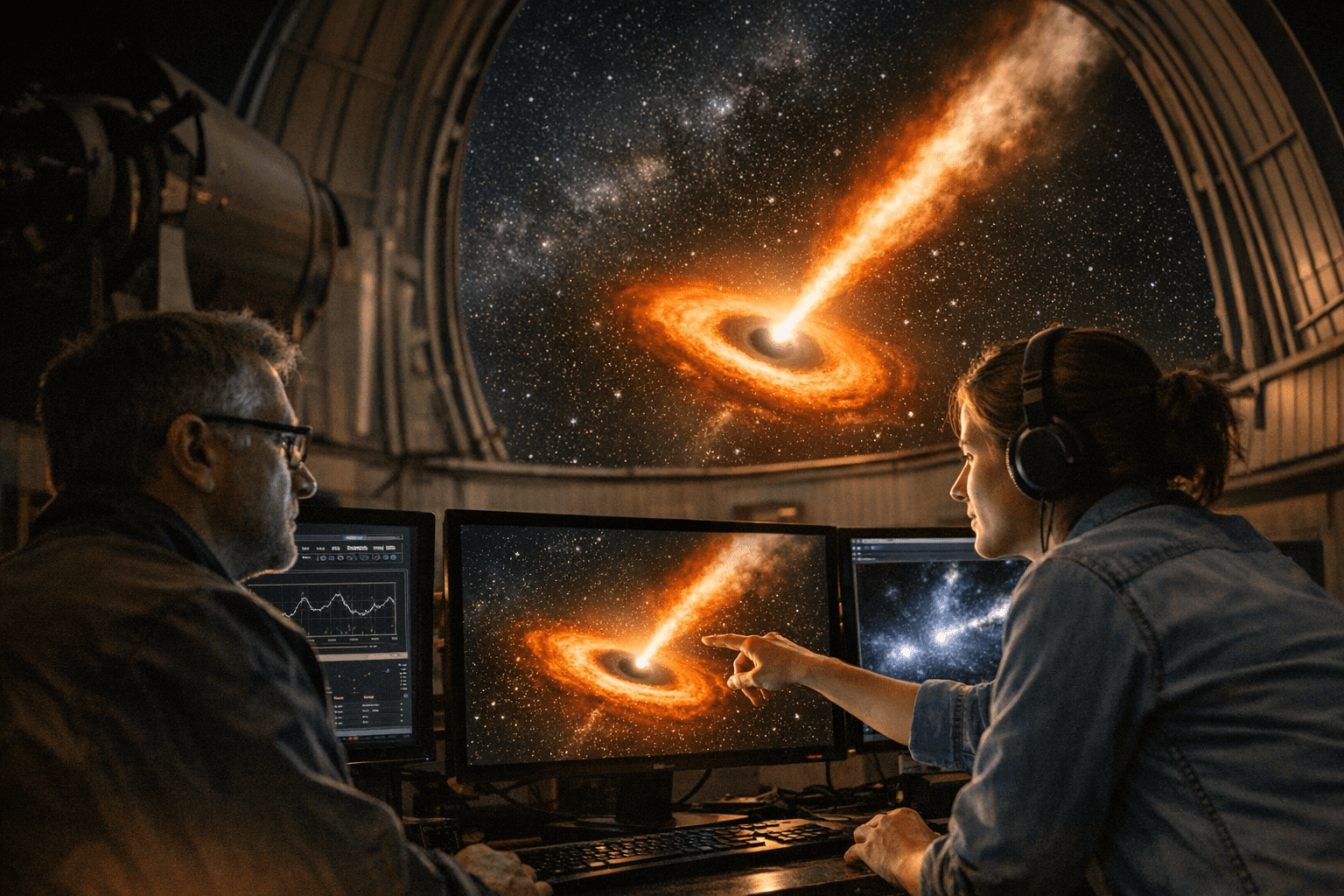
Astronomers have finally put a number on a famous black hole jet as it was happening, and the figure is startling: the outflow from Cygnus X-1 was measured at the equivalent of about 10,000 suns, moving at roughly 150,000 kilometers per second, close to half the speed of light.
That matters because black hole jets have long been seen as one of the universe’s most powerful engines, but their peak power has been difficult to catch directly. Until now, scientists usually had to infer jet energy from features built up over very long periods, sometimes tens of thousands of years, or rely on assumptions drawn from the cavities and bubbles those jets left behind.
The new measurement came from 18 years of high-resolution radio imaging, which allowed Steve Prabu, working with colleagues at the University of Oxford and Curtin University, to track how the jets were bent and shoved by the wind from Cygnus X-1’s blue supergiant companion. As the two objects orbited one another, the stellar wind repeatedly deflected the jets, giving researchers a way to estimate the instantaneous kinetic power rather than a long-term average.
The paper in Nature Astronomy reported log10(Ljet/erg s−1)=37.3, with an uncertainty of +0.1 and -0.2. Oxford said that means about 10% of the energy released as matter falls into the black hole was carried away by the jets. That makes the result especially important for galaxy-formation simulations and black-hole accretion models, both of which have had to lean on rough estimates of how much energy jets inject into their surroundings.
Cygnus X-1 has been a landmark object for decades. It was first proposed as a black hole in 1972, and a 2005 Nature paper argued that a large ring-like structure around the system, about 5 parsecs across, had likely been inflated by the inner radio jet. The new work updates that classic system with modern data and turns a long-suspected phenomenon into something measurable in real time.
For astronomers, the payoff is broader than one binary system 7,200 light-years away in Cygnus. A direct jet-power measurement gives a firmer basis for understanding how matter falling toward a black hole is converted into energy and then expelled, shaping the gas, stars and larger environment around some of the most extreme objects in the Milky Way.
This article was produced by Prism’s automated news system from verified source data, official records, and press releases, then run through automated quality and moderation checks before publishing. The system is built and supervised by the people who set the standards it runs under. Read our full AI policy.
Did this article answer your question?