Chef Robotics expands AI robot arms beyond factories into smaller kitchens
Chef Robotics says 102.7 million servings helped save its automation business after a fast-casual pivot failed, pushing it from factories toward airline catering and ghost kitchens.

Chef Robotics has survived in a category that has swallowed many automation startups by abandoning the hardest part of restaurant robotics and rebuilding around food manufacturing, where repetitive work and high-volume production make the numbers work better. The San Francisco company says its AI-guided robot arms have completed more than 102.7 million servings in production across seven North American cities, while posting 300% year-over-year growth.
That growth reflects a sharp change in strategy. Chef Robotics was founded in 2019 with a plan to automate fast-casual restaurants, but Rajat Bhageria says the company found stronger demand in factories and other large-scale kitchens. Today its customers include Amy’s Kitchen, Chef Bombay, Cafe Spice, Sunbasket, F&S Fresh Foods, CookUnity, Avatar Foods and Project Open Hand, along with one of the largest school lunch providers in the country. The company also raised $43.1 million in Series A financing in 2025, including $20.6 million in equity and $22.5 million in equipment financing debt, underscoring how much capital food robotics still requires before it can show durable unit economics.
The pitch is not about novelty. Chef says its robots are built for high-mix food environments and can handle wet, sticky and delicate ingredients while improving consistency and reducing giveaway. On its website, the company says customers have seen 2-3x output, 88% lower giveaway, 60% higher labor productivity and 30% higher consistency. In an industry where thin margins can be wiped out by ingredient waste or slow, unreliable labor, those gains are the difference between a demo and a lasting deployment.
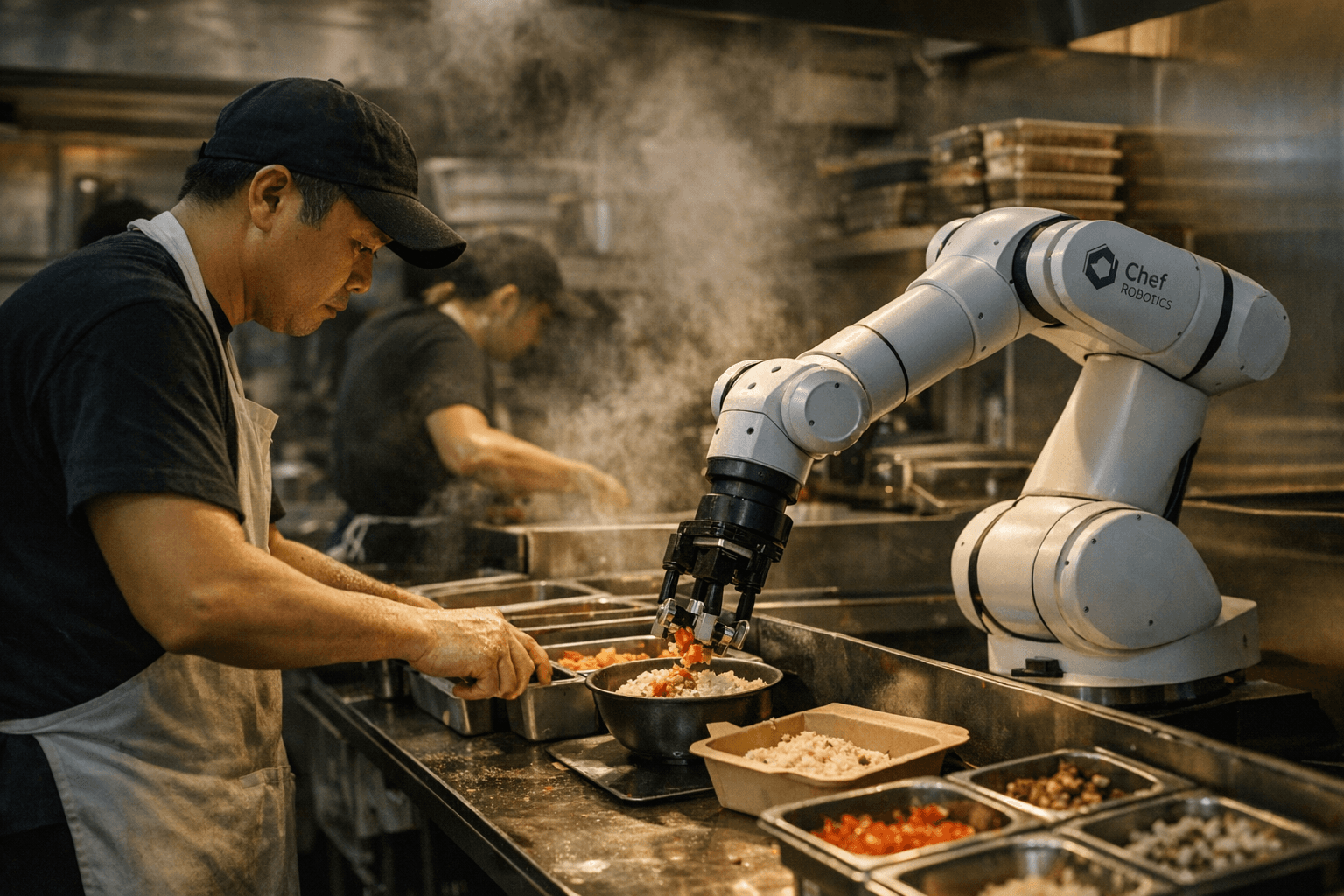
Chef’s survival also depends on the environment it chooses. Food manufacturing, unlike many restaurant kitchens, can offer standardized workflows, stable volumes and a clearer business case for automation. Bhageria says the company’s data flywheel is strengthening that case: more than 100 million servings of production data now feed AI models for food handling and packaging, making the system smarter as it handles more meals. The robots also received NSF certification for food safety in 2025, a credential Chef says helps customers meet compliance requirements and trust the system in food assembly.
Now the company is trying to move beyond factories without returning to the restaurant automation graveyard that buried earlier efforts. Bhageria says Chef is targeting what it calls smaller kitchens, including ghost kitchens, airline catering, stadiums and prisons. One of its newer customers, he says, is one of the largest airline catering companies in the world. The expansion suggests Chef is betting that automation survives not by replacing every kitchen, but by choosing the ones where labor is hardest to find and the economics are hardest to ignore.
This article was produced by Prism’s automated news system from verified source data, official records, and press releases, then run through automated quality and moderation checks before publishing. The system is built and supervised by the people who set the standards it runs under. Read our full AI policy.
Did this article answer your question?