Scientists say interstellar comet 3I/ATLAS may be oldest ever seen
A comet from beyond the solar system may also be a fossil from the early Milky Way, with chemistry pointing to an origin 10 to 12 billion years ago.
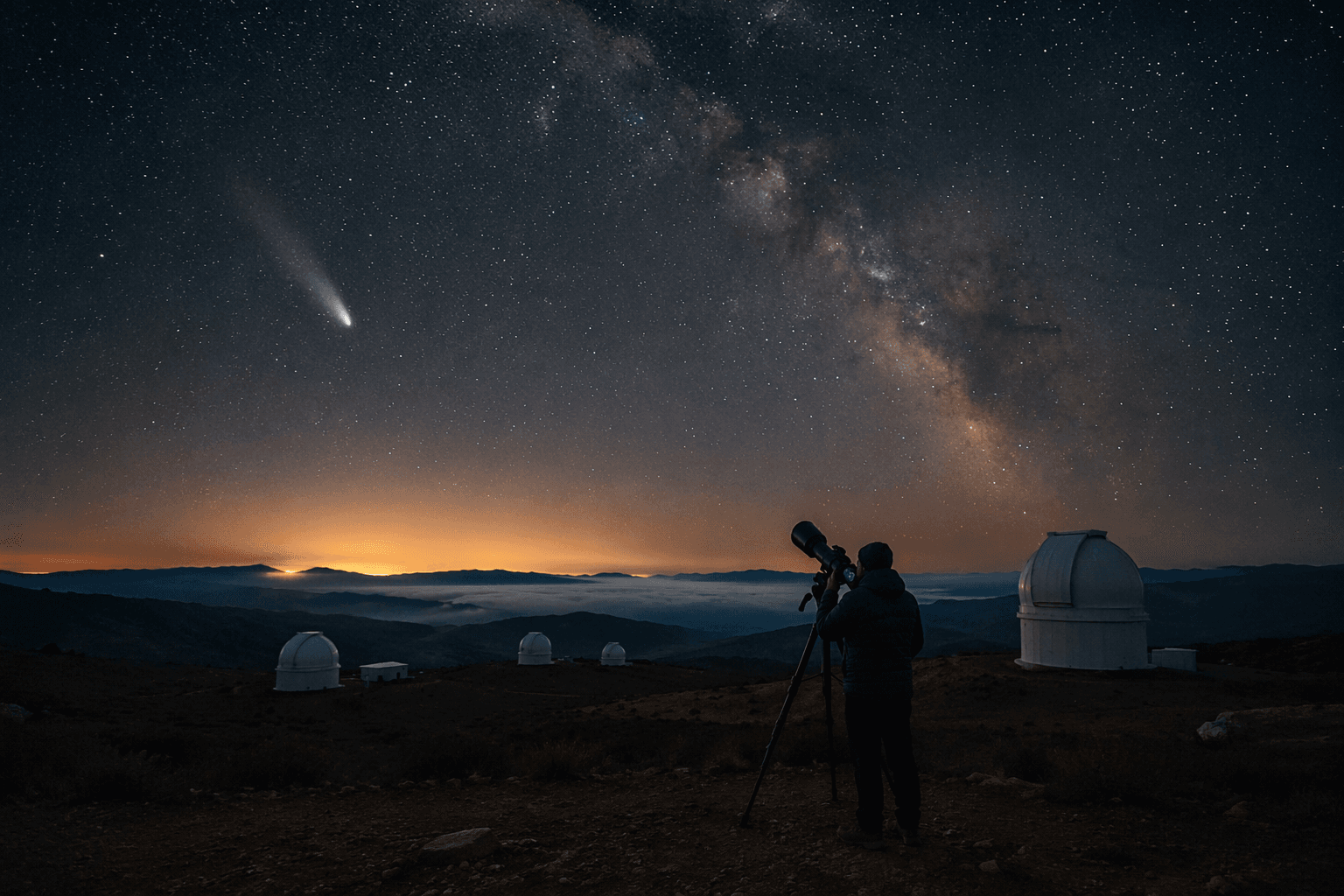
A traveler from beyond the Sun is now being described as a relic of the early Milky Way. Scientists say interstellar comet 3I/ATLAS may be 10 to 12 billion years old, a span that would make it older than Earth and possibly the oldest object ever observed passing through the solar system.
The claim rests on chemistry, not guesswork. Using the James Webb Space Telescope’s NIRSpec instrument, researchers found carbon and deuterium ratios in the comet that do not match Solar System comets. Martin Cordiner of NASA’s Goddard Space Flight Center led the Webb study, which reported deuterium levels about 30 times higher than those seen in comets that formed near the Sun. An arXiv version of the work said the water had a deuterium-to-hydrogen ratio of 0.95 percent, while carbon isotope ratios in carbon dioxide and carbon monoxide were also higher than typical Solar System values.
That unusual fingerprint points to a very different birthplace. The team inferred that 3I/ATLAS formed in a cold, relatively metal-poor environment at temperatures at or below about 30 kelvin, then was later ejected from its home system and sent drifting through interstellar space. Because the comet appears to preserve material from a planetary system formed during an early burst of star formation, scientists say it offers a rare glimpse of how galaxies assembled the raw ingredients for planets long before the Sun existed.
3I/ATLAS is only the third confirmed interstellar object ever identified in the solar system, after 1I/'Oumuamua in 2017 and 2I/Borisov in 2019. NASA says the object was found by the NASA-funded ATLAS survey telescope in Rio Hurtado, Chile, and reported to the Minor Planet Center on July 1, 2025. The agency estimates its nucleus is between 1,400 feet and 3.5 miles wide, and says it was moving about 137,000 miles per hour when discovered, later reaching about 153,000 miles per hour at perihelion on Oct. 30, 2025, when it passed about 1.4 astronomical units from the Sun, just outside Mars’ orbit.
The comet never threatened Earth, coming no closer than 170 million miles. Earlier ALMA observations, published in Nature Astronomy on April 23, 2026, found deuterated water in the object for the first time in an interstellar body, with a water deuterium-to-hydrogen ratio about 40 times that of Earth’s oceans and about 30 times the average for Solar System comets. Together, the measurements make 3I/ATLAS less a passing curiosity than a time capsule, carrying evidence of how icy bodies formed in another era, around another star, in a galaxy still taking shape.
This article was produced by Prism’s automated news system from verified source data, official records, and press releases, then run through automated quality and moderation checks before publishing. The system is built and supervised by the people who set the standards it runs under. Read our full AI policy.
Know something we missed? Have a correction or additional information?
Submit a Tip