Secret Reveals Killer in 1999 Beaumont Mom Kimberly Langwell Case
A tow truck driver’s decades-old secret led investigators to a 3-by-5-foot void under a Beaumont bedroom floor, where Kimberly Langwell’s remains were found wrapped in a blanket.
A quarter-century after Beaumont mother Kimberly Langwell vanished on her way home to dinner plans, investigators found her buried under a bedroom slab after a longtime confidant finally disclosed what he said he knew in 1999: that Terry Rose had killed her and poured concrete over the grave.
Langwell, 34, disappeared after work on Friday, July 9, 1999. By the next day, Beaumont Police Detective Joe Ball was called to a strip mall parking lot in front of what was then an Eckerd Pharmacy after Langwell’s car was located there. Her 15-year-old daughter, Tiffani McInnis, and Langwell’s sister, Susan Butts, were present as police examined the vehicle. Langwell’s boyfriend at the time, Ken Weatherford, had contacted McInnis and was also the person who discovered the abandoned car the night Langwell disappeared.
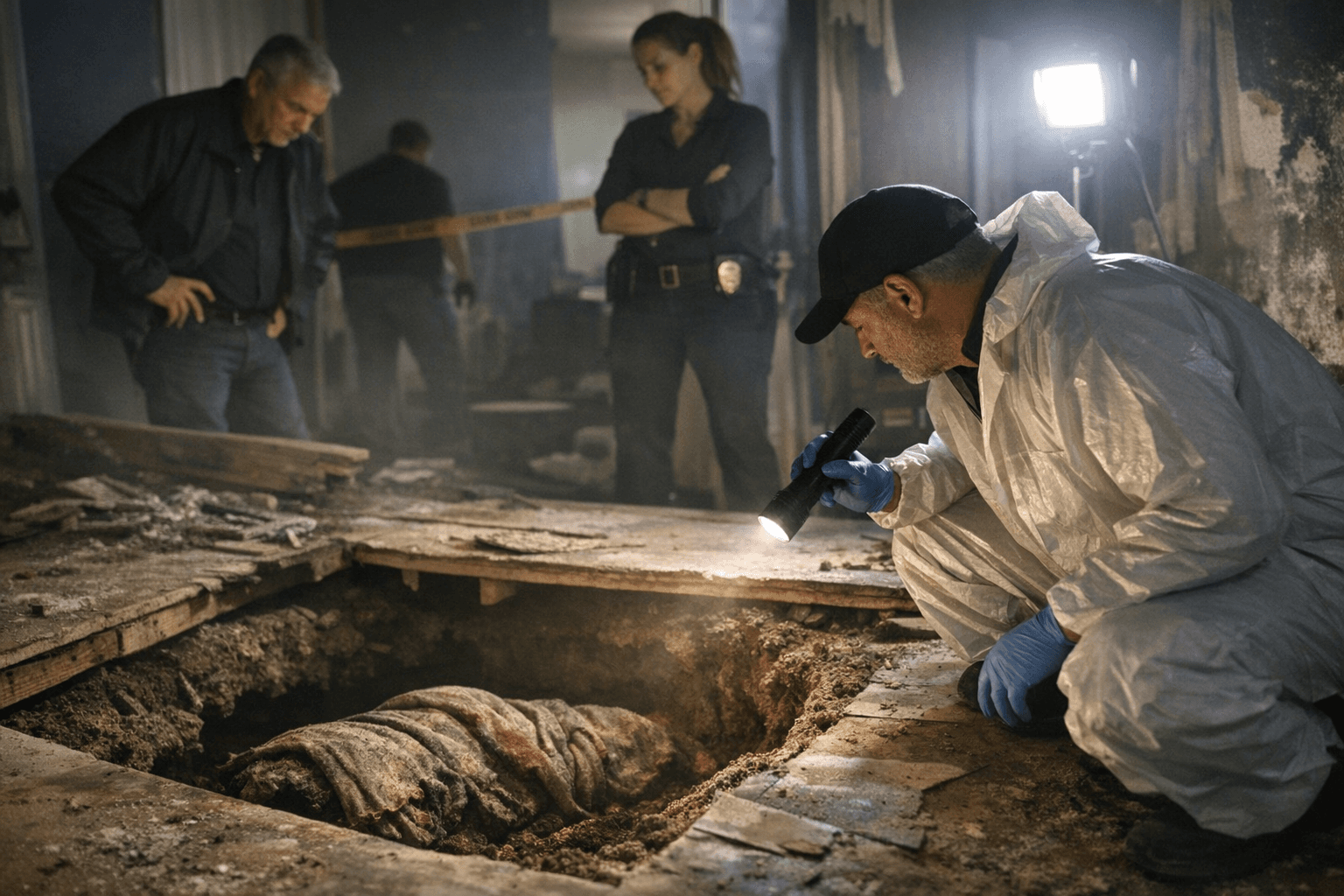
The investigative break came from outside the traditional forensic pipeline. Beaumont Police obtained a search warrant for Rose’s Lindbergh Drive property, citing information characterized as coming from a “reliable informant,” and the case accelerated through grand jury activity in 2024. Search activity began June 10, 2024, and the FBI joined later that week. Texas EquuSearch, a volunteer search organization led by Tim Miller, brought ground-penetrating radar that flagged an anomalous area roughly 3 feet by 5 feet beneath a bedroom floor, a section that lacked expected reinforcement. Investigators cut into the concrete and excavated by hand. Remains found wrapped in a blanket were scientifically confirmed as Langwell’s on July 23, 2024.
Legally, the discovery transformed an old disappearance into a provable homicide with a body, a shift that matters in court because Texas requires evidence beyond an out-of-court confession that a crime occurred. Prosecutors initially charged Rose with capital murder, then resolved the case through a plea: Rose pleaded guilty to murder on Dec. 2, 2025, under an agreement capped at 40 years. Judge Raquel West sentenced him to the maximum 40 years on Dec. 16, 2025, with parole eligibility only after serving half the term, a timetable that pushed potential eligibility to roughly age 88.
At sentencing, David Wiley, described as a former tow truck driver for Rose, testified that Rose confessed shortly after the disappearance that he shot Langwell in the back of the head and buried her beneath the bedroom slab. Wiley said he kept the information to himself in 1999 and disclosed it to a grand jury in 2024. Separately, a wrongful death lawsuit was filed against Rose by the law firm Provost Umphrey.
The human cost is written into the time line. McInnis described her mother as “an amazing mom,” and family friend Esther Randall, who called Langwell “Mimi,” rejected the idea that she would abandon her child. Miller called the recovery the “best possible” outcome under the circumstances.
The case also lands amid a national backdrop of strained investigative capacity. The Bureau of Justice Statistics estimated 19,800 homicide victimizations in the U.S. in 2023, and reported that about 47% were cleared by arrest, a clearance gap that leaves thousands of families in long waits for answers. In that context, Langwell’s case shows how modern cold-case solves increasingly hinge on targeted warrants, interagency evidence teams, volunteer technology like ground-penetrating radar, and late-breaking insider testimony, even as key unknowns remain about Langwell’s final movements, the missing personal items from her car, and why the killing happened at all.
This article was produced by Prism’s automated news system from verified source data, official records, and press releases, then run through automated quality and moderation checks before publishing. The system is built and supervised by the people who set the standards it runs under. Read our full AI policy.
Did this article answer your question?