Semrush updates SEO authority playbook for AI search era
Authority is no longer a backlink contest. Semrush’s new framing gives agencies a cleaner way to sell trust, clarity, and AI-readability.
Authority is now a client education problem
Authority used to be the easiest shorthand in SEO. A bigger backlink profile, a stronger domain metric, a better chance to rank. Semrush’s latest authority guide pushes that idea into sharper territory: authority now has to work for search engines, AI systems, and the humans approving the retainer. For agencies, that makes authority less of a score to brag about and more of a system to explain, prove, and report.
The shift matters because visibility is no longer decided only on the blue-link results page. Google’s automated ranking systems are built to prioritize helpful, reliable information created for people, and they evaluate signals across hundreds of billions of web pages and other content. At the same time, AI search features are changing what users see, what they click, and what gets remembered. If a client still thinks authority is just about “more links,” the agency is already behind.
Why the old authority shorthand is breaking down
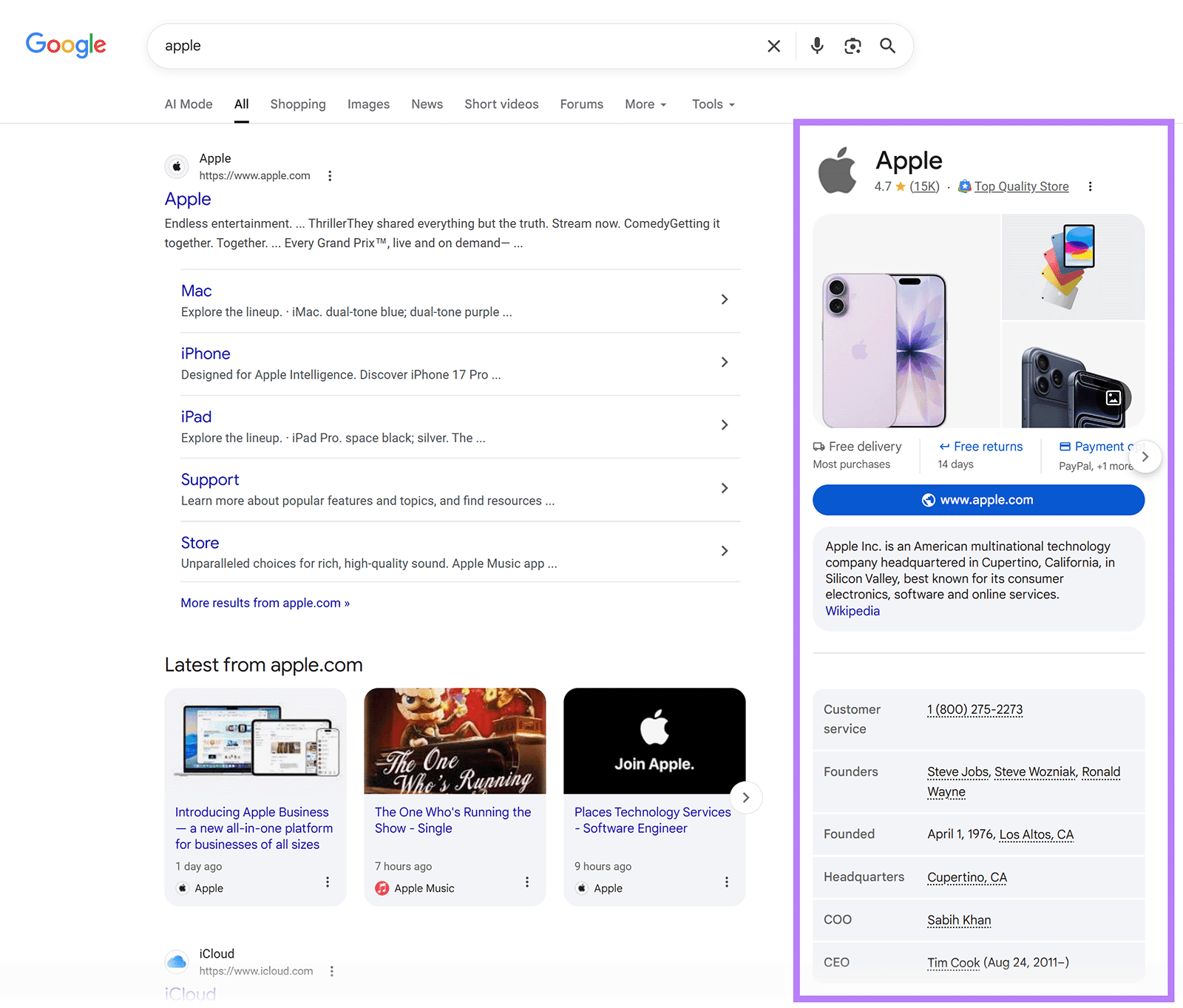
Semrush separates three ideas that agencies often blur together: website authority, brand authority, and entity authority. Website authority is the site-level picture, shaped by backlinks, content quality, organic traffic, and technical health. Brand authority is broader market credibility. Entity authority is how well machines can connect a brand to the right people, topics, and offerings.
That distinction is useful because it explains why generic link building no longer carries the whole argument. A site can accumulate links and still fail to look consistent, trustworthy, or machine-readable. In the AI era, the strongest authority signals are the ones that line up across the site, the brand, and the entity layer: clear topical depth, expert attribution, consistent brand mentions, high-intent links, and structured data that helps systems extract the right facts quickly.
Moz’s long-running metrics show how the industry once tried to quantify these ideas separately. Moz defines Domain Authority as a comparative estimate of how well a domain will perform in organic search, and Brand Authority as a 1 to 100 measure of total brand strength. Semrush’s framing takes that older split and pushes it one step further, toward entity clarity and machine readability.
What agencies can actually influence
The practical opportunity is that authority is still buildable. It just needs to be managed as a coordinated program instead of a grab bag of SEO tasks. Semrush’s guide points agencies toward five levers that can be packaged together, and each one is something a client can understand when it is tied back to trust and visibility.
- Topical depth: Build content clusters that cover a subject thoroughly instead of publishing disconnected posts that never reinforce one another.
- Expert attribution: Put real names, credentials, and editorial ownership on content so the site looks like it comes from people who know the topic.
- Structured data: Mark up content so search engines and AI systems can extract entities, services, authors, and relationships without guessing.
- Brand mentions and off-site support: Earn mentions from reputable sources that confirm the brand exists beyond its own website.
- High-intent links: Focus on links that make sense contextually and come from pages that support the topic, not just any page with authority.
That mix is what turns authority from a vague promise into a reporting framework. It gives agencies a reason to stop selling isolated deliverables and start selling authority development programs that combine content, link acquisition, digital PR, and technical work into one story clients can follow.
Semrush is turning authority into a reporting language
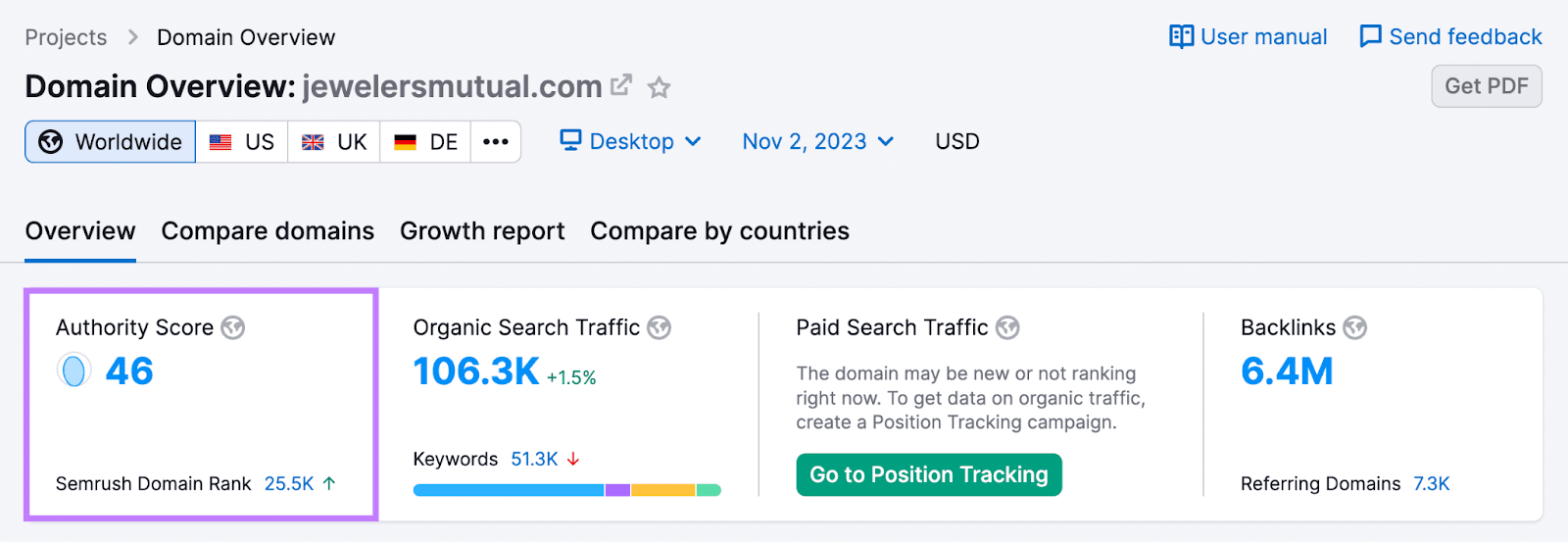
Semrush is clearly trying to make that story easier to package. Its Authority Score is a compound metric graded on a 0 to 100 scale, and Semrush says it is based on multiple signals, including backlink strength and spam signals. That makes it useful as a benchmark in client conversations, especially when the goal is to show progress over time rather than promise a magic ranking jump.
The company’s Domain Overview report now goes further by placing authority alongside organic search, paid search, backlink authority, and AI search visibility. That matters because it reflects how agencies actually work today. A client does not experience authority in a vacuum. They experience it through a mix of rankings, traffic, paid media performance, brand presence, and the increasingly visible layer of AI-driven search surfaces.
For agency reporting, that creates a cleaner narrative: instead of showing one number and calling it success, show how authority is moving across the site, the brand, and the entity footprint. If the score rises but the content remains thin, the attribution is weak, or the brand is absent from third-party coverage, the report should say so.
The business case got stronger as AI search changed click behavior
The urgency comes from user behavior, not just SEO theory. Pew Research Center found that 58% of respondents encountered at least one Google search with an AI-generated summary in March 2025, and users were less likely to click links when a summary appeared. Pew also found that users very rarely clicked on the sources cited in those summaries, which is a blunt reminder that visibility and traffic are no longer the same thing.
Other studies point in the same direction. Ahrefs reported that AI Overviews were associated with a 34.5% lower average click-through rate for the top-ranking page on informational keywords. A Seer Interactive study, as summarized by Search Engine Land, found organic click-through rates down 61% on informational queries with AI Overviews since mid-2024. Google has also expanded AI Overviews to more than 200 countries and territories and more than 40 languages, and said at I/O 2025 that the feature had reached 1.5 billion monthly users.
That scale changes the agency pitch. A client is no longer just buying a path to page-one rankings. They are buying a position in a search environment where answers are increasingly mediated by AI, and where the source of truth must be clear enough to survive extraction, summarization, and the loss of a click.
How to reposition authority for 2026
The strongest agencies will treat authority as a trust system they can document, not a score they can oversell. That means building client education around three ideas: authority is layered, authority is measurable, and authority is shared across SEO, PR, content, and structured data.
A useful internal playbook looks like this:
1. Map the client’s current website authority, brand authority, and entity authority separately.
2. Identify the pages and topics that need deeper expertise, clearer attribution, and stronger source support.
3. Build a reporting model that pairs Semrush’s Authority Score with evidence of topical coverage, mentions, links, and structured data growth.
4. Tie every recommendation to how search engines and AI systems evaluate trust, not just to how a keyword chart looks.
That is the real update in Semrush’s playbook. Authority is no longer a single SEO checkbox, and it is definitely not just a third-party metric to wave around in a sales deck. In the AI search era, agencies win when they can show clients how trust is built, how machines read it, and how that same foundation still supports long-term visibility across search, answers, and the next interface that sits between the brand and the audience.
Sources:
Know something we missed? Have a correction or additional information?
Submit a Tip