Senate Republicans strip Trump ballroom funding from immigration bill
Republicans cut Trump’s ballroom money from the immigration bill after a rules clash and enough intraparty resistance to threaten the broader package. The vote exposed the limits of loyalty.

Senate Republicans removed up to $1 billion in White House ballroom-related security money from a major immigration enforcement bill on June 3, 2026, then pushed the revised package forward on a 53-46 party-line vote. The move spared a $72 billion reconciliation bill that would finance Department of Homeland Security immigration agencies, including Immigration and Customs Enforcement and Customs and Border Protection, through fiscal year 2029.
The decision was as much about arithmetic as it was about politics. Republicans held only 53 Senate seats, which left little room for defections if the bill needed to survive with some Democratic support. Senate leaders concluded the ballroom language risked derailing the larger measure both procedurally and politically, especially after Senate parliamentarian Elizabeth MacDonough ruled in May that the earlier version ran afoul of reconciliation rules under the Byrd Rule because it fell outside the Judiciary Committee’s jurisdiction.
The removed money had been folded into the security side of the bill for what the White House described as a response to an alleged assassination attempt against Donald Trump at the White House Correspondents’ Association Dinner at the Washington Hilton on April 25, 2026. Administration officials said only about $200 million of the request would have gone directly to the ballroom, with the rest earmarked for Secret Service upgrades. But several Republicans objected to using taxpayer money for the president’s East Wing project, and GOP leaders were bracing for a furious reaction from Trump if the funding disappeared.
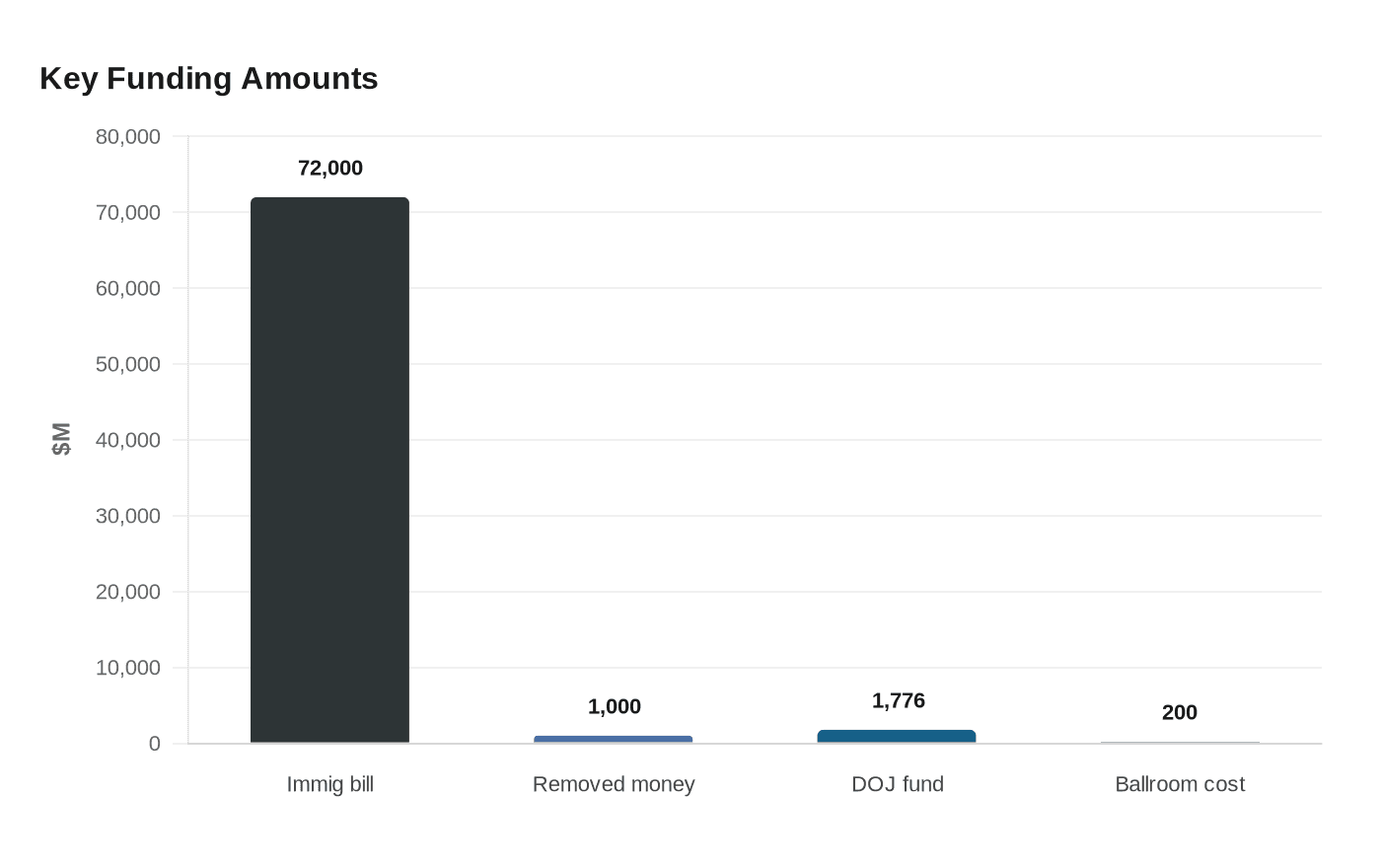
The fight over the ballroom came on top of an earlier intraparty collision over a separate Justice Department “anti-weaponization fund.” The U.S. Department of Justice announced a $1.776 billion compensation fund on May 18, 2026, to hear claims from people alleging harm from government overreach, including Trump allies, before acting Attorney General Todd Blanche later told Congress the department was not moving forward with it. That dispute had already slowed the immigration bill, underscoring how quickly reconciliation can become a battleground for unrelated White House priorities.
Trump has promoted the ballroom as a major modernization of the White House complex. The White House says the State Ballroom would be about 90,000 square feet, seat 650 people, cost about $200 million and begin in September 2025, replacing the East Wing, which was built in 1902 and later modified, including a second story added in 1942. The East Wing fight now stands as an early test of whether Senate Republicans will police Trump’s spending ambitions when those ambitions collide with budget rules, and whether loyalty still has limits in a narrow chamber.
This article was produced by Prism’s automated news system from verified source data, official records, and press releases, then run through automated quality and moderation checks before publishing. The system is built and supervised by the people who set the standards it runs under. Read our full AI policy.
Know something we missed? Have a correction or additional information?
Submit a Tip