Serious Eats Tests Step-by-Step Method for Making Fresh Pasta at Home
Learn Serious Eats' tested, step-by-step method for making fresh pasta at home, including dough building, machine rolls, portioning, freezing, and quick cooking tips.
%3Amax_bytes(150000)%3Astrip_icc()%2F__opt__aboutcom__coeus__resources__content_migration__serious_eats__seriouseats.com__images__2014__12__20141222-pasta-making-collage-eggs-6047a06df8a541e89fac5103391863db.jpg&w=1920&q=75)
Fresh pasta is a rewarding weekend project that pays off in texture and speed at the stove. Below is Serious Eats’ tested, step-by-step method, laid out so you can follow the exact procedural cues and practical handling tips for building dough, rolling it through a pasta maker, shaping nests, freezing, and cooking.
1. Choosing flour and eggs
Serious Eats frames the process as starting with choosing flour and eggs, but the supplied excerpts do not list specific flour types or exact ratios. Treat this step as a reminder: you need flour, whole eggs and egg yolks, and salt to begin; the guide calls out the importance of choosing ingredients but does not provide brand names, flours, or quantities in the provided text. If you want to experiment, note that the article treats ingredient choice as the foundation, plan to test what your pantry yields and follow the measured cues later in the process.
2. Make the dough
Follow Serious Eats’ hands-on beginning: “On a large, clean work surface, pour flour in a mound. Make a well in the center about 4 inches wide. Pour whole eggs, egg yolks, and salt into well and, using a fork, beat thoroughly. When combined, gradually incorporate flour into the eggs until a wet, sticky dough has formed.” Work on a large surface so you can incorporate flour gradually and see the dough’s transition from slurry to a wet, sticky mass, this visual cue is central when you don’t have weights.
3. Scrape, fold and develop the dough with a bench knife
Once the egg-and-flour mixture comes together, use a bench knife to keep things tidy and to help gluten development: “Using a bench knife, scrape excess dough from fork and fingers. Begin to fold additional flour into the dough with the bench knife, turning the dough roughly 45 degrees each time, until dough feels firm and dry, and can form a craggy-looking ball, 2 to 5 minutes.” This is your initial kneading stage, short, mechanical, and visual. Aim for a craggy-looking ball and the 2–5 minute window as your benchmarks rather than an exact number of strokes.
4. Resting the dough (noted but unspecified)
Resting the dough is listed as a step in the high-level guide, but the supplied excerpts do not include a resting time or method. Treat resting as an explicit stage in Serious Eats’ sequence, plan to cover your bases by allowing the dough to relax before heavy rolling, but follow any timing from your fuller recipe source if you want a precise rest period. The guide emphasizes the step without giving a time in the provided notes, so don’t skip this pause if you encounter tougher dough.
5. Set your pasta maker to the widest setting and begin passes
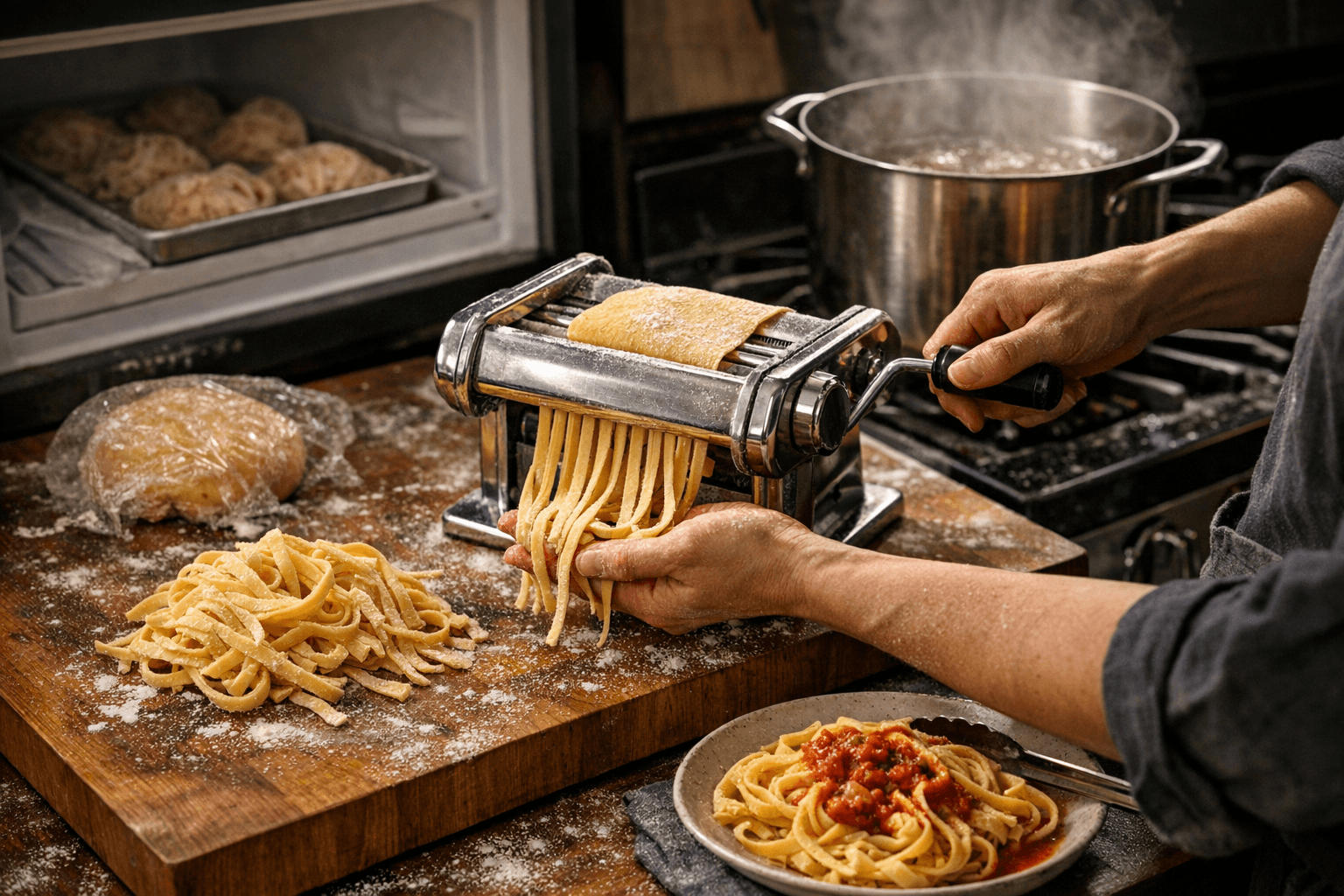
When you move to the machine, start wide and be consistent: “Set pasta maker to widest setting and pass dough 3 times through the machine at this setting.” Repeating three passes at the widest setting helps compress and align gluten strands without over-thinning the sheet. Keep the sheet fairly uniform and lightly floured as needed to prevent sticking; these initial passes prime the dough for folding and additional thinning.
6. Fold, flatten to 1/2-inch, and pass through the rollers
After the initial machine passes, shape and compress the sheet for finer results: “Place dough on a lightly floured work surface. Fold both ends in so that they meet at the center of the dough, and then fold the dough in half where the end points meet, trying not to incorporate too much air into the folds. Using rolling pin, flatten dough to 1/2-inch thick. Pass through the rollers 3 additional times.” These folds concentrate the dough, and the rolling-pin flattening to a 1/2-inch thickness gives the machine a consistent starting thickness for those additional passes. Avoid bringing air into the dough when folding, air pockets can cause bubbles later when rolling thin.
7. Narrow the roller setting bit by bit until the dough is delicate and slightly translucent
Thin the sheet gradually, one notch at a time: “Narrow the setting by 1 notch and repeat Step 7. Repeat once more (the dough should now have passed through the third widest setting). Continue passing the dough through the rollers, reducing the thickness by 1 setting each time until it reaches the desired thickness. It should now be very delicate and elastic to the touch, and slightly translucent.” The guide emphasizes a measured progression: don’t jump settings or force the dough too thin at once. The tactile and visual cues, very delicate, elastic, slightly translucent, are your endpoint signals.
8. Divide, portion, dust, curl into nests, and store or freeze
After cutting noodles, handle portions gently: “Divide the cut noodles into individual portions, dust lightly with flour, and curl into a nest. Place on parchment-lined rimmed baking sheet and gently cover with kitchen towel until ready to cook.” For longer storage: “Pasta can be frozen directly on the baking sheet, transferred to a zipper-lock freezer bag, and stored in the freezer for up to 3 weeks before cooking. Cook frozen pasta directly from the freezer.” The nest format is community-tested for portioning; freezing on a sheet first prevents clumping, then bagging preserves space in your freezer. Follow the three-week guideline in the excerpt if you plan to freeze.
9. Cook fresh (or frozen) pasta quickly and taste for doneness
Cooking is brisk: “To Cook: Bring a large pot of salted water to a rolling boil. Add pasta, stir gently with a wooden spoon, chopsticks, or a cooking fork, and cook, tasting at regular intervals until noodles are just set with a definite bite, about 1 1/2 to 2 minutes. Drain, toss with sauce, and serve.” Fresh pasta takes far less time than dried. Use a rolling boil, stir gently to keep strands separate, and trust the bite, 1 1/2 to 2 minutes is the provided benchmark, but tasting at intervals is the explicit instruction for final doneness.
10. Reddit user tip (verbatim; user-supplied and incomplete)
A short user-supplied variant appears in the notes: “Put and egg into a good sized bowl add a bit of oil and a pinch o salt. Stir briskly. Start adding flour slowly stirring to blend until you can”, this quote is verbatim and truncated. It shows a bowl-based method and the inclusion of oil as a user tip; because it’s incomplete, treat it as an alternative approach rather than a replacement for Serious Eats’ surface-well method.
- Keep a bench knife handy to scrape and fold, clean hands and a tidy surface speed the process.
- Lightly flour surfaces and sheets to prevent sticking but avoid overflouring, which can dry the dough.
- Freeze nests on a parchment-lined sheet before bagging to preserve shape and prevent sticking; the guide permits up to 3 weeks in a zipper-lock bag.
- Use your senses: the dough’s craggy ball, delicate/translucent sheet, and the pasta’s “definite bite” are the practical gauges the guide supplies.
Practical tips from the method (quick bullets)
Community relevance and why this matters This Serious Eats-tested workflow breaks the craft into repeatable, tactile cues that are ideal for community cooks who value consistency without chasing exact weights. The machine-pass counts, the 4-inch well, the 1/2-inch rolling-pin flattening, the 2–5 minute kneading window, and the 1 1/2–2 minute cook time are the kinds of concrete anchors home cooks trade in forums and kitchens to troubleshoot and replicate each other’s results.
Closing practical wisdom Start by following these steps exactly the first few times, measurements in this excerpt are deliberately tactile and procedural so you learn feel and timing. Once you’ve nailed the sequence (well, fold, 3 passes, fold/flatten/pass, step down notches, nest, freeze/cook), you’ll have the rhythm to customize flour types, egg ratios, or thicknesses safely. Keep notes on what you change, and you’ll turn a Serious Eats-tested routine into your signature pasta.
Know something we missed? Have a correction or additional information?
Submit a Tip