Shield AI Raises $1.5 Billion, Valuation Jumps to $12.7 Billion After Air Force Selection
Shield AI's valuation surged 140% to $12.7B in one year, fueled by a $1.5B Series G and the U.S. Air Force's decision to run rival software on the same drone.

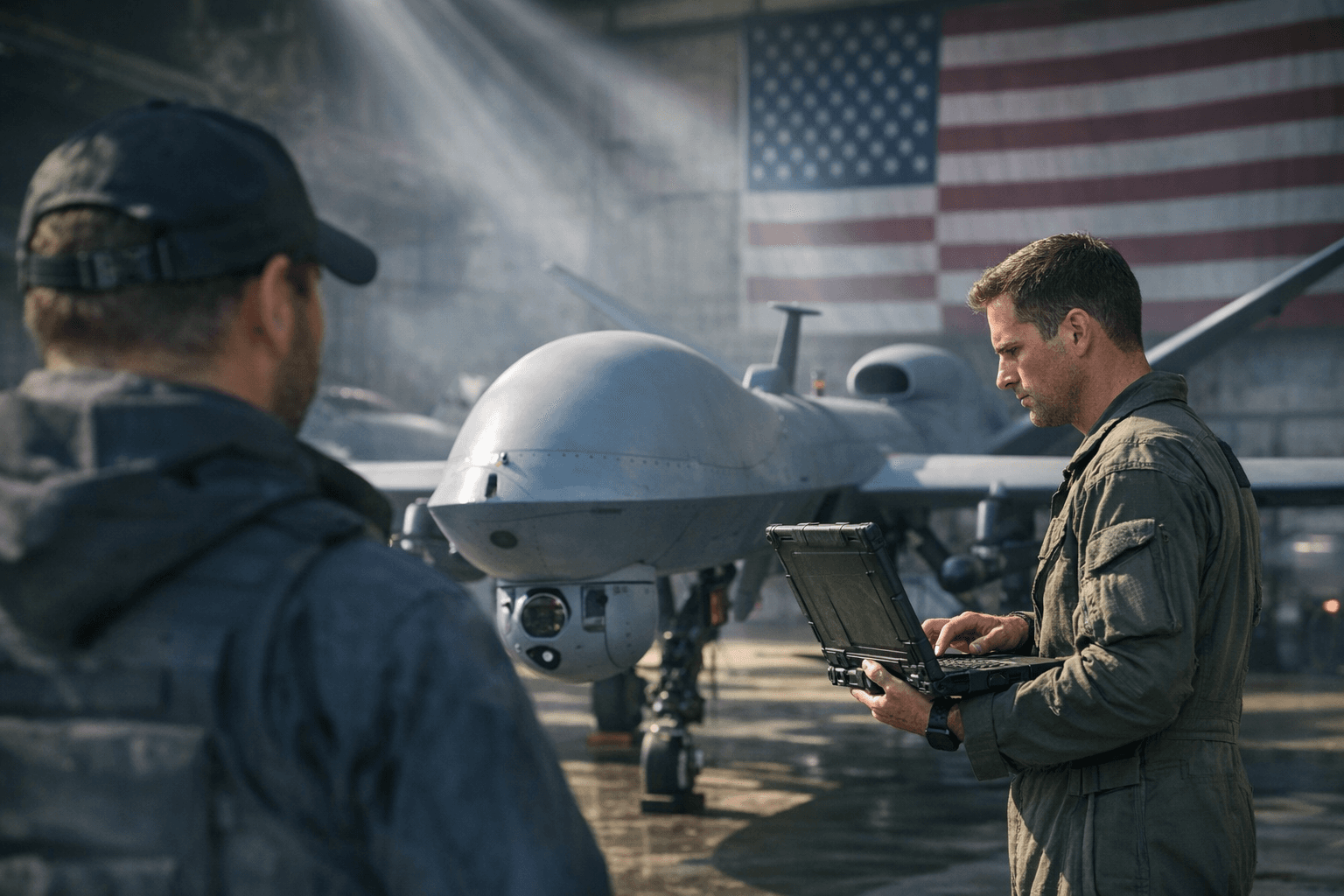
Shield AI's Hivemind autonomy software had already been integrated on Anduril's Fury (YFQ-44A) aircraft and was supporting system-level testing when the San Diego company announced its next major move: a $1.5 billion fundraise that has reset expectations for what autonomous military software is worth.
Shield AI announced it is raising $1.5 billion in Series G funding at a $12.7 billion post-money valuation and $500 million in fixed-return preferred equity financing. When Blackstone's separate commitments are included, some outlets reported the combined capital raise at $2 billion. Funds managed by Blackstone are investing $500 million of preferred equity financing, as well as committing an additional $250 million delayed draw facility to support future growth, which would bring Blackstone's total potential investment to $750 million.
The new round comes after Shield raised $240 million at a $5.3 billion valuation in March 2025, meaning its value leaped 140% in one year. The catalyst was unmistakable. The U.S. Air Force selected Hivemind for the Collaborative Combat Aircraft program, the first time mission autonomy software has been decoupled from the aircraft. That selection, announced in February, paired Shield AI's software directly with a competitor's hardware: the YFQ-44A CCA switched between Shield AI's Hivemind and Anduril's Lattice AIs during the same flight, completing tasks with both, as both companies announced on Feb. 26, 2026.
For the Air Force, the exercise demonstrated something central to the Collaborative Combat Aircraft concept: a combat aircraft able to operate with interchangeable autonomy software rather than being tied to a single vendor's architecture. By avoiding proprietary software lock-in, the Air Force hopes to accelerate innovation while retaining the ability to introduce improved algorithms or capabilities without redesigning the aircraft itself.
Advent International and the Strategic Investment Group of JPMorgan Chase's Security and Resiliency Initiative co-led the $1.5 billion Series G funding round. The Series G also drew participation from existing investors Snowpoint Ventures, Innovation X Advisors, Riot Ventures, Disruptive, Apandion, and others. Advent's involvement carries additional weight: the PE firm's agreement to co-lead the Series G represents an early move by the firm to invest up to $1 billion in emerging defense technology companies, including those focused on artificial intelligence and autonomous systems. Advent's chairman, David Mussafer, will join Shield AI's board of directors, and JPMorgan's Todd Combs will join as a board observer.
JPMorgan's participation reflects a broader institutional shift. The round was co-led by the direct investment arm of JPMorgan Chase's Security and Resiliency Initiative, an initiative the bank unveiled in October to commit $1.5 trillion in capital toward national security and critical industries, with plans to make $10 billion in direct equity and venture capital investments in companies.
A portion of the proceeds will fund the acquisition of Aechelon Technology, a Sagewind Capital portfolio company. Aechelon Technology is an image generation and simulation software developer that opened for business in 1998; the software is designed to help enable full-flight aircraft simulators for training military pilots and testing uncrewed aircraft before live flight. Critically, Aechelon's technology is used by the U.S. military and allies to train pilots and test advanced aircraft and autonomous systems before live flight, and supports a range of critical national security platforms, including the Pentagon's Joint Simulation Environment. Financial terms of the Aechelon deal were not disclosed. CEO Gary Steele framed the acquisition in direct operational terms: "The acquisition of Aechelon will accelerate the work we are doing with Hivemind, particularly in simulation like the Department of War's JSE (Joint Simulation Environment)."
Founded in 2015 by former Navy SEAL Brandon Tseng, along with Ryan Tseng and Andrew Reiter, Shield AI focuses on autonomy for government customers. The company's origin story is rooted in a specific operational problem: how to conduct reconnaissance and strikes in environments where GPS is jammed or unavailable and communications are severed, conditions the military designates as DDIL: disconnected, degraded, intermittent, or low-bandwidth. Its systems are already in use by the U.S. and Ukrainian governments, placing it in active operational environments rather than controlled settings.
Venture capital deals in the defense sector reached $49.1 billion in 2025, according to PitchBook, nearly double the $27.2 billion recorded the previous year, a surge driven by the visible role of autonomous tools in active conflicts. With Anduril's Fury now in serial production at its Arsenal-1 factory in Ohio and Hivemind already proven across that platform, Shield AI has moved from promising startup to a central node in the Pentagon's next-generation air warfare architecture.
This article was produced by Prism’s automated news system from verified source data, official records, and press releases, then run through automated quality and moderation checks before publishing. The system is built and supervised by the people who set the standards it runs under. Read our full AI policy.
Did this article answer your question?

