Shrinking Salton Sea Dust Stunts Lung Growth in Nearby Children
Children within 7 miles of California's Salton Sea lose measurable lung capacity each year, a new NIH-funded study finds, with effects rivaling life beside a freeway.
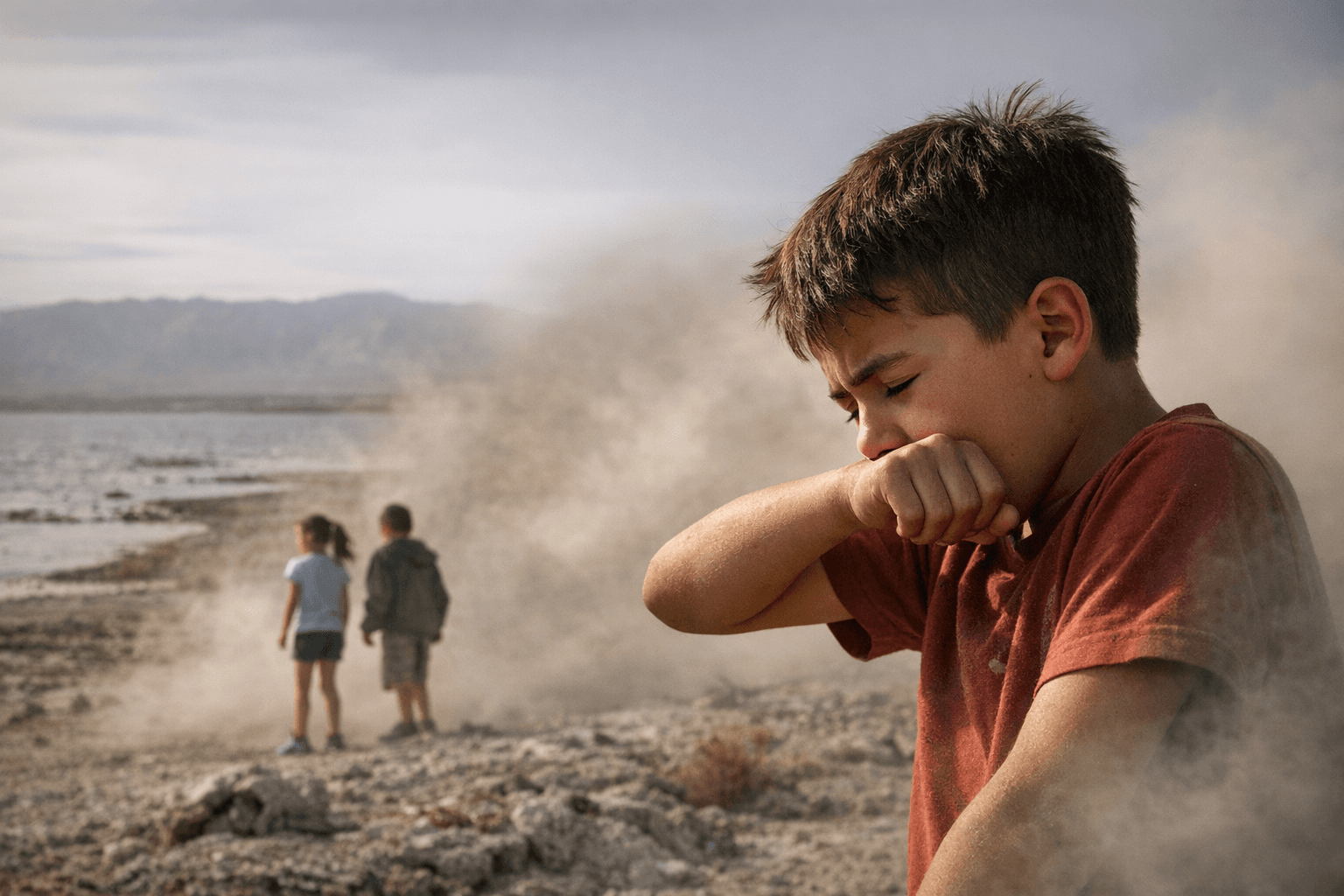
Children who live within 11 kilometers of the Salton Sea grow measurably less lung capacity between ages 10 and 12 than children who live farther away, according to a study published in JAMA Network Open. The impact is comparable to living within 500 meters of a freeway and could affect respiratory health into adulthood.
Specifically, children living within that boundary showed 52.18 milliliters per year lower growth in forced vital capacity (FVC) and 38.7 milliliters per year lower growth in FEV1 than peers who lived farther from the lake. Those two measures capture how much air the lungs can hold and how forcefully they can expel it — indicators that, when suppressed during childhood, tend to stay suppressed.
The research group led by the Keck School of Medicine of USC represents the first attempt to quantitatively assess changes in lung capacity over time in these children. The team, which also included epidemiologists from the University of California, Irvine's Joe C. Wen School of Population and Public Health and community researchers from Comité Civico del Valle in Brawley, tracked higher dust exposure measured in hours per year and found it was linked to lower lung function, with the negative effects most pronounced among children living closest to the lake. In total, roughly 700 children from Imperial Valley communities participated in the longitudinal study.
The severity of what those children are breathing distinguishes this from conventional urban air-quality problems. The authors write that observed effects on lung function "have been greater than what studies find in urban California communities near busy roadways," a comparison that underscores how dramatically the drying lake has recalibrated risk for a rural region.
The Salton Sea, a saline lake near the United States-Mexico border, formed in 1905 when the Colorado River broke through an irrigation canal. Today the lake is shrinking due to drought, heat and water diversions, exposing large areas of dry lakebed that release dust into the air as fine particles. That dust carries the chemical legacy of the valley's agricultural economy: decades of pesticides, fertilizers, heavy metals and concentrated salts that runoff deposited into the basin before the lake began retreating. Wind picks it up and carries it into homes, classrooms and lungs.
Low-income, predominantly Latino neighborhoods face the greatest health risks, and the findings highlight the need for air monitoring and public health interventions. Imperial County already ranks among California's poorest counties, and residents have long faced limited access to specialty health care.
State agencies have acknowledged the problem and committed resources, but progress has been uneven. The California Natural Resources Agency, the California Department of Water Resources and the California Department of Fish and Wildlife are managing the Salton Sea Management Program, which includes a 10-year plan aimed at constructing 30,000 acres of habitat and dust suppression projects around the lake. The $206.5 million Species Conservation Habitat project at the southern end of the sea, built by Kiewit Infrastructure West Co., began construction in 2021 and represents the state's first large-scale effort to reduce exposed lakebed and create environmental habitat. Dust suppression activities began in 2020, but the 10-year plan's full buildout targets 2028, and the gap between what has been completed and what the lakebed continues to expose remains wide.
The researchers warn that proposed lithium extraction operations around the Salton Sea could disturb sediments further, accelerating dust generation at a moment when the epidemiological evidence now makes clear that children in the valley are already paying a physiological price. The team will continue monitoring the children to learn whether the effects on lung function persist into adolescence and adulthood, and will also study which components of the dust are most harmful as part of a broader investigation of air pollution in Imperial Valley.
For a region where the lake was once a mid-century resort destination and is now a source of toxic particulate matter drifting across schoolyards, the study puts a precise number on what delay costs: 52 milliliters of lung growth, per child, per year.
This article was produced by Prism’s automated news system from verified source data, official records, and press releases, then run through automated quality and moderation checks before publishing. The system is built and supervised by the people who set the standards it runs under. Read our full AI policy.
Did this article answer your question?