SlamBall Rulebook Clarifies Court Setup, Face-Offs, and Safety Priorities
The SlamBall League’s official rules lay out precise court dimensions, equipment mandates, game timing, and penalty procedures that shape play, coaching, and roster construction. These rules matter because they codify safety protocols for high-flying play, define Face-Off penalties that swing possession and scoring, and force teams to practice specific skills around springbeds and substitution flow.
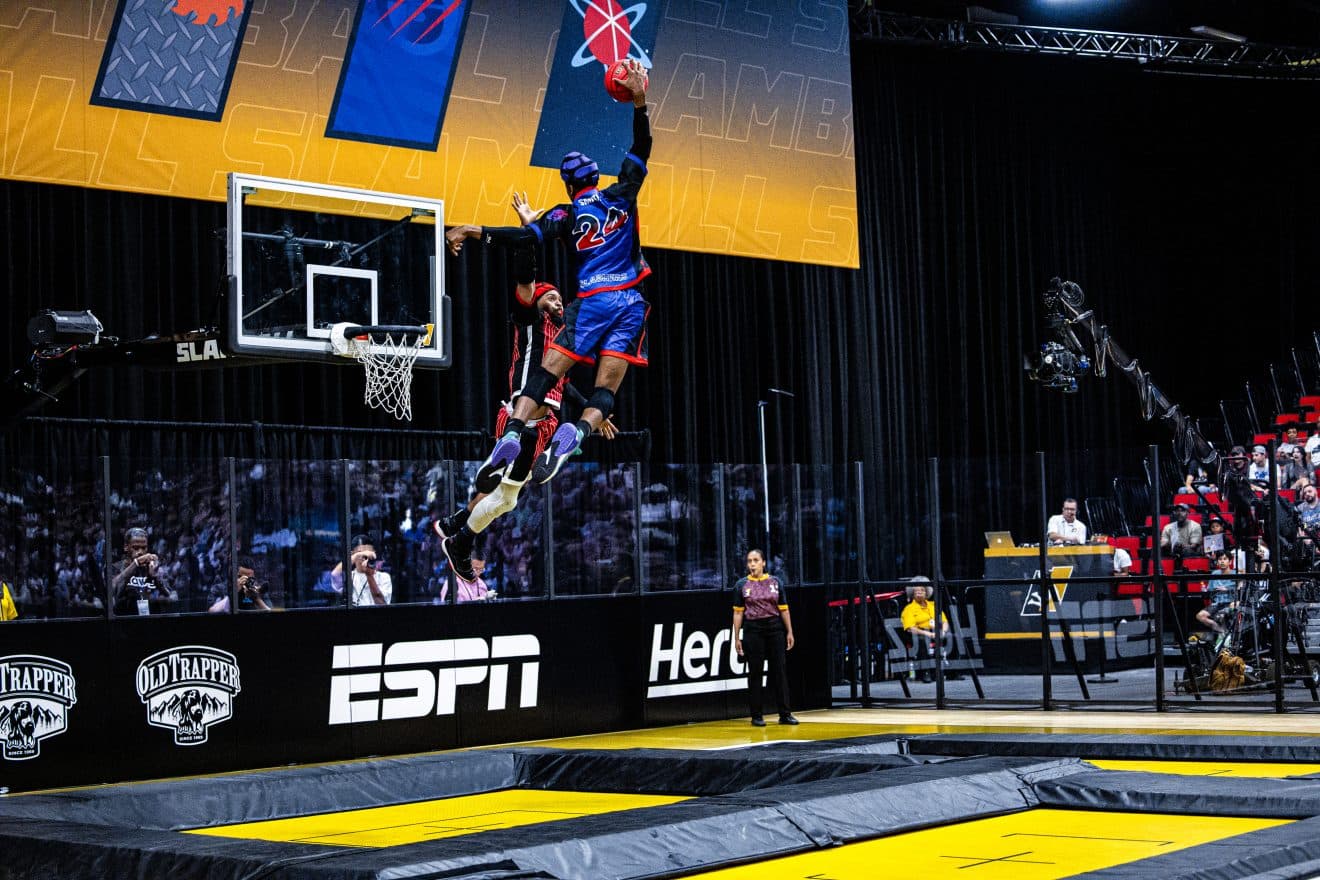
SlamBall presents a distinct blend of trampoline athletics and contact sport, and the league’s rulebook now serves as a clear roadmap for teams, coaches, and local leagues. The court is a 96-foot by 64-foot rectangle with three identical 7-foot by 14-foot springbeds above the surface and a larger 10-foot by 14-foot scoring bed directly in front of the rim. An 8-foot plexiglass wall encircles the court in most areas and rims sit at the standard 10-foot height. Those details matter because they fix the physical parameters players must master when launching, landing, and contesting shots.
Game structure emphasizes rapid action and strategic clock management. Teams may carry up to seven active players and play four players at a time. Games run four 5-minute quarters with a running clock except during face-offs and timeouts; the final minute reverts to stoppage time. Each team gets one 45-second timeout usable only in the fourth quarter, so coaches must plan substitutions and strategy with tight margins.
The Throwdown starts each half with an inverted tip-off: an official slams the ball down to create a high bounce and players battle for position beneath the apex. Inbounding after scores, face-offs, and timeouts typically comes from the defensive springbed area. Substitutions use a hockey-style on-the-fly system with a 5-foot exit zone, although dead-ball subs remain allowed. That flow rewards disciplined line management and conditioning.
Scoring separates dunks and perimeter shots, with higher values for emphatic dunks and an extended arc for higher-value perimeter attempts. Face-Offs function as structured one-on-one penalty attacks after many personal fouls. Points scored in Face-Offs count toward the team total and often preserve or award possession, so teams must rehearse both attacking and defending these isolated scenarios.

Safety and contact rules are central. The Island, a padded strip between springbeds, is a no-contact zone where players may occupy for up to three seconds or must perform a multi-tramp transfer to reset that count. The Stopper—positioned beneath the basket—must be given a safe landing area and cannot be struck in its traditional on-floor position. Controlled, front-facing contact is permitted, but wrapping, tackling, tripping, and dangerous off-ball hits are forbidden. Illegal or excessive contact triggers a personal foul and typically a Face-Off. Players facing repeated personal fouls face removal per competition committee limits; technical and unsportsmanlike acts carry separate penalties.
Ball-handling expectations are specific: players must dribble when approaching springbeds, may take up to two steps after gathering before launching, and springbed bounces do not count as steps. Protective equipment—padded helmets, elbow and knee pads, and custom padded garments—is mandatory to reduce risk during high transfers.
For coaches and teams the practical takeaways are clear: build lineups for vertical explosiveness, drill dribble-to-tramp timing, rehearse on-the-fly substitution patterns, and practice Face-Off offense and defense. Emphasize disciplined, chest-to-chest defense that avoids illegal contact, and enforce protective equipment compliance. With these rules, teams can optimize performance while keeping the sport’s high-energy style safer and more strategic.
Sources:
Know something we missed? Have a correction or additional information?
Submit a Tip