South Korea mobilizes to shield chip industry after U.S. 25% AI‑chip tariff
Seoul convenes emergency talks and delays trade officials' travel after the U.S. order; companies and analysts watch exemptions and a planned tariff‑offset program closely.
President Donald Trump signs a proclamation imposing a 25 percent tariff on a narrow list of advanced artificial intelligence and high‑performance semiconductor chips when those products are imported into the United States and then reexported to third countries, setting off immediate alarm in Seoul about potential ripples through Korea’s vital chip industry.
The White House measure singles out a limited set of accelerators and related products, with media reports and government summaries citing Nvidia’s H200 AI accelerator and AMD’s MI325X as examples of items on the list. The proclamation frames the move as a two‑phase plan: the initial tariff applies to specific reexported chips, while a second phase would expand tariffs and create a tariff‑offset program to favor companies that invest in U.S. semiconductor manufacturing. Details of that offset program remain unclear, complicating planning for foreign suppliers and equipment makers.
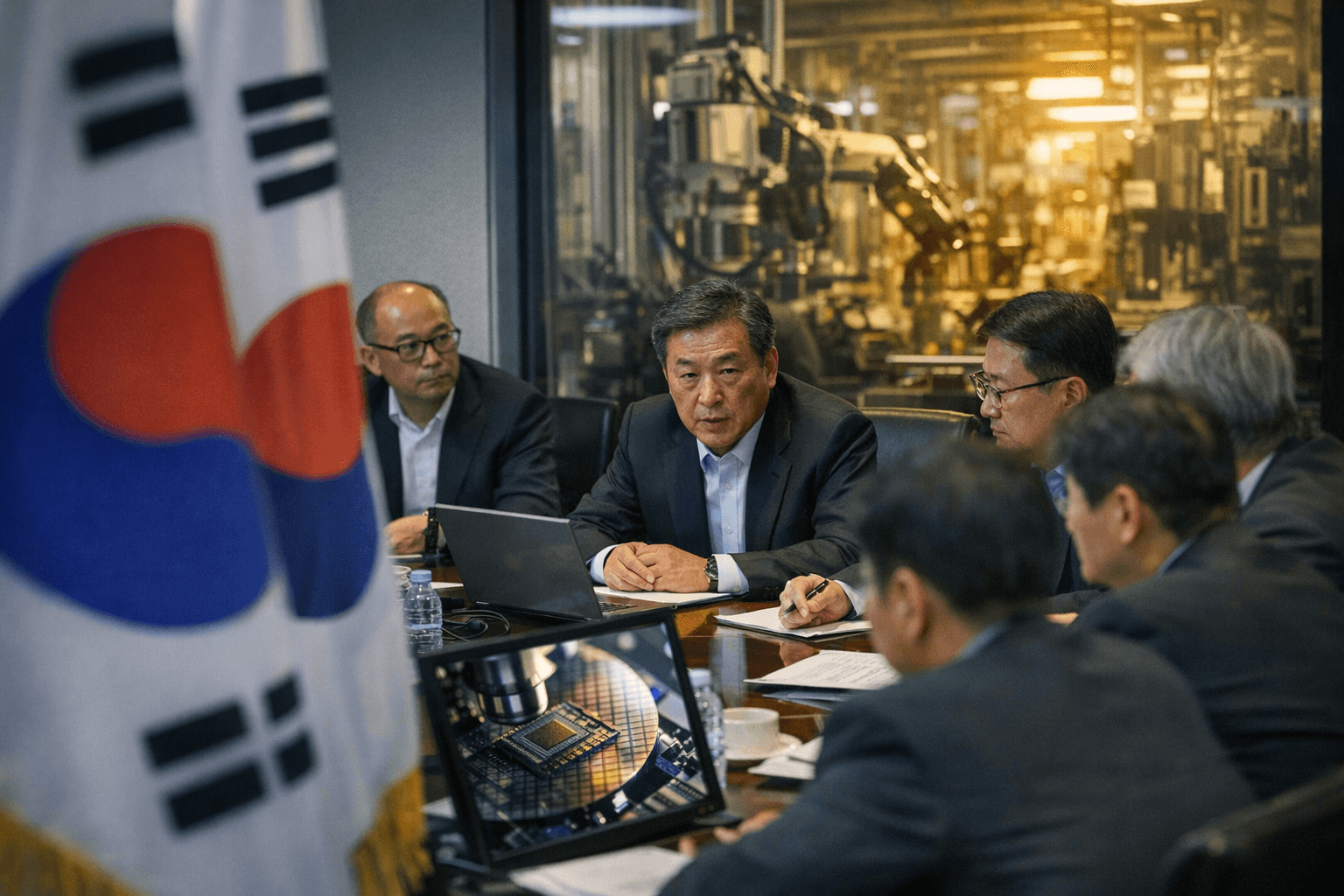
Seoul’s Ministry of Trade, Industry and Energy convenes an emergency meeting chaired by Industry Minister Kim Jung‑kwan, who ordered officials to review response measures, communicate Korea’s position to Washington and coordinate closely with industry. The ministry said it would hold talks with major chipmakers later the same day. Korea’s chief trade negotiator, Yeo Han‑koo, has delayed his return from Washington to remain involved in assessing the proclamation’s implications and shaping Seoul’s response.
Officials pledged "all‑out" efforts to minimize economic harm to Korean firms while maintaining lines of communication with affected companies and with U.S. counterparts. Government sources also emphasized the bilateral tariff arrangement reached last year under which the United States promised Korea tariff treatment that would not be less favorable than that applied to direct competitors, a commitment Seoul plans to invoke in discussions with Washington.
Industry leaders reacted with cautious monitoring. Samsung Electronics and SK hynix, major suppliers of high‑bandwidth memory and server DRAM used in AI systems, issued statements saying they were closely tracking developments and assessing exposure. Multiple analysts and Korean reporting assessed that the immediate, direct impact on memory makers is likely limited because most Korean memory shipped to the U.S. is destined for U.S.‑based AI servers and data centers, which the proclamation exempts. The order distinguishes chips destined for domestic data centers and servers from those reexported abroad, and it includes carve‑outs for research and development, repairs and replacements, startups and other uses judged to bolster U.S. technology supply chains.
But companies and officials warned that uncertainties remain. Much memory bound for final AI systems passes through third countries, particularly original equipment manufacturers in Taiwan, before entering the United States, a routing that can complicate how the new tariff applies in practice. Seoul and industry sources say they are especially concerned about the proposed second‑phase measures and the mechanics of the tariff‑offset program, and they warn of potential downstream cost pass‑throughs across global supply chains.
Seoul’s leaders also view the measure through a geopolitical lens. "For now, this action targets China," a government source told a Korean paper, reflecting broader views that the U.S. move attempts to limit advanced AI capabilities reaching strategic competitors.
Korean authorities plan further consultations with chipmakers and U.S. interlocutors in the coming days. The industry will be watching for formal lists of covered products, implementing guidance on exemptions for data‑center and R&D use, and the detailed rules that will determine how, and how much, the second‑phase tariff‑offset program reshapes global semiconductor investment.
This article was produced by Prism’s automated news system from verified source data, official records, and press releases, then run through automated quality and moderation checks before publishing. The system is built and supervised by the people who set the standards it runs under. Read our full AI policy.
Did this article answer your question?