South Korea to begin Sejong presidential office construction in 2027
Sejong’s presidential footprint is set to grow again, with construction due to start in August 2027 on a 350,000-square-metre office tied to Lee Jae Myung’s decentralization push.
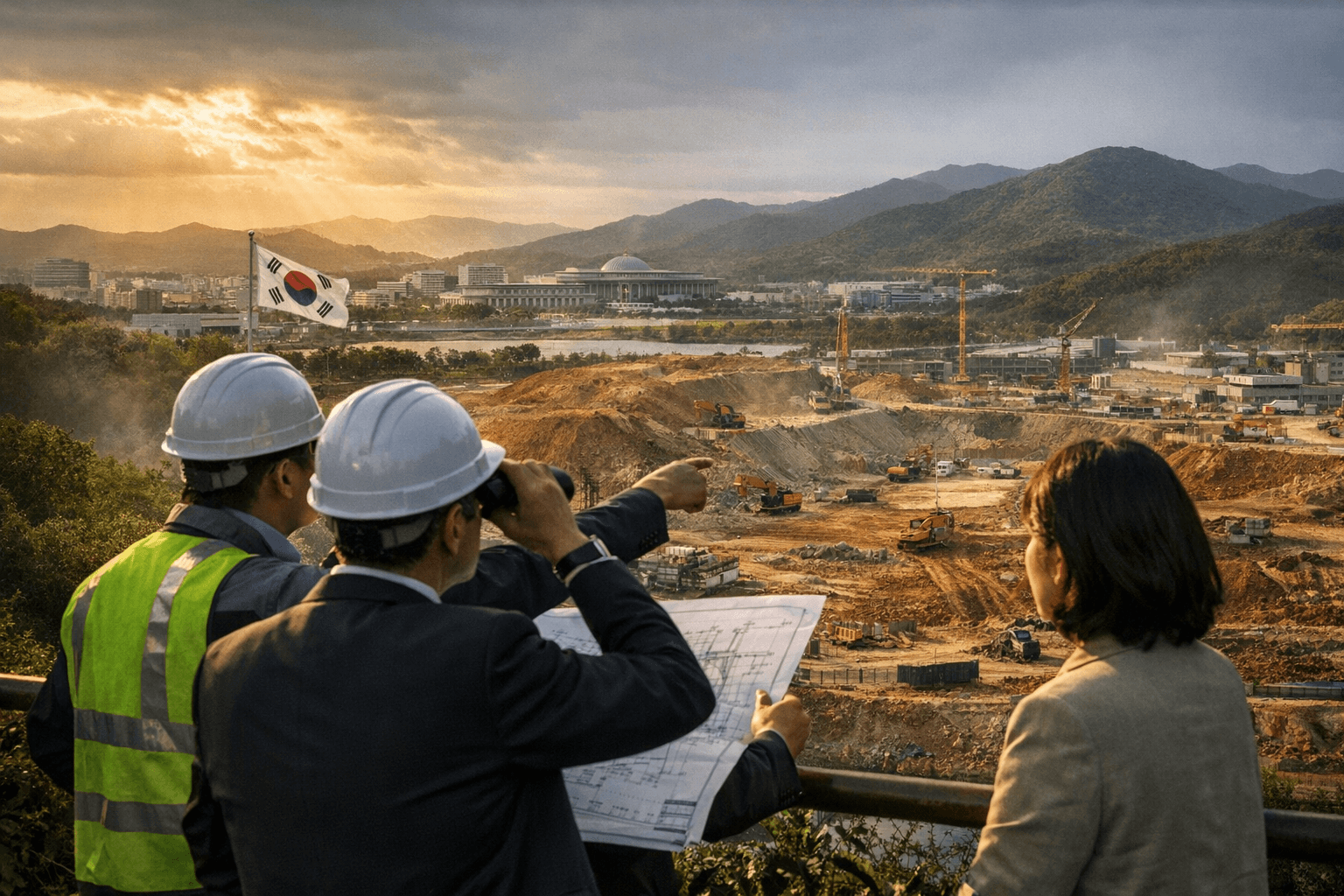
South Korea will start building a presidential office in Sejong in August 2027, a move that would give the administrative city a far more visible share of the state’s power and deepen the long-running effort to pull government functions away from Seoul.
The planned complex, set to span about 350,000 square metres, is central to President Lee Jae Myung’s pledge to strengthen Sejong as a government hub and to have the new office ready for use within his term. Officials estimated site-preparation costs at 9.8 billion won, or about $6.6 million, and said the construction period would last roughly 14 months. A tender notice for the site work was due to be issued on Wednesday, while a design competition was already under way, with a winning proposal expected by the end of April 2026.
The government said it wants the president to move into the Sejong office by August 2029. But the plan’s broader ambition goes beyond one building. Whether Sejong becomes the presidency’s main base, rather than an auxiliary office, would still require wider public agreement and likely legislative action.
That caution reflects how politically charged the location of the presidency has become in South Korea. The office was moved from Cheong Wa Dae to the Yongsan defense ministry compound under Yoon Suk Yeol in 2022, then returned to the Blue House under Lee in 2025. Each move reinforced the sense that the presidency’s address is not just an administrative choice but a signal of power, legitimacy and political control.
Sejong itself was created to change that geography. Formally launched on July 1, 2012, it was built from parts of South Chungcheong Province and North Chungcheong Province to relieve congestion in the Seoul metropolitan area and to support decentralization and balanced development. Government background material says the city now hosts 44 central government agencies and about 14,000 civil servants, making it the country’s main administrative outpost outside Seoul.
Lee has cast the Sejong plan as part of a broader regional-development agenda, saying balanced growth is essential for sustainable economic expansion and for easing pressure on Seoul. He also promised during his 2025 campaign to build both a presidential office and a National Assembly chamber in Sejong, though he has acknowledged that a permanent relocation of the presidency and legislature would depend on social consensus and legal change. In a country where political power has long been concentrated in the capital, the Sejong office is as much a symbol of state rebalancing as it is a construction project.
This article was produced by Prism’s automated news system from verified source data, official records, and press releases, then run through automated quality and moderation checks before publishing. The system is built and supervised by the people who set the standards it runs under. Read our full AI policy.
Did this article answer your question?

