SpaceX to Launch Europe’s Mars Rover Rosalind Franklin in 2028
After years of launcher swaps and geopolitical shocks, Europe’s Rosalind Franklin rover is finally headed to Mars on SpaceX’s Falcon Heavy in 2028.
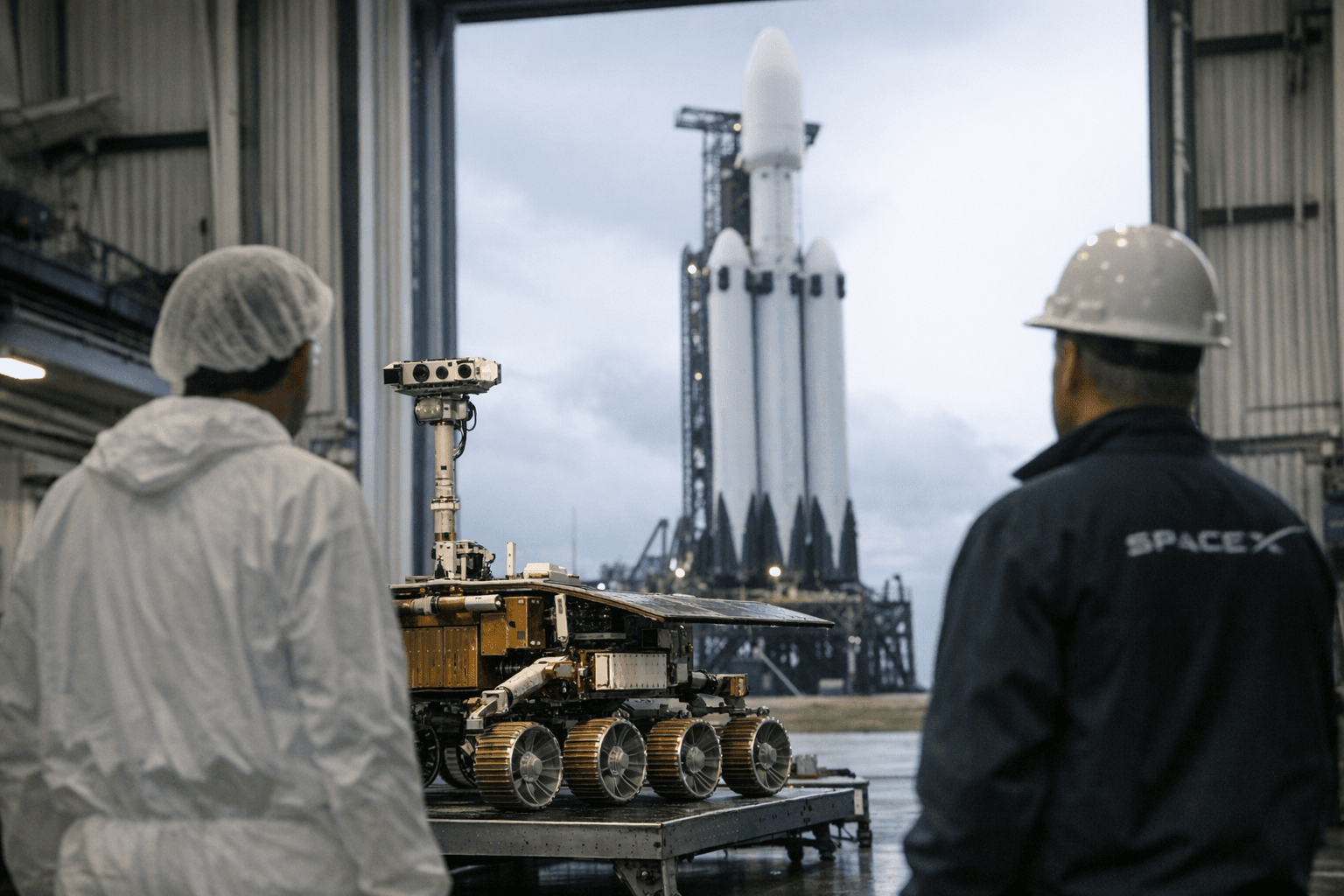
SpaceX has won the job of sending Europe’s long-delayed Rosalind Franklin rover to Mars, a decision that ends years of uncertainty and gives ESA’s flagship ExoMars mission a clear ride at last. NASA selected Falcon Heavy to launch the rover from Launch Complex 39A at Kennedy Space Center in Florida, a major reset for a project that has been pushed from one partnership to another as geopolitics repeatedly intervened.
The mission has already lived through more than a decade of missed windows and hard pivots. The ExoMars programme began with the Trace Gas Orbiter, launched in 2016, but the rover mission was upended after ESA cut ties with Roscosmos following Russia’s invasion of Ukraine. Before that rupture, Europe had counted on Russian launch and landing help. Afterward, ESA and NASA signed a new agreement in May 2024 to rebuild the mission around U.S. support, including the launch service, parts of the landing propulsion system, radioisotope heater units and NASA instrument contributions.
Rosalind Franklin is meant to do something no Mars mission has done before for ESA: combine mobility across the surface with the ability to study Mars at depth. The rover is designed to drill up to 2 metres below the surface, far beneath the radiation and temperature swings that batter the top layer of soil. ESA says that gives the mission a better chance to look for organic molecules and other signs of ancient life at Oxia Planum, with the scientific goal of addressing whether life ever existed on Mars.
NASA’s role now reaches into the science package as well. Its contribution includes a mass spectrometer for the Mars Organic Molecule Analyzer, known as MOMA, adding more analytical power to the rover’s search for preserved chemistry below the surface. That partnership is not just technical. It signals that Europe’s largest planetary ambition still depends on deep transatlantic cooperation, even after the collapse of the Russian route that once underpinned the mission.
The timing matters almost as much as the rocket. ESA says the spacecraft will take about two years to reach Mars, and the rover must complete its primary operations before Martian autumn and winter cut sunlight and limit power and science time. If the 2028 launch holds, Rosalind Franklin will finally move from a diplomatic casualty of the last decade to the centerpiece of Europe’s next attempt to land a rover on Mars.
This article was produced by Prism’s automated news system from verified source data, official records, and press releases, then run through automated quality and moderation checks before publishing. The system is built and supervised by the people who set the standards it runs under. Read our full AI policy.
Did this article answer your question?


