Spain confirms 0.6% first-quarter growth as economy slows slightly
Spain’s first-quarter growth held at 0.6%, but momentum cooled as domestic demand did the heavy lifting and exports and imports both fell.

Spain’s economy grew 0.6% in the first quarter from the previous three months, confirming a slower pace of expansion even as output still rose 2.7% from a year earlier, the National Statistics Institute said. The reading matched the preliminary estimate and left Spain growing, but no longer accelerating, after a 0.8% increase in the final quarter of 2025.
Domestic demand carried most of the quarter’s growth, adding 0.4 percentage points to GDP. Household consumption rose 0.6%, public administration spending increased 0.2% and gross fixed capital formation edged up 0.1%, while external demand added 0.2 points. Exports of goods and services fell 0.5% and imports dropped 1.2%, a combination that lifted the contribution from trade even as it pointed to softer underlying demand abroad.

The sectoral breakdown showed the same pattern of uneven strength. Services expanded 0.7% on the quarter, construction rose 0.1% and primary sectors increased 3.3%. Hours worked climbed 2.1% from a year earlier, offering a sign that labor demand is still supporting the expansion even as the pace cools.
The Bank of Spain has kept its 2026 growth forecast at 2.3% and its 2027 projection at 1.7%, with second-quarter GDP expected to rise about 0.5% to 0.6% quarter on quarter. In the same June update, the central bank lifted its inflation outlook for 2026 to 3.6%, underscoring the policy challenge of keeping growth steady without letting price pressures re-accelerate.
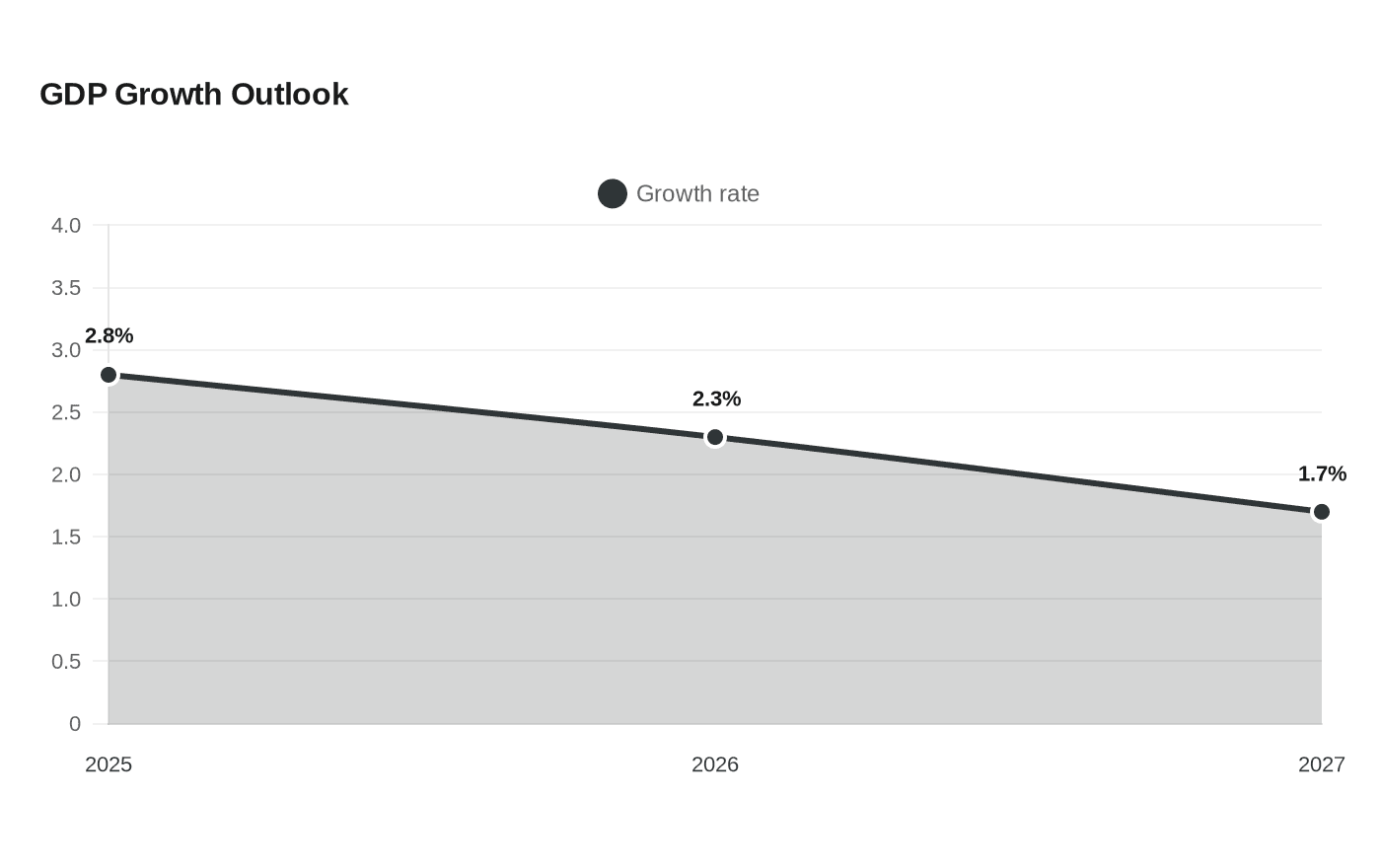
Spain’s 2025 growth rate of 2.8% means the latest forecast still points to a modest slowdown rather than a hard landing. That is important because Spain has been one of the strongest large economies in Europe, helped by tourism, domestic consumption and immigration, while much of the euro zone has been weaker. For investors and policymakers, the latest figures suggest Spain is still doing enough to support eurozone momentum, but the balance is shifting from rapid catch-up to a more mature expansion that will depend on whether consumption and services can keep carrying the load.
This article was produced by Prism’s automated news system from verified source data, official records, and press releases, then run through automated quality and moderation checks before publishing. The system is built and supervised by the people who set the standards it runs under. Read our full AI policy.
Know something we missed? Have a correction or additional information?
Submit a Tip