Spain Police Uncover Drug-Smuggling Tunnel Complete With Rail System and Cranes
Spain's Policia Nacional busted a three-level drug tunnel in Ceuta packed with rail carts, cranes, and pulleys, arresting 27 people including the alleged "narco-architect."
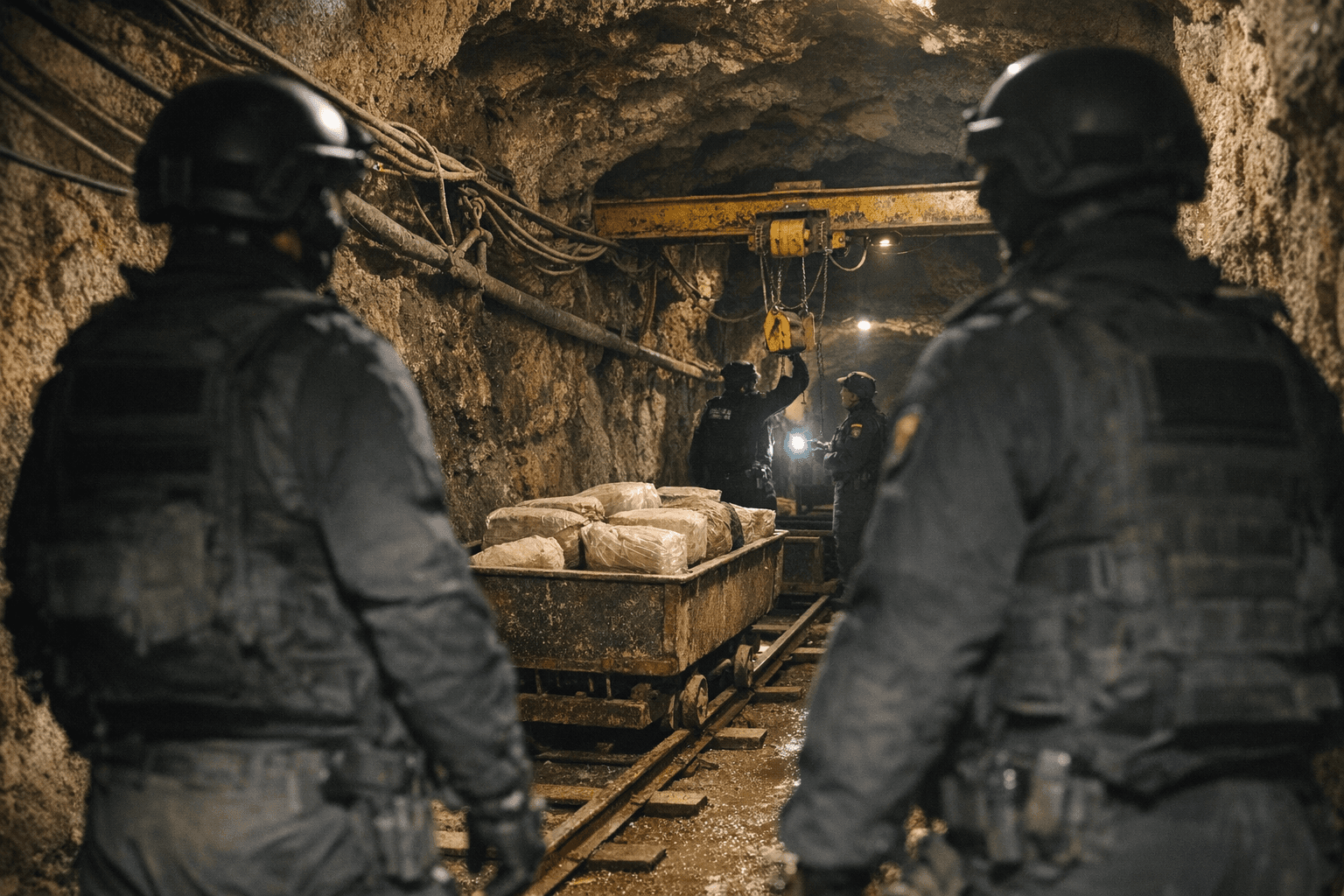
Behind a large soundproof refrigerator inside an industrial warehouse in Ceuta, Spain's Policia Nacional found something far more elaborate than a simple smuggling passage: a three-level underground system engineered to move tonnes of hashish from Morocco into Europe without smugglers ever needing to see each other.
The bottom of the three-level tunnel, which led directly to Morocco, resembled "a maze typical of a mine," equipped with trolleys that moved on a rail system of complex construction. At the lowest level, cranes and pulleys lifted heavy loads of hashish onto pallets, while the middle chamber served as a storage and preparation floor. Bales of hashish were transferred through a descending shaft to an intermediate storage chamber before being moved along a final passage towards the exit, allowing the drugs to be handled, stored, and transported without direct visual contact between those involved.
Spanish police on Tuesday said they had uncovered the technologically sophisticated and "maze-like" underground tunnel, used to smuggle tonnes of hashish from Morocco to Spain's North African exclave of Ceuta and on into Europe. The site in Ceuta was concealed under an industrial warehouse protected by pumping and soundproofing systems to avoid detection.
The tunnel was discovered at the Tarajal industrial park by a deployment of over 250 police officers specializing in drug-trafficking and organized crime on the afternoon of March 28. Dozens of arrests were made across Ceuta, Andalusia, and Galicia, with 20 of them taking place in the Spanish exclave. In total, 27 people were arrested in the operation, including the network's two suspected leaders.
The Policia Nacional said the operation was led by two key figures. One, based in Morocco, is believed to be the "narco-architect" and "master of the tunnels" and is also the alleged mastermind behind another tunnel discovered by officers last year. The other, operating in Ceuta, handled negotiations, finalized deals, and owned all the seized drugs. The Morocco-based suspect was arrested on March 26, two days before the tunnel itself was secured.
The tunnel formed part of what officers described as a "hashish network of networks." The investigation began in early 2025 and uncovered a trafficking operation stretching from Andalusia to Galicia. Along the way, officers intercepted multiple shipments, including 15 tonnes of hashish seized in Almeria and hundreds of kilos recovered in Malaga and Ceuta.
This discovery is the second one recorded in the same zone; earlier in 2025, Spanish authorities sealed off a warehouse after discovering a tunnel suspected of being used to smuggle drugs from Morocco. The back-to-back finds suggest that traffickers view the Tarajal industrial corridor as a reliable artery, one that engineers like the alleged narco-architect have repeatedly rebuilt and refined. The arrest of the same suspected designer in connection with both tunnels points to a pattern of specialization within organized trafficking networks, where technical expertise is as valuable as the contraband itself.
This article was produced by Prism’s automated news system from verified source data, official records, and press releases, then run through automated quality and moderation checks before publishing. The system is built and supervised by the people who set the standards it runs under. Read our full AI policy.
Did this article answer your question?


