Spotify launches verification badge to distinguish human artists from AI acts
Spotify’s new green check will flag artists with 10,000 monthly listeners and 1,000 followers, while AI-persona profiles stay out. Deezer says nearly 75,000 AI tracks now hit streaming daily.

Spotify is drawing a green line between human musicians and synthetic acts. Its new Verified by Spotify badge, a light green checkmark, will appear on artist profiles and in search results over the coming weeks, giving listeners a signal that a page has been reviewed for authenticity while excluding profiles that primarily represent AI-generated music or AI-created personas.
The company says the badge is not a blanket endorsement of artistry. Eligibility rests on sustained listener activity, platform compliance and profile authenticity, with Spotify’s support page offering examples such as at least 10,000 monthly active listeners over three consecutive months and at least 1,000 followers. Reviews will happen on a rolling basis, and badge status can be removed if an artist later breaks platform rules. Spotify said more than 99 percent of artists listeners actively search for will already be verified at launch, putting the rollout in reach of hundreds of thousands of artists across genres and countries.
Spotify is pairing the badge with a new information section on artist pages, whether or not a performer has the checkmark. The section will surface career highlights, release patterns and live performance history, a move the company compares to nutritional labeling because it gives users a faster read on an artist’s track record and authenticity. The company has also tied the effort to human review and a new Artist Profile Protection feature in beta, signaling that trust on the platform is becoming a managed product rather than an assumed one.
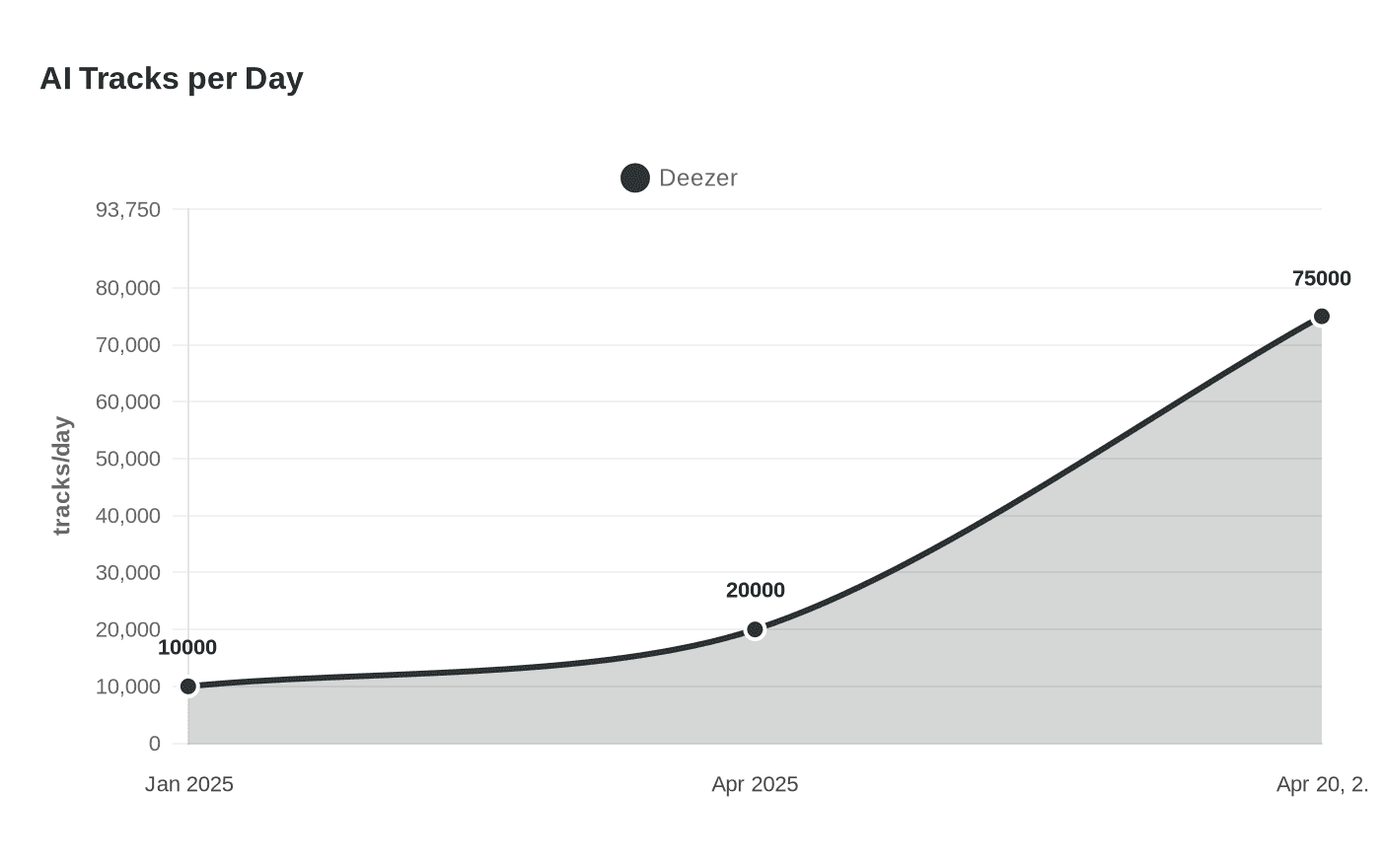
The timing reflects how quickly synthetic music has scaled across streaming services. Deezer said on April 20, 2026 that it was receiving nearly 75,000 AI-generated tracks per day, about 44 percent of all daily uploads. Even so, Deezer said AI-generated music still accounted for only 1 percent to 3 percent of its streams, and that 85 percent of those streams were detected as fraudulent and demonetized. Deezer’s figures also show the pace of change: it reported about 10,000 AI tracks a day in January 2025 and more than 20,000 a day, or 18 percent of new uploads, by April 2025.
The industry backlash has widened beyond streaming platforms. Sony Music Group issued an AI training opt-out declaration on May 16, 2024, saying it supports responsible AI but prohibits text and data mining and web scraping of its content for AI training unless explicitly authorized. Against that backdrop, Spotify is trying to preserve trust in a catalog that reached more than 760 million monthly active users and 293 million Premium subscribers in its April 28, 2026 earnings report, with quarterly revenue of €4.5 billion. The badge may help listeners decide what to support, but it also raises the harder question of who gets to prove they are real, and who gets left carrying the burden of proof.
This article was produced by Prism’s automated news system from verified source data, official records, and press releases, then run through automated quality and moderation checks before publishing. The system is built and supervised by the people who set the standards it runs under. Read our full AI policy.
Did this article answer your question?