St. Benedict’s freshmen tackle Appalachian Trail rite of passage
St. Benedict’s Trail turns a 55-mile hike into a test of leadership, trust, and endurance. The school says it forges community, while the gear and black hoodie make the rite unmistakably elite.

A hike that doubles as a school philosophy
At St. Benedict’s Preparatory School, the Appalachian Trail is not a scenic outing. It is a five-day, 55-mile rite of passage that every freshman must complete before fully entering the school community, and it is built around one hard idea: teenagers learn best when they have to rely on one another.
The program, known as The Trail or The Backpacking Project, asks first-year students to hike in teams of seven or eight, each person assigned a distinct job such as captain, navigator, medic, or camp specialist. St. Benedict’s describes that structure as “horizontal dependence,” a deliberately flattened kind of responsibility in which no one student can carry the group alone. The reward is not just a memory. It is the right to wear the school’s iconic black hoodie, a symbol that signals the freshman has earned a place in the school’s tight-knit culture.
How the route works
The hike begins at High Point State Park and ends at the Delaware Water Gap in northwest New Jersey, tracing a stretch of the Appalachian Trail through some of the state’s most rugged backcountry. Before the May hike, students train during Spring Phase, and the Appalachian Trail Conservancy says they typically spend about three weeks learning backpacking basics, including cooking, camping, navigation, and first aid, along with shorter practice hikes.
By the time the main trip begins, the point is not simply to finish the miles. It is to function as a unit under strain. Staff members and older students are present for safety, but the teams are expected to solve problems themselves, which gives the outing the feel of a supervised experiment in peer leadership. The U.S. Naval Academy’s Center for Experiential Leadership Development says the school also staggers departures over several days and uses midshipmen as part of that broader leadership-training structure.
Why St. Benedict’s preserved it
The Trail dates to 1973, when the school reopened after a dramatic enrollment collapse. According to St. Benedict’s and Catholic Schools in the Archdiocese of Newark, enrollment had fallen from 800 students to just 46 in seven years. The first outing involved two teachers and 12 boys, an experimental attempt to give freshmen hands-on learning and to pull a rowdy group of students off campus and out of their usual environment.
Headmaster Father Edwin Leahy, O.S.B., framed the school’s revival as more than an academic reset. He described the rebuilt institution as a small, interracial school that would prepare students either for college or for careers such as carpentry or plumbing. That spirit still shapes the Trail today. The school says the tradition was inspired by John Dewey’s philosophy of experiential education, a view that treats learning as something done in action, not just absorbed in classrooms.
That is why the hike has lasted for more than five decades. It is not a decorative custom or a nostalgic throwback. It is a structural expression of what the school believes education should do: build competence, responsibility, and trust under real pressure.
What students are expected to learn
St. Benedict’s says The Trail is part of a larger leadership-training system that also includes The Overnight and other experiential-learning programs. The school’s stated goals are straightforward: leadership, teamwork, resilience, and persistence. Those aims make sense in the context of the hike itself, where students have to manage fatigue, weather, hunger, navigation, and interpersonal strain while still performing their assigned roles.
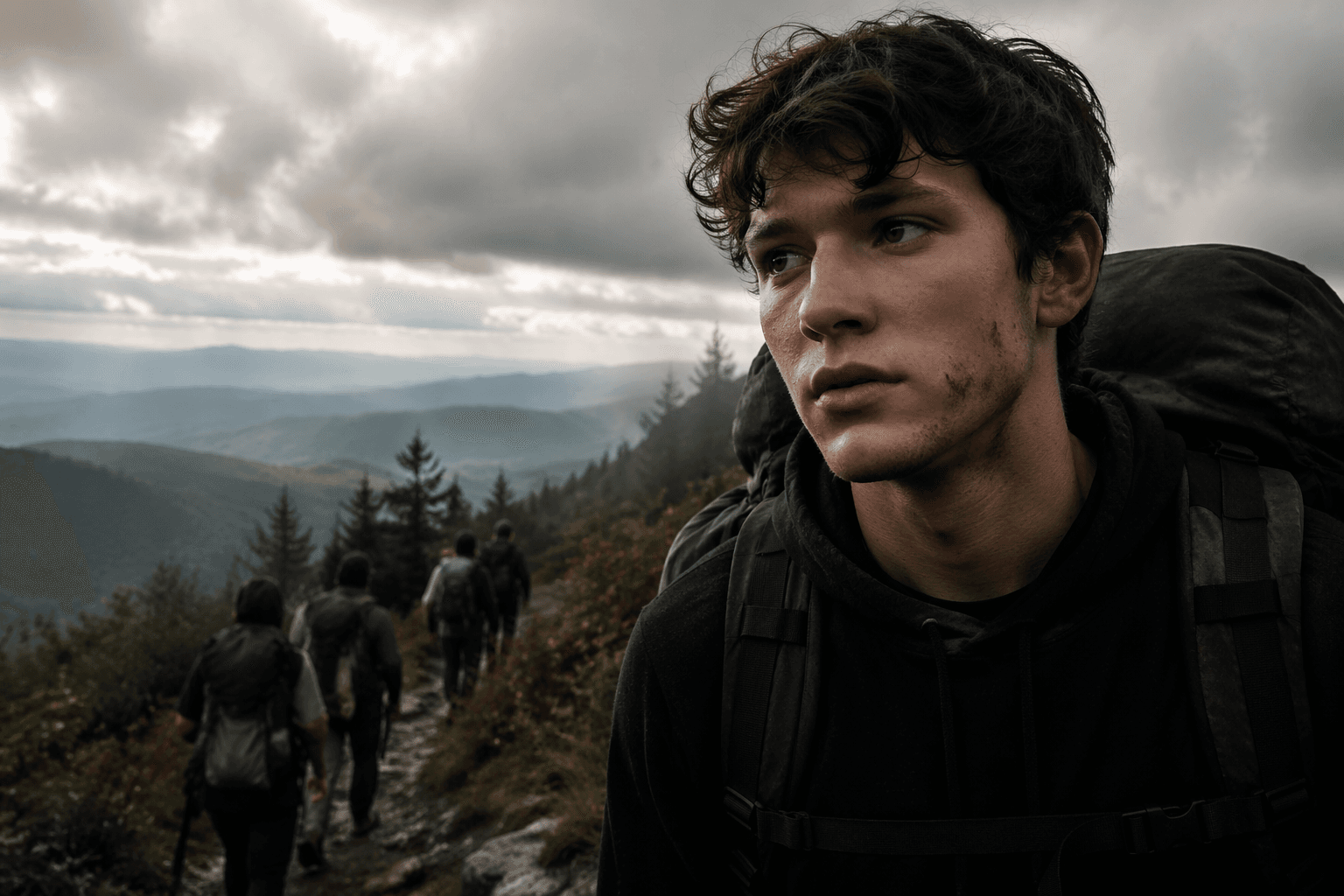
That structure matters because the school is not trying to create isolated overachievers. It is trying to create students who can function in a group when no one is in charge in the usual sense. A captain has to coordinate. A navigator has to keep the team on course. A medic has to be alert to risk. A camp specialist has to keep the group moving from daylight into night. The design turns endurance into a lesson about interdependence, not just toughness.
The urban-to-wilderness contrast
Part of what makes the program so distinctive is where the students come from. St. Benedict’s is an all-boys, Catholic college-prep school in Newark’s Central Ward, and the Appalachian Trail Conservancy notes that many of the students are far more familiar with Newark than with the woods. For many, the hike is their first backpacking experience.
That contrast is central to the school’s identity. The Trail asks students who live in an urban environment to prove themselves in a setting that strips away comfort, routine, and familiar status cues. The result is a powerful institutional ritual: boys who may have arrived as freshmen from very different backgrounds are placed into small teams where competence matters more than reputation. In that sense, the hike functions both as character formation and as a visible marker of belonging.
Pandemic interruption and the weight of the pack
The tradition was interrupted when the pandemic canceled it one year, and in 2021 The New York Times reported that the hike returned shortened to 40 miles over four days because training time was limited. That same report said backpacks weighed about 25 to 40 pounds, a reminder that this is not symbolic hardship. It is physical, immediate, and hard to fake.
The same article noted that some students who could not afford gear rented it from the school’s stockpile, a detail that complicates any simple reading of the hike as pure branding. St. Benedict’s has built a visibly distinctive culture, but it has also created systems to make participation possible for students who lack expensive equipment. That tension is part of the story: the program is at once a demanding initiation and a school-managed attempt to broaden access to a powerful communal experience.
Character formation, elite branding, or both
The Trail is easiest to understand when those two ideas are held together. On one hand, it clearly serves the school’s philosophy of formation. Students learn to work, lead, and endure together, and the institution presents the hike as a way to earn membership rather than inherit it. On the other hand, the black hoodie, the symbolism, the mountain route, and the five-day ordeal create a powerful identity marker that separates St. Benedict’s from ordinary prep-school branding.
That is part of why the tradition has endured for 53 years. It converts school values into a rite that is hard to dismiss and harder to forget. In a culture where institutions often struggle to make their missions visible, St. Benedict’s has turned a backpacking trip into its clearest statement of purpose.
This article was produced by Prism’s automated news system from verified source data, official records, and press releases, then run through automated quality and moderation checks before publishing. The system is built and supervised by the people who set the standards it runs under. Read our full AI policy.
Know something we missed? Have a correction or additional information?
Submit a Tip