State Voting Rules Echo Trump Election Bill as Congress Fails
Congress may stall on the SAVE Act, but 23 states have already copied parts of it, tightening voter registration and ID rules before the 2026 midterms.
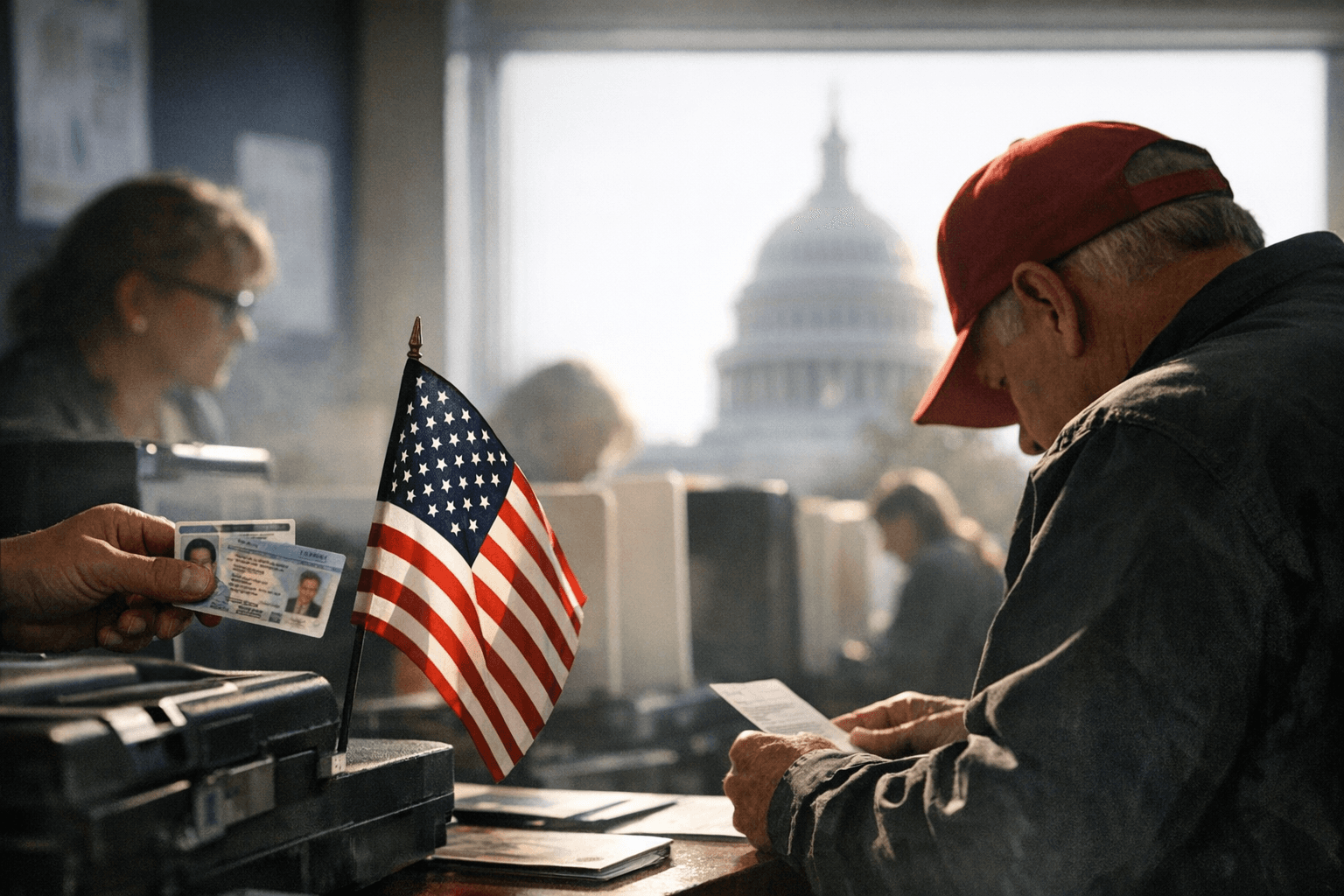
The fight over Trump’s election package has already moved out of Congress and into state law. A Reuters analysis found that 23 mostly Republican-led states have recently changed voting procedures to mirror key parts of the SAVE America Act, even as the bill appears headed for failure in Washington.
Those state changes are not identical to the federal proposal, but they point in the same direction. Since 2024, states from Wyoming to Georgia have imposed new proof-of-citizenship requirements for voter registration and narrowed the photo IDs accepted at polling places. Reuters also found that at least 17 states now require election officials to compare registration lists against a federal system normally used to verify eligibility for public benefits.
The federal bill itself would go further. Congress.gov says the SAVE Act, formally the Safeguard American Voter Eligibility Act, would require documentary proof of U.S. citizenship before a voter could register for federal elections. The House passed the measure in April 2025, but it did not advance in the Senate then. This year, lawmakers revived the push, with Senate Democrats including Alex Padilla and Senate Democratic Leader Chuck Schumer publicly opposing it. Voting-rights groups, including the League of Women Voters of the United States, say the measure would put new obstacles in front of eligible voters who do not have passports, birth certificates or naturalization papers readily available. The Brennan Center for Justice says roughly 21 million American citizens do not have those documents readily accessible.
The legal and political clash is now playing out on several fronts at once. On March 31, 2026, Trump issued an executive order aimed at tightening mail voting, and on April 3, 23 Democratic-led states and the District of Columbia sued in Massachusetts to block it. The order has already been challenged in court and is unlikely to take effect soon. At the same time, Florida Gov. Ron DeSantis signed the Florida SAVE Act on April 2, Mississippi Gov. Tate Reeves signed a citizenship-verification law on April 1, South Dakota Gov. Larry Rhoden signed SB 175 on March 26, and Utah Gov. Spencer Cox signed HB 209 on March 25.
The broader picture is one of a country splitting its election rules state by state ahead of the 2026 midterms, when control of Congress will be on the ballot. Ballotpedia says 24 states have introduced 41 bills tied to proof of citizenship for elections, while Arizona continues to defend its own law after the U.S. Supreme Court held in 2013 that Arizona’s documentary-proof requirement was preempted for applicants using the federal registration form. Even if the SAVE Act dies in the Senate, the policy it carries has already taken root across much of the country.
This article was produced by Prism’s automated news system from verified source data, official records, and press releases, then run through automated quality and moderation checks before publishing. The system is built and supervised by the people who set the standards it runs under. Read our full AI policy.
Did this article answer your question?

