Stocks Fall for Fifth Straight Week as Iran War Rattles Markets
The S&P 500 closed its worst week since the Iran war began, down 8.7% from its January high, as the Dow entered correction territory and oil topped $106 a barrel.

Wall Street finished off a fifth straight losing week Friday, its longest such streak in nearly four years, with the S&P 500 falling 1.7% to close its worst week since the war with Iran began. The Dow Jones Industrial Average lost 793 points, or 1.7%, and fell more than 10% from its record set last month, while the Nasdaq composite sank 2.1%.
The Dow tumbled into correction territory as Brent crude topped $110 after incidents in the Strait of Hormuz exacerbated investors' energy supply concerns and President Donald Trump's latest comments failed to encourage traders to scoop up shares. The losses were a break from Wall Street's pattern this week, where the U.S. stock market flip-flopped from gains to losses each day as hopes rose and fell about a possible end to the war.
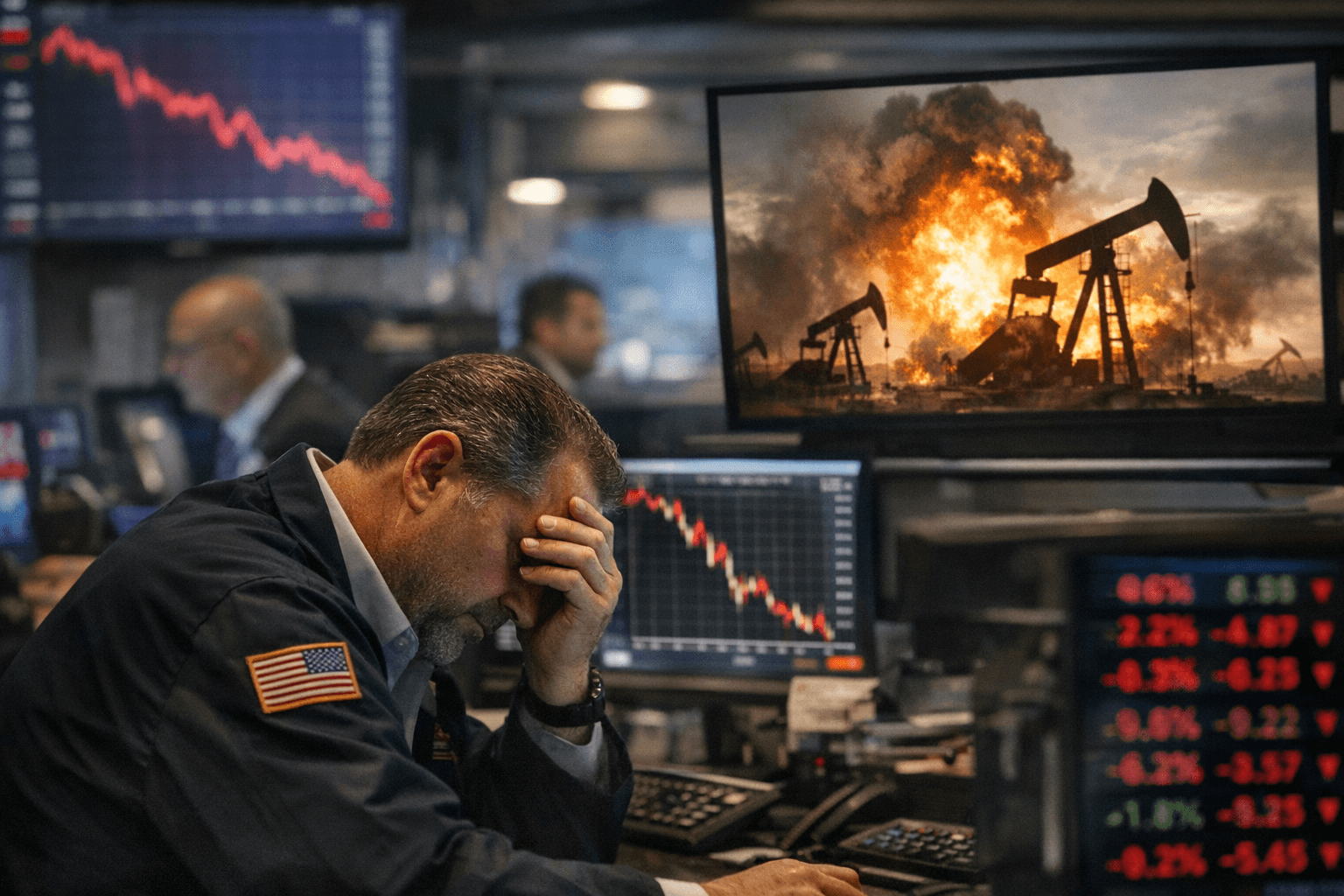
The driver is a stranglehold on the world's most critical oil corridor. Iran's chokehold on the Strait of Hormuz has sent shockwaves through the global economy; more than one-fifth of the world's oil supply passes through the narrow waterway along Iran's shoreline, and faced with threats to oil tankers, traffic through the strait has largely ground to a halt. Oil briefly spiked to nearly $120 per barrel earlier this week, the highest price since the summer of 2022, and some analysts warn prices could quickly reach $150 if the strait remains closed. By Friday, Brent crude traded above $106 a barrel while West Texas Intermediate topped $100 as investors eyed the growing economic hit from the halt to Strait of Hormuz traffic.
Three out of every four S&P 500 stocks fell on the day. The index, the main measure of U.S. stock market health, is 8.7% below its all-time high set in January. Big Tech stocks were among the heaviest weights on the market, with drops of 4% for Amazon, 4% for Meta Platforms, and 2.2% for Nvidia. Companies selling non-essentials, which customers could stop buying if spending too much on gasoline, also sank sharply: Norwegian Cruise Line Holdings lost 6.9%, Starbucks dropped 4.8%, and Chipotle Mexican Grill sank 4.1%.
U.S. Secretary of State Marco Rubio told G7 foreign ministers that the war with Iran is likely to continue for another two to four weeks, stoking concern about a prolonged conflict. For the second time this week, Trump extended an ultimatum for Iran to completely open the Strait of Hormuz, saying peace talks "are going very well," and announced in a social media post Thursday that, upon a request from the Iranian government, he was "pausing the period of Energy Plant destruction by 10 days." The new deadline is April 6 at 8 p.m. ET. Trump had previously extended his initial deadline Monday evening by five days, citing progress in peace negotiations; that deadline had been set to expire on Friday.
Markets are no longer moving on Trump's optimism. Mixed signals persisted all week, with Trump suggesting a deal was close while Iran, through its state media and its foreign minister, said it had no plans to negotiate with the U.S. Jim Bianco, president and macro strategist at Bianco Research, put it plainly: "Any further statements by Trump about a deal are white noise to the markets. Only if the IRANIANS say the talks are going well will it impact markets."
Surging energy prices, rising import costs, and mounting stagflation concerns are pushing markets to consider that the Federal Reserve's next move could be a rate hike. Traders in the futures market pushed the probability of a rate increase by the end of 2026 to 52% Friday morning, the first time it has crossed the 50% threshold. Preliminary U.S. business activity data for March from S&P Global's flash purchasing managers index fell to an eleven-month low, pointing to growing pressure on overall growth from rising prices linked to the war-related energy shock.

Anthony Saglimbene, chief market strategist at Ameriprise, offered a longer view: "Although volatility may feel uncomfortable, could rise from here, and possibly cause a near-term drawdown in stocks, volatility in itself tends to be brief when it reaches more extreme levels. And, more often than not, the extreme volatility provides investors with a solid long-term entry point to buy stocks rather than sell."
Iran's Revolutionary Guard Corps said Friday that the Strait of Hormuz will remain closed to any ships that don't have approval to pass from Tehran, a declaration that left little doubt about why the market's patience ran out. The S&P 500 is now down 6.8% in March alone; if that holds, it would mark the benchmark's biggest monthly slide since December 2022.
Know something we missed? Have a correction or additional information?
Submit a Tip