Stocks Retreat From Rally Highs as Oil Rebounds Amid Iran War
U.S. crude settled at $88.13, down 10.3%, after Trump's Iran ceasefire pause sent stocks surging then gave back gains as oil rebounded.
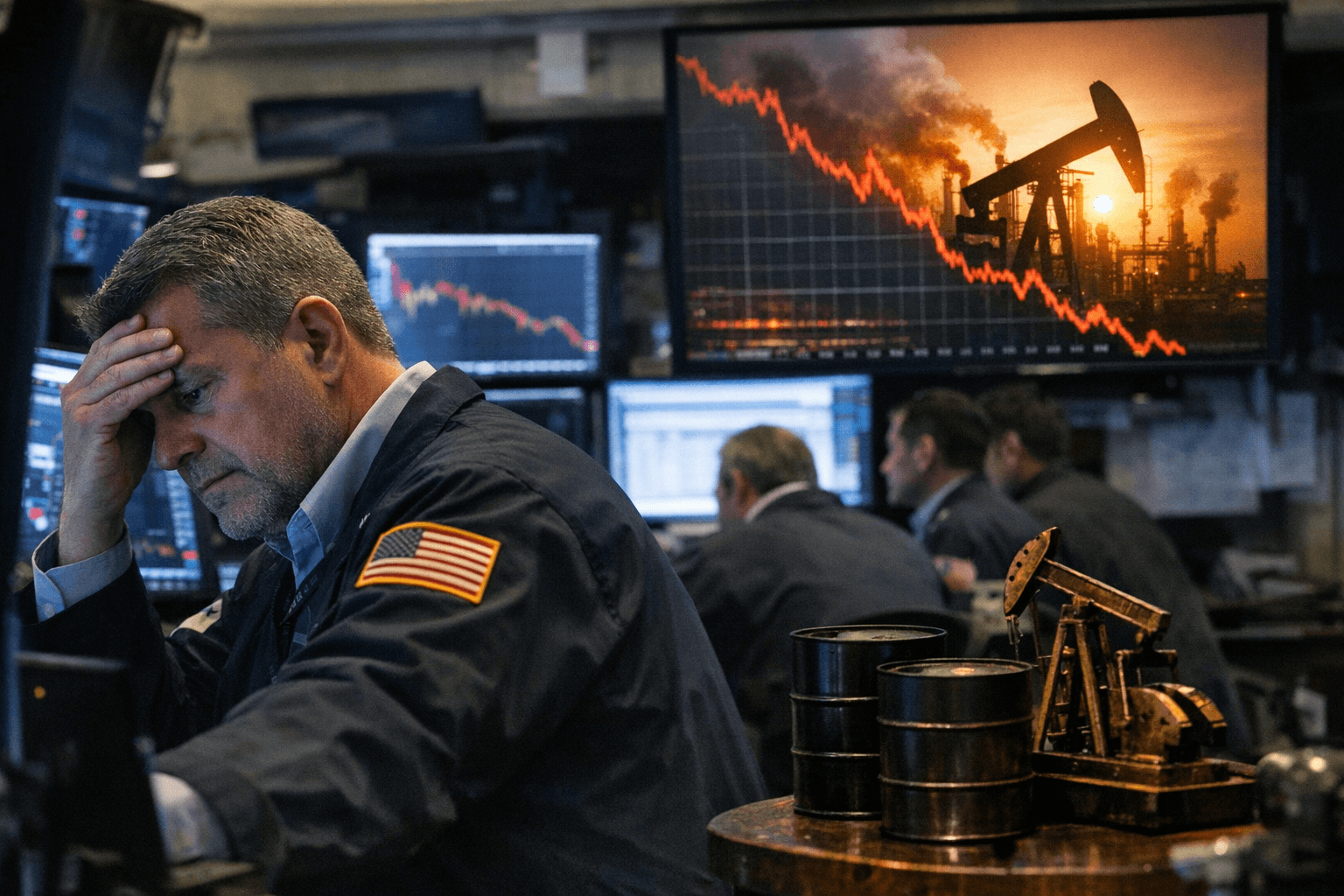
Oil prices tumbled Monday after President Donald Trump said the U.S. and Iran had productive talks about ending the war and ordered a five-day halt on strikes against key energy infrastructure — but by the close, Wall Street had surrendered a large chunk of its initial euphoria as crude clawed back off its lows.
Before Trump's Truth Social post early Monday, futures were pointing to more losses for equity markets under siege from skyrocketing oil prices and uncertainty about the duration of the Iran conflict. After his comments, Dow futures briefly surged more than 1,000 points. The S&P 500 was up 1.7% in afternoon trading, while the Nasdaq Composite and Dow Jones Industrial Average rose 1.8% and more than 800 points respectively at their session peaks. The three stock indexes pared some gains after rising more than 2% earlier; still, the move higher halted a recent slide.
The Dow Jones Industrial Average jumped 631 points, or 1.38%, to close at 46,208.47. The S&P 500 rose 1.15% and ended at 6,581.00, while the Nasdaq Composite gained 1.38% and settled at 21,946.76.
The oil market told the more complicated story. Brent crude, the global oil benchmark, fell 10.92% to settle at $99.94 per barrel, its first close below $100 since March 11. U.S. crude sank 10.28% to settle at $88.13 per barrel, its lowest settle since March 11. The path to those settlements was violent: benchmark U.S. crude initially dropped toward $84 a barrel before bouncing back above $92, then drifting lower into the close. Oil prices posted their biggest single-day drop since March 10, when Trump said the Iran war would be over "very soon." The declines came after oil prices on Friday had settled at their highest level since July 2022.
Over the weekend, Trump had threatened to "obliterate" Iran's power plants within 48 hours if Iran didn't let ships pass through the Strait of Hormuz. But on Monday, hours before his deadline, Trump posted on social media that the U.S. and Iran have had "very good and productive conversations regarding a complete and total resolution of our hostilities in the Middle East" and said the U.S. would postpone attacks on Iran's power plants and energy infrastructure for five days. Iran denied talks had been held. Iranian parliament speaker Mohammad Bagher Qalibaf posted on X that "fakenews is used to manipulate the financial and oil markets."
Shipping traffic through the Strait of Hormuz has virtually ground to a halt since the U.S. and Israel launched airstrikes on Iran on February 28. Iran has retaliated by targeting ships trying to pass through the strait, with several incidents reported in recent weeks. The strait normally handles roughly 20% of global oil supplies.
The stocks that moved most sharply were those most exposed to fuel costs. Norwegian Cruise Line Holdings surged 6.2%, United Airlines climbed 4.5%, and American Airlines rose 3.6% on the prospect of cheaper jet fuel and lower voyage costs. All three, however, remain down for the year as the war's cumulative toll on energy prices has erased earlier gains.
U.S. gas prices rose for the 23rd straight day Monday, reaching $3.96 in the latest reading from AAA, the highest since August 2022. The average price is now up $1.02, or 34%, in the last month. That is a bigger one-month gain than in the wake of Hurricane Katrina in 2005 and also the Russian invasion of Ukraine in 2022.
Even with Monday's declines in oil prices, crude remains around a third higher than before the United States and Israel attacked Iran on February 28. That persistent premium is keeping pressure on the Federal Reserve. Before the war, traders were betting the Fed would cut rates at least twice this year; elevated energy costs have dashed those expectations. The yield on the 10-year Treasury fell to 4.35% from 4.39% late Friday but remains well above its pre-war level of 3.97%, a signal that bond markets have not yet priced in any near-term rate relief.
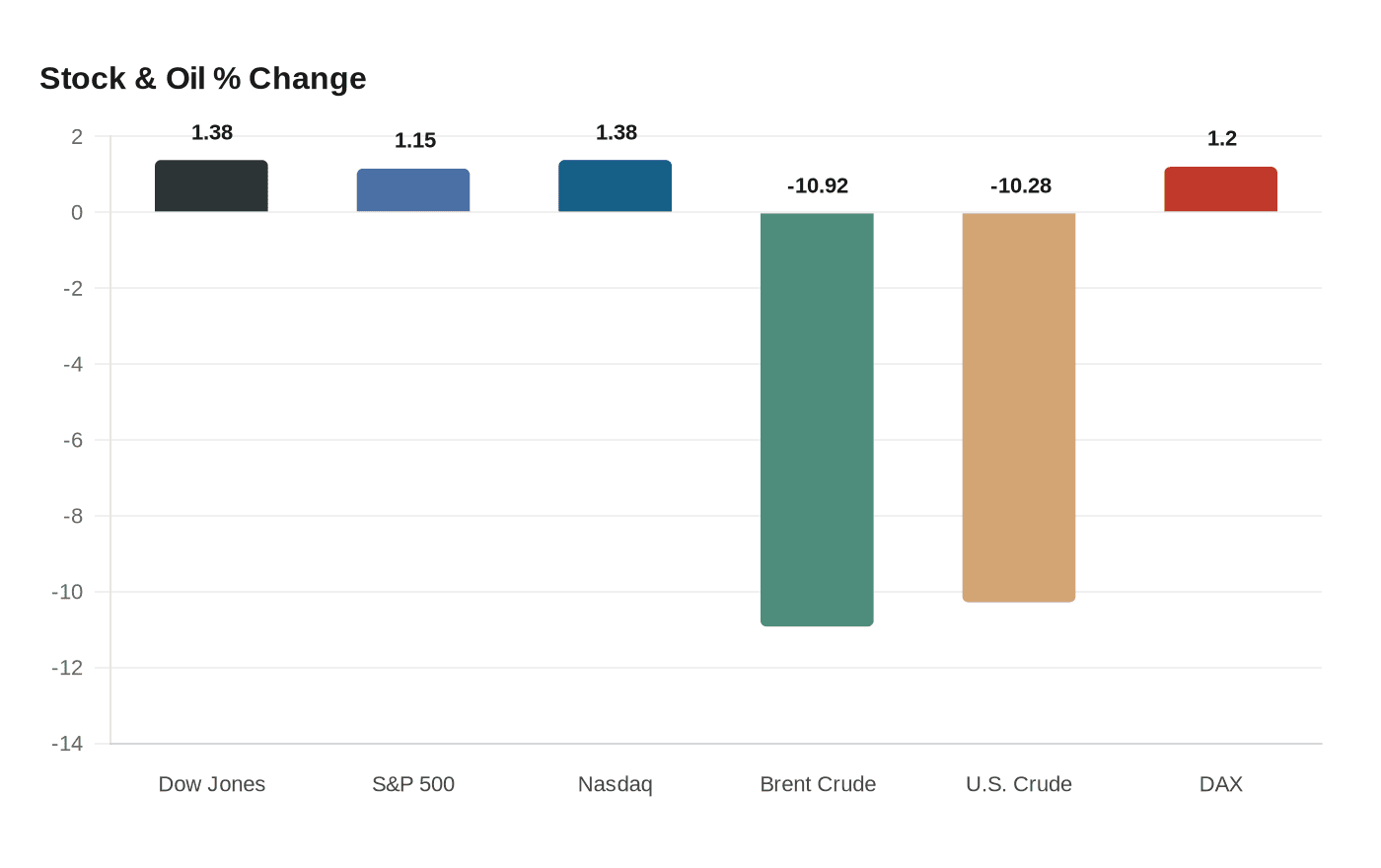
Germany's DAX index closed higher by 1.2% after initially surging more than 3.5%. In Asia, the session that preceded Trump's announcement was painful: the war launched by the U.S. and Israel has killed more than 2,000 people, shaken the global economy, sent oil prices surging, and endangered some of the world's busiest air corridors. South Korea's Kospi dove 6.5% to 5,405.75 and Hong Kong's Hang Seng slipped 3.5% to 24,382.47, with Japan's Nikkei 225 also dropping 3.5% to 51,515.49.
Goldman Sachs sharply raised its oil price forecasts Monday, expecting Brent to average $110 in March and April, up from a previous forecast of $98. The bank also upgraded its WTI estimates to $98 in March and $105 in April. Goldman analysts noted that if Hormuz flows remain at 5% of normal through April 10, prices are likely to trend higher over that period, and should flows remain that constrained for 10 weeks, daily Brent prices will likely exceed their 2008 record level.
PNC Asset Management chief investment officer Yung-Yu Ma told CNBC that "the market's positive reaction is warranted," but cautioned that "what looked like a high likelihood of military escalation and increased economic disruption is at least moderated" and that "a near-term off ramp is a realistic possibility," adding that "the threatened step of widespread infrastructure damage across Iran and possibly all of the Middle East could have far-reaching economic effects."
Crude prices resumed their rally Tuesday while the Iran war moved further into its fourth week, a reminder that one day's relief rally does not resolve a conflict now weighing on every corner of the global economy.
This article was produced by Prism’s automated news system from verified source data, official records, and press releases, then run through automated quality and moderation checks before publishing. The system is built and supervised by the people who set the standards it runs under. Read our full AI policy.
Did this article answer your question?