Stocks Surge Nearly 3%, Post Best Day Since May on Iran Peace Hopes
Wall Street added $1.7 trillion in a single session Tuesday as Iran peace signals drove the S&P 500's best day since May 2025, recovering nearly a third of its war-driven losses.
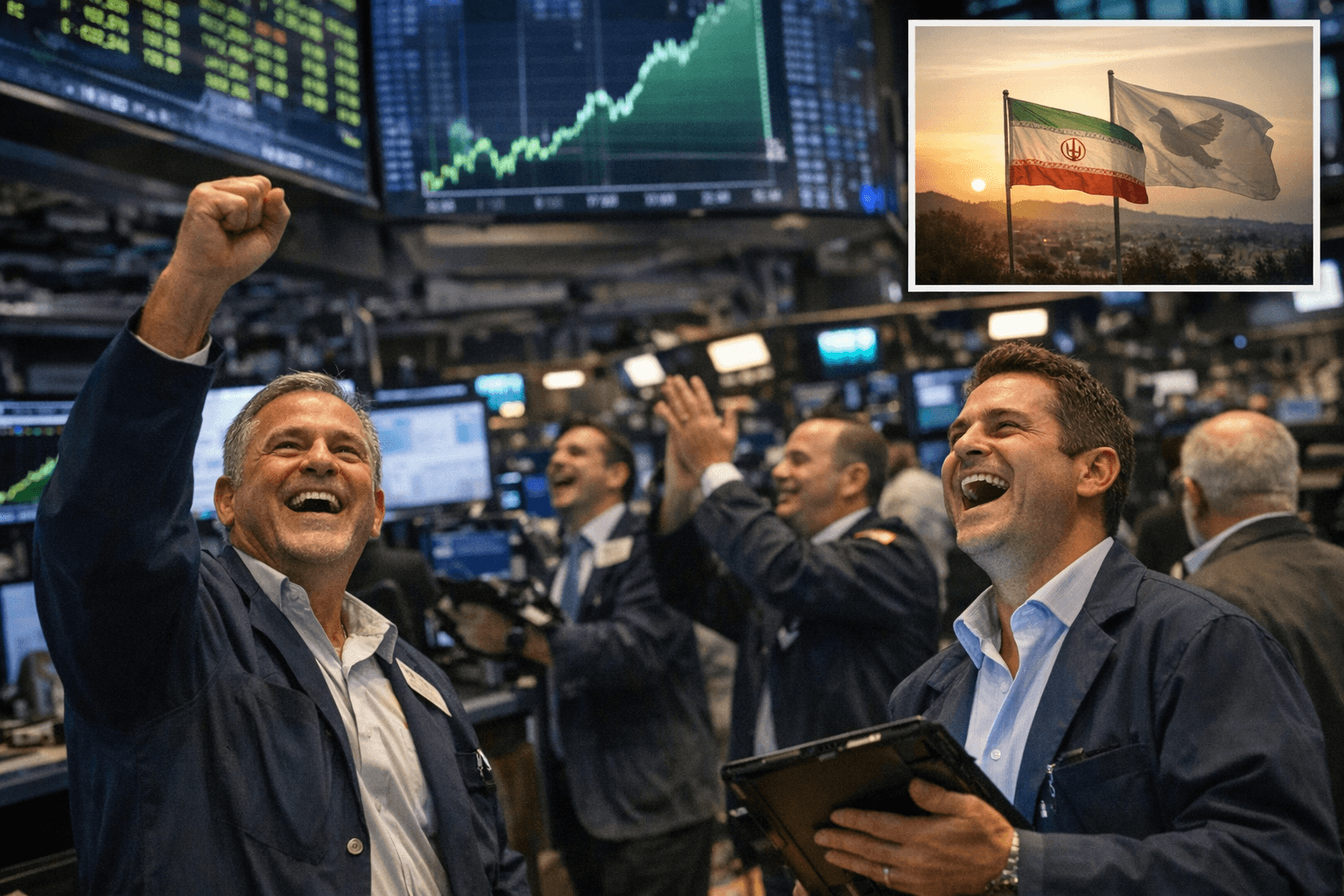
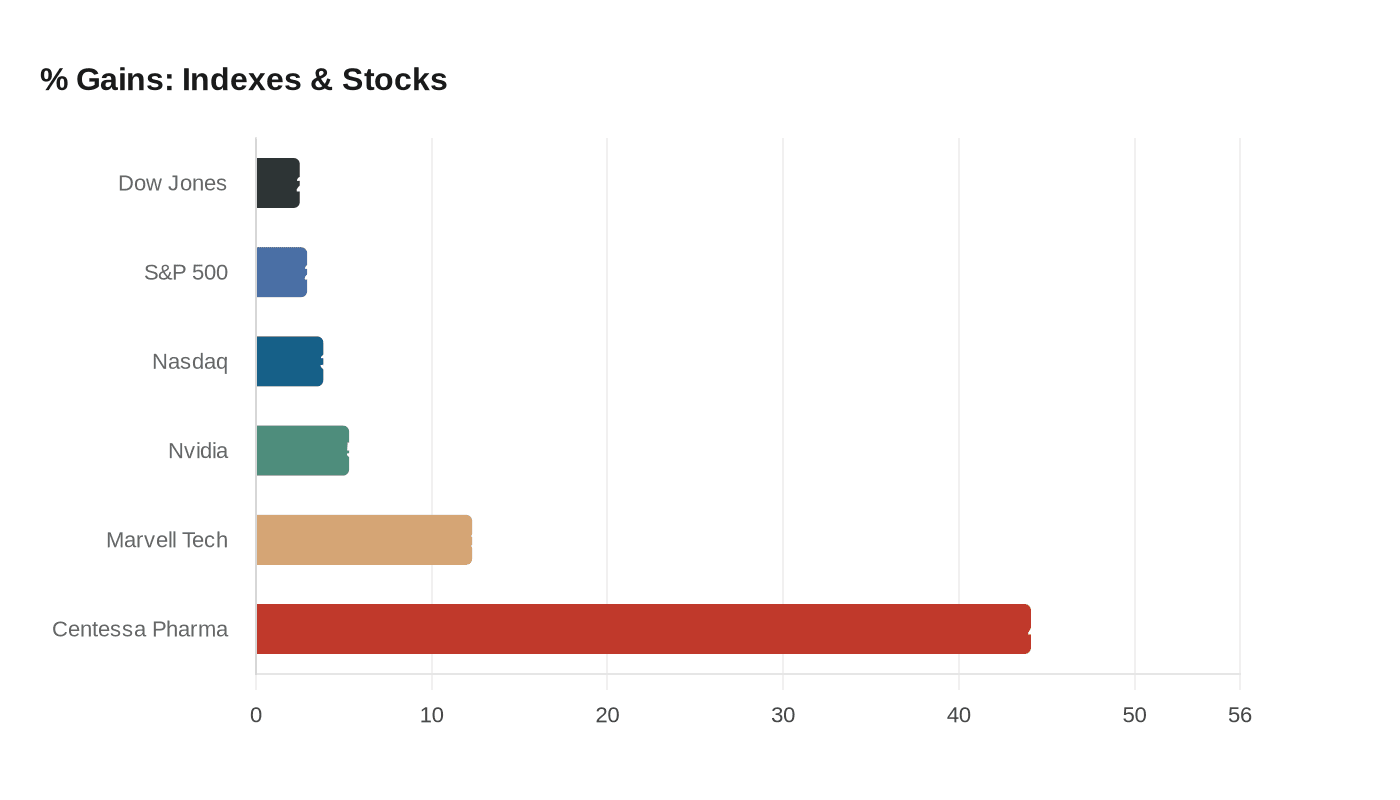
A wave of diplomatic optimism swept through financial markets Tuesday, sending the S&P 500 surging 2.91% to 6,528.52 in its strongest single-session performance since May 12, 2025. The Dow Jones Industrial Average climbed 1,125.37 points, or 2.49%, to close at 46,341.51, while the Nasdaq Composite jumped 3.83% to 21,590.63. The session added roughly $1.7 trillion in market capitalization and recovered approximately 30% of the S&P 500's total drawdown since the U.S.-Iran war began, snapping what had been one of the most punishing months and quarters Wall Street had seen in years.
The catalyst was a pair of diplomatic signals that broke weeks of deadlock. The Wall Street Journal reported that President Donald Trump told aides he was willing to end the U.S. military campaign against Iran, dubbed Operation Epic Fury, even if the Strait of Hormuz remains largely closed, separating the question of a ceasefire from the longer-term task of reopening the waterway. White House press secretary Karoline Leavitt confirmed the shift in posture, stating that reopening the Strait was not a "core objective" of winning the war. Leavitt told reporters that talks were "continuing and going well," adding: "What is said publicly is, of course, much different than what's being communicated to us privately."
From Tehran, Iran's official news agency reported that President Masoud Pezeshkian told EU officials that Iran has the "necessary will" to end the war but was seeking guarantees. Secretary of Defense Pete Hegseth characterized the moment starkly, calling the coming days "decisive." The signals were notable given how recently the diplomatic picture had appeared frozen: Iranian parliament speaker Mohammad Bagher Ghalibaf had rejected any ongoing negotiations as recently as March 29.
The backdrop to Tuesday's rally was a six-week energy crisis that rattled global markets. Iran closed the Strait of Hormuz on March 4, cutting off a chokepoint that normally handles approximately one-fifth of the world's oil supply. Brent crude crossed $100 per barrel on March 8, the first time in four years, before peaking at $126 per barrel. The benchmark crude posted a 63% gain in March alone, the largest monthly surge since 1988. Despite Tuesday's equity euphoria, oil traders remained skeptical: Brent rose nearly 5% on the day to close at $118.35 per barrel, its highest close since June 2022, suggesting markets were pricing in peace as a possibility rather than a certainty. Trump, speaking to CBS News, offered a blunt forecast on energy costs: "They'll drop when we leave, when it's over."
Several individual stocks amplified the broad market move. Nvidia rose 5.3% and was the single largest contributor to the S&P 500's gain. Marvell Technology surged 12.3% after Nvidia announced a $2 billion investment in the company alongside a new partnership. Centessa Pharmaceuticals soared 44.1% following Eli Lilly's announcement that it would acquire the company. More than three-quarters of S&P 500 constituents finished in positive territory. Canadian markets moved in lockstep, with the S&P/TSX Composite rising more than 800 points.
Deutsche Bank analysts framed the day's move against its nearest historical parallel, noting that the S&P 500's 2.91% gain matched the magnitude of the May 12, 2025 session when the U.S. and China reached a trade truce following the Liberation Day tariff escalation. Broader historical patterns from the Gulf War in 1991 and the Iraq War in 2003 suggest equity markets tend to bottom not when conflicts end, but when their scope becomes clearer. Just one day before Tuesday's session, the S&P 500 was still more than 9% below its 2026 all-time high. Shortly after 6 p.m. ET, futures tied to all three major indexes ticked marginally higher, each within 0.1% of flat, signaling that investors were cautiously holding their ground as negotiations entered what Hegseth called their most consequential phase.
This article was produced by Prism’s automated news system from verified source data, official records, and press releases, then run through automated quality and moderation checks before publishing. The system is built and supervised by the people who set the standards it runs under. Read our full AI policy.
Did this article answer your question?

