Storm Erminio Kills One Near Athens, Saharan Dust Blankets Crete in Orange Haze
A man in his 50s was found trapped under a car in Nea Makri as Storm Erminio swept Greece, while Saharan dust hit near 1,000 micrograms per cubic meter over Crete.
A man approximately 50 years old was found trapped under a car in Nea Makri, a rural area northeast of Athens, after Storm Erminio tore through Greece on Thursday with gale-force winds, killing him and triggering nearly 500 emergency calls to fire services in the greater Athens area alone.
The Greek fire department confirmed the fatality. More than 30 of the nearly 500 emergency calls received by fire services were classified as active rescue requests, a volume that reflects the breadth of destruction across Attica during the three-day storm front. In Athens' southern suburbs, the neighborhoods of Voula and Agios Dimitrios, also known as Argyroupoli, absorbed the worst of the damage, with dozens of fallen trees blocking roads and destroying property. A massive tree collapsed onto overhead power lines on Digenis Akritas Street in Argyroupoli, forcing a full road closure.
The Hellenic National Meteorological Service issued red-level alerts for Attica, the Eastern Peloponnese, eastern Central Greece, Evia, Thessaly, the Sporades, Pieria, and the Dodecanese for April 1-2, forecasting prolonged rain, thunderstorms, and localized hailstorms. Schools across the greater Athens area, Crete, and several Cycladic islands closed Thursday. Authorities activated the national emergency number 112 and urged Attica residents to limit non-essential travel through the evening.
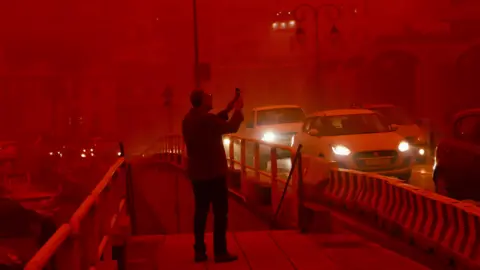
On Crete, the emergency took a different and medically alarming form. Saharan dust enveloped the island simultaneously with the storm, turning skies over Heraklion, Rethymno, and Chania a reddish-orange hue. Airborne particle concentrations at monitoring stations at Rethymno's Town Hall and at Adele reached near or above 1,000 micrograms per cubic meter, levels confirmed by Dr. Costas Lagouvardos, Director of Research at the National Observatory of Athens, drawing on data from Meteo.gr and the Observatory. Lagouvardos characterized the episode as one of the most intense Saharan dust intrusions in recent years, comparable in severity to the major event of March 21-22, 2018. At those concentrations, the dust poses extreme risk to anyone with respiratory conditions. Authorities in Heraklion and Lassithi issued explicit warnings urging residents, particularly those with asthma or lung disease, to remain indoors.
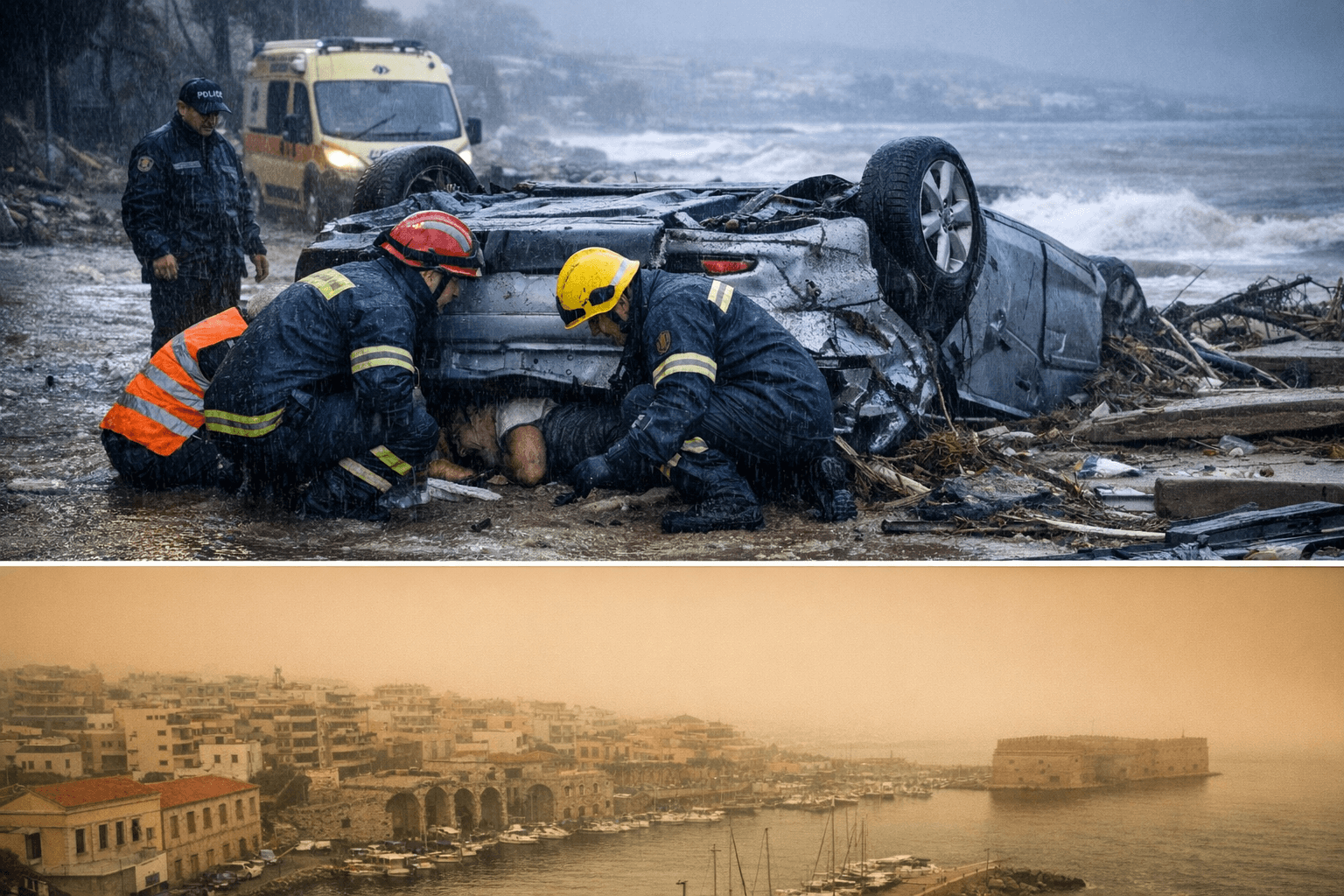
Crete's transport network was effectively shut down. Port authorities suspended all vessel departures. Visibility plummeted to the point that at least two flights, one operated by British Airways and one by SKY Express, were rerouted away from Heraklion airport to alternative airports including Corfu and Athens. Winds across the island reached 10 to 11 Beaufort.
The island's southern coast faced additional violence. A tornado struck the district of Pachia Ammos, and large waves driven by southerly winds crashed into homes in the coastal town of Ierapetra, causing flooding and structural damage. On Poros in the Saronic Gulf, floodwaters were severe enough to collapse a vital bridge, prompting school closures on the island. On Rhodes, gale-force winds toppled trees and damaged parked vehicles.
Most of Greece's ferry network was already confined to port on Wednesday as the front moved in. Storm Erminio was forecast to ease by Friday, April 3, though residual dust concentrations over Crete posed health risks that were not expected to dissipate as quickly as the winds.
This article was produced by Prism’s automated news system from verified source data, official records, and press releases, then run through automated quality and moderation checks before publishing. The system is built and supervised by the people who set the standards it runs under. Read our full AI policy.
Did this article answer your question?


