Strategy Inc. uses mid-February ATM sales to buy hundreds of Bitcoin, raising $39.7M
Strategy Inc. disclosed using at-the-market equity sales to buy 592 BTC with roughly $39.7 million from Feb 17–22, adding to earlier mid‑February purchases.

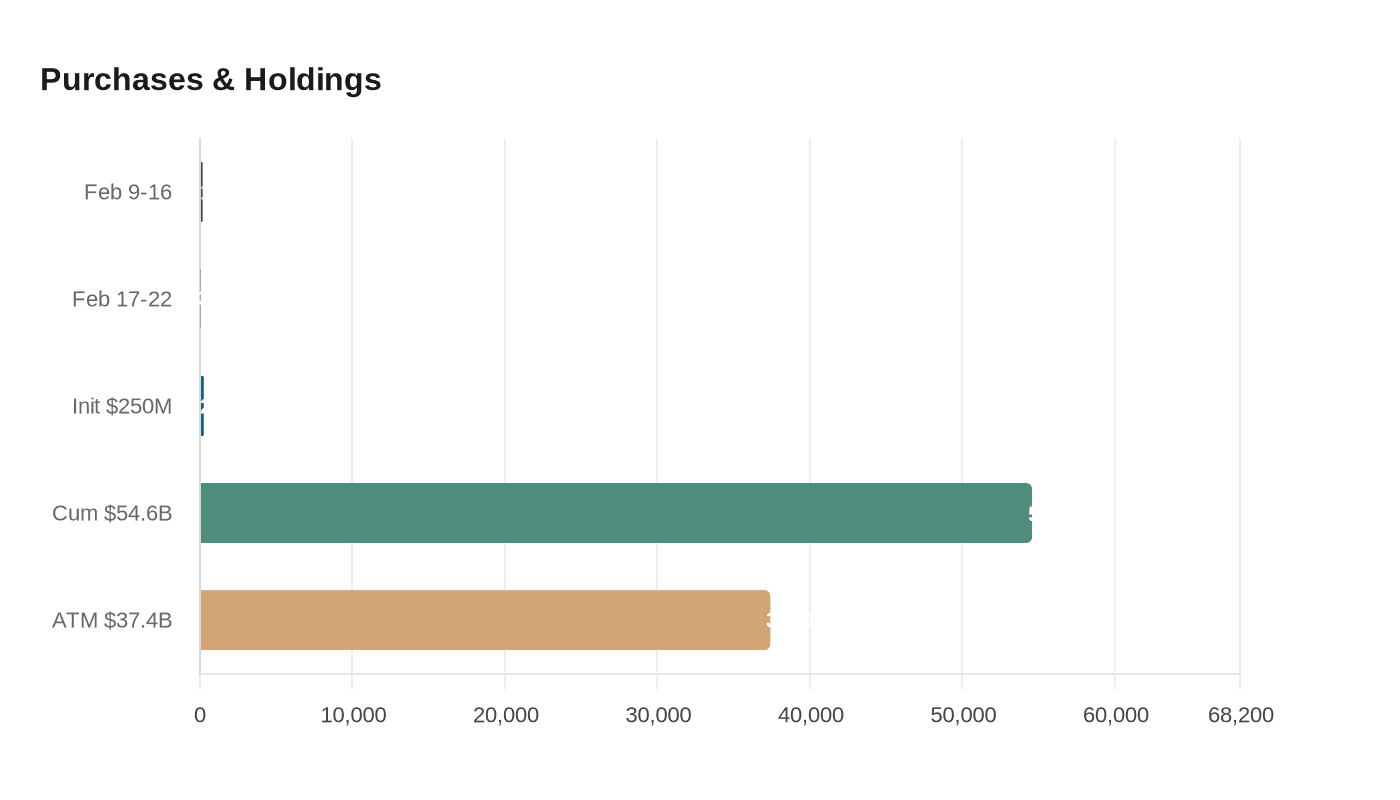
Strategy Inc. disclosed in a Form 8-K that it used at-the-market equity sales to buy 592 Bitcoin with about $39.7 million raised from selling 297,940 Class A shares between Feb. 17 and Feb. 22, 2026, boosting its reported holdings to roughly 717,722 BTC at a cumulative cost near $54.56 billion.
The filing and contemporaneous market reports show the Feb. 17–22 purchase was the latest in a string of mid-February transactions that also included an earlier Feb. 9–16 window. Between Feb. 9 and Feb. 16, Strategy sold preferred and common stock and used proceeds to acquire 2,486 BTC for $168.4 million, at an average near $67,710 per coin, according to a separate report of the company’s ATM activity. Taken together, those purchases added more than 3,000 coins to the company’s reserves in two weeks.
The Feb. 17–22 buy was financed by the sale of Class A common stock. Tradingview and crypto outlets cite net proceeds of approximately $39.7 million from the 297,940 shares sold and list the bitcoin aggregate purchase price around $39.8 million. The company’s reported cumulative holdings rose from 717,131 BTC as of Feb. 16 to about 717,722 BTC as of Feb. 22, reflecting those two reporting windows and modest rounding differences across sources.
Strategy’s public disclosures, reproduced by market trackers, include a signature block indicating the filing was executed by Thomas C. Chow, executive vice president and general counsel, dated Feb. 17, 2026. Executive chairman Michael Saylor signaled the milestone on social media with the caption "The Orange Century" alongside a chart of prior purchases.
Financial analysts and the company’s own disclosures make clear this accumulation strategy is funded primarily through capital markets activity. Strategy has used equity issuance and other instruments since it began buying bitcoin in August 2020 with an initial $250 million allocation, and the firm continues to rely on ATM programs to convert share sales into treasury crypto. As of Feb. 22 the company reported roughly $37.4 billion of securities could be sold under ATM programs in the future, including large tranches of preferred and common lines.
Market response was immediate: retail trading commentary showed MSTR futures pressure and premarket weakness, and tracking platforms reported a drop in sentiment around the stock. Analysts note the approach preserves balance sheet flexibility and avoids concentrated issuances that would more directly dilute shareholders, but they also warn that concentrating corporate treasury into a volatile asset raises financial and operational risk that investors will monitor closely.
There are broader social implications when public companies allocate large pools of capital to speculative assets. If volatility forces cutbacks, workers, suppliers, and local services linked to company spending could feel downstream effects. Public health and community advocates say such financing choices merit scrutiny because corporate stability underpins jobs, health benefits, and municipal revenue streams that fund social supports.
Strategy’s filings and third-party trackers provide the numeric detail of the week’s transactions; securities filings remain the authoritative record for exact counts, prices, and timing as investors and community stakeholders weigh the tradeoffs of this high-profile accumulation strategy.
This article was produced by Prism’s automated news system from verified source data, official records, and press releases, then run through automated quality and moderation checks before publishing. The system is built and supervised by the people who set the standards it runs under. Read our full AI policy.
Did this article answer your question?